Before I begin this properly, a little announcement: some of my writing is now going up over at FEMUSINGS, a brilliant new(ish) feminist news/humour site. The bits up there at the moment are all cross-posted from my blog so you are not yet missing anything new, but that will soon change. It also means that my totally arbitrary self-imposed 30 day rules are changing, because averaging much more than one blog post a day will definitely kill me, no exaggeration. So on days that I post over there, don't expect anything here! Them's the breaks.
Now, when we last left our train of thought (or what passes for a train of thought around these parts), I had just had a lengthy whinge about the misuse of the word "troll" in current discussions, only to suggest that as word misappropriations go, it doesn't really matter. Leaving aside the question of what kind of crazy person would write that much on a thing they know doesn't matter (A: a crazy person who has to fill a blog post a day, that's who), the next pertinent question would be "when does this sort of word use matter"?
My answer to that is lovingly contained in a 70-page Master's thesis currently locked in a vault somewhere in Tsinghua University's library, and if you want to know more you should go and look it up, the end. No, just kidding ‒ about you reading that thesis, not about its existence. It's long and dry and Chinese visas are getting more expensive and harder to obtain so let me just tell you what I think is interesting and then we can all move on with our lives.
So. International Development, at its heart, involves a lot of one group of people (development professionals) talking about another group of people (poor people, often women, generally entire countries' worth), for the benefit of a third group of people (i.e. the ones with money). This all takes place with the best of intentions, but still involves an uncomfortable amount of neocolonialism, generalisations, oversimplifications and the occasional hidden neoliberal agenda. (That's neoliberal the "open all your markets and buy all our stuff" economic policy, not "wouldn't it be nice if everybody could do what they want" ‒ the latter generally doesn't get as much airtime as it perhaps should). What this situation leads to, aside from a lot of potential for frustration and a fascinating thesis, is a particular kind of development discourse
Let's step outside the British feminist bubble for a minute and consider what might be general international problems for women, because it's still not a great world for most of us most of the time. Most of the list involves violence from men. Rape still happens everywhere, at appallingly high rates, and is explained away far too often. Sometimes it is used as a weapon of war. Marginally less awful but even more likely to be ignored is the prevalence of domestic violence. There were a couple of high profile cases in China whilst I was interning over there which activists hoped would change public opinion somewhat, but it remains intractable there as everywhere. If you are a woman you are more likely to be worried about your general security, about having enough to eat and a place to sleep and stuff that you actually own to help you live; more often than not you have to worry about those things for your children as well. And then there's maternal mortality and natal healthcare, good luck with those. It's extremely unfashionable to talk about the world as if it's bleak and hopeless because of course it isn't, few people have unrelentingly awful lives all the time, but some of these things (especially the violence) are just endemic. No number of uplifting "woman gets microloan and improves village!" anecdotes
Some of these are big, complex, international issues Instead of this, too much "development" (Full disclosure: I speak specifically from gender and climate change here but I'm not so overspecialised that this generalisation is inaccurate) stops at telling us that women in developing countries (in itself an enormous simplificitation of most of the world's states) are "vulnerable". They might not be suffering right now, because being vulnerable doesn't imply present harm. But something might happen! Like climate change could happen. To that figurative woman. And then there would be a problem, because of farming. And then her husband might get mad, or move away. Whoops! But she's only vulnerable right now, we're not saying any of these things are true now. Being "vulnerable" in development is sort of like the negativity equivalent of describing a person as "interesting". What you mean is a whole range of different nuanced things, some more serious than others! What you have said is one, not very interesting thing. "Vulnerable" = generically bad. But maybe not even happening yet! So no worries.
What we must strive for, is for women to be the opposite of vulnerable. And the opposite of vulnerable, in development-speak, is "empowered". Being development-empowered is great because it can be applied to literally anything, from high-falutin' metaphors about helping to bring up the rising sun of prosperity on a golden dawn of happiness (not a literal example but some things come close), to "woman x is empowered to take her cow to market on Thursday". What women are rarely empowered to do is actually be in power. Usually, empowerment involves talking, or being able to do things that women were doing anyway but a little bit more efficiently. Occasionally there are role changes involved. FUN FACT: Studying what "empowerment" means when it is used in development literature has given me a general hatred of the word. 99 times out of 100, a person using "empowerment" in any context does not actually want to talk about power relations, because talking about power relations at its heart involves a discussion about why so many men rape and hit women, even women they claim to love, and men don't like talking about that, it makes them angry and defensive and anyway women have been known to hit men so the gendered point is irreverent, case closed. Whoops, that was a tangent. Anyway! When women are "empowered", we can assume that generic good things are happening to them, and they are hopefully less "vulnerable". Hurrah!
In both cases, words are being undermined. The vulnerability is a very specific state with a very specific meaning, and that meaning exists because it is useful to have in the english language as more than just "generic bad thing". Empowerment likewise. If we want to talk about generically good and generically bad things, we have words for that too: "good" and "bad". Unfortunately, this is where it becomes problematic that the issue of development is effectively a conversation between three groups of people. Group two (actual affected people) and hopefully most of group one (development professionals on the ground) understand that things are complicated and nuanced and there are no big international simplifications to be made. But groups one and two also need money and support. They need to talk to group three, to movers and shakers and policymakers, and sometimes also to the average Jo on the street who has just been accosted by fundraisers. Group three are unlikely to be affected by entreaties to "stop this generic bad thing" if it's written like that, but if it's sprinkled with some important sounding words... well. Who can argue about vulnerability and empowerment? And thus, ridiculous meaningless discourse is born.
I hate it! I know this is is a very arrogant and hypocritical statement coming from a woman whose development career hasn't even reached the "employment" stage and whose favourite form of humour is "say something ridiculously wrong in a deadpan manner and hope people trust you enough to know you're joking", but when the most used words in your vocabulary are meaningless flourishes, meaningful debate is becomes incredibly difficult. I'm not defending precise language in the grumpy old man way of refusing to believe that English ever changes, because it does, I love it for that, please look back to my enjoyment of "sexting" (the word not the act!) as irrefutable proof of this fact. But there's a difference between change and decay, especially in some fields. To return to yesterday's example, if "troll" becomes synonym for "abuser", the internet will easily adapt, because the internet can invent new words ridiculously easily (unrelated: today I learned what "subtweet" means. I wish there was a facebook equivalent because that is a phenomenon that needs a name). But what do we call empowerment, if "empowerment" doesn't mean empowerment any more? Particularly if the strength of the new use of "empowerment" relies on the power (oh god) of the old use. It's all too much!
This has all gone on too long, and I feel this is not the entry for flowery closing words, so: Dear everyone. Say what you mean. From Adrienne. The End.
Friday, 2 August 2013

Thursday, 1 August 2013
On saying what you mean. Part one
I promised an argument today and I think I have been doing too much arts and not enough social sciences during this EXTREME BLOGGING MARATHON. I am now going to partly deliver on that promise. Today's blog is going to be the first of a two-parter on "Adrienne gets extremely worked up about language use!" I'm afraid this part of the two-parter is about the Twitter Thing again. I'm as sorry as you are about that. The Twitter Thing has been blogged about enough, but here we are again.
The Twitter Thing (and I have now seen several other people refer to it as The Twitter Thing so I'm glad I'm not the only one who can't figure out anything else good to call it) is still a Thing. A pretty big thing, which has made international news and is going to lead to a government inquiry with the bosses of Twitter UK. The legal question here is how much responsibility Twitter has for its uploaded content, and because 1) this is not the main point of my writing, 2) I have no good legal insights on this and 3) this isn't an academic essay so nobody is going to call me out for hedging, I am going to say the answer to this question is "some".
There have been calls for Twitter to require real addresses during sign-up, which is disturbingly similar to Sina Weibo's (government mandated) requirement for a real ID number to be attached to people's accounts. Generally speaking, if you think a thing you think is a good idea for protecting progressive thought in civil society ‒ because allowing women to have a violence-free platform for speech is still a progressive idea, god help us all ‒ it does not help your argument if said thing is already law in China. There are some good green policies worth copying and their poverty reduction track record is impressive (and let's not get started on how much we all love their resources for infrastructure aid model), but civil freedoms? Not so much.
But this is unlikely to happen, and given how many other governments Twitter gives its data to (sucks to be you, one thousand monitored US citizens!) there is probably nothing extra to worry about anyway. The most likely outcome here seems to be this: Twitter will increase its report abuse functions. The government will repeat what I said above about Twitter having "some" responsibility, except in Policese not English. A significant number of men who were sending abuse simply because it was easy will find a new hobby, whilst a few very persistent abusers who create constant new accounts and spend enormous portions of their lives being abusive will have trouble will get a call from the police. The morons in the middle of this spectrum, who actively believe it is worthwhile to put women in their place but don't do it so regularly that it flags up serious attention, will keep making empty accounts with lots of letters and numbers in the name and sending their little gems of wisdom to whoever they choose. Abuse will be lessened but it will not go away just as a result of this. The effects themselves depend on how serious Twitter is about employing real, sensitivity-educated people to sit at the other end of its "report abuse" button and figure out what is and isn't abuse. I am sceptical about this.
Notice the language in the paragraph above. The men who are doing these things (and yes I assume it is just men, sorry not sorry) are "abusers". They threaten violence or attempt emotional manipulation in order to change people's behaviour, because they believe that their control is under threat or because they just like exerting power. As I mentioned at the end of Saturday's post, however, the word that's being used most to describe this behaviour isn't "abuser". It's "troll". And no matter how much I want to ignore this and focus on the argument at hand, every time I read arguments about trolls I cringe involuntarily.
This is not what we mean when we talk about rape threats on Twitter. There is a huge difference between "derailing a discussion" and "coming into a discussion and graphically threatening to murder someone for being in that discussion", and trolls are on the right side of that line. Trolling is the internet equivalent of a little kid asking "why" to every single thing a parent says, then triumphantly assuming the argument is won when the parent resorts to "because I said so!". Trolls regularly do use sexist, racist, homophobic, transphobic and ableist language but usually just in tired stereotype, because they know that tired stereotype is most irritating to targets. Hence the endless calls for sandwiches. Trolling is immature, annoying and morally bereft, and it does have emotional impacts which trolls themselves tend to get defensive about, because at the end of the day they honestly do think they are just having fun. On a systematic level, they contribute to some shitty power structures, but individually? They are just iterations of Scumbag Steve.
For those who are not familiar with this part of the internet, Steve is one of an ever-expanding series of advice animal memes, where stock images are overlaid with different captions which all play to a particular character. There's socially awkward penguin, foul bachelor frog, courage wolf (and my personal favourite, insanity wolf), good guy greg, philosoraptor... really just google any of those and you'll get the idea. A good advice animal meme is one where the character's behaviour is immediately recognisable to viewers as "oh this is me!" or "this is someone I know". Scumbag Steve is specifically the arsehole in one's friendship group who ruins parties, "borrows" (steals) all your stuff and is generally socially inept in a way that is infuriating but never quite bad enough to not hang around with him any more.
So perhaps what we need is a "tiring sexist troll" meme, to make it easy to test what is trolling and what is abuse. For any given comment, try writing it in 36pt Impact on top of a picture of a middle-aged man in a fedora (sorry, innocent fedora wearers, I'm gonna borrow the stereotype feminists have of you for a minute). Is what you have produced funny to other people, in a "oh god, haha, I totally identify with that, what a tiring moron that archetype is, this meme is fun though"? If yes, the behaviour is trolling ‒ overwhelming in quantity and more emotionally affecting than it ideally should be, but in the end a product of a man's stupidity, not his (conscious) hate. If, on the other hand, the comment is "I am going to tie you up and then kill you slowly" or any one of the much more awful and creative thing which women in the spotlight receive on a daily basis, your picture will not be funny at all. This is because abuse is not funny, even to the people who write it. And this should be called abuse, and fought against as abuse.
At the end of the day, this distinction does not matter all that much. Internet terminology is relatively fluid, and the fact that a weaker term (troll) is being used in place of a stronger one (abuser) is unimportant when the actual behaviour is being made public and can be judged by all. Even the false dichotomies of "omg conventional wisdom says don't feed the trolls but I AM GOING TO" aren't particularly affected, because while losing the (usually valid) "don't feed the trolls" maxim is annoying, conventional wisdom for verbal abuse also insists that we "just ignore it", which is equally stupid and wrong. I suspect what will happen here is that "troll" will come to mean what Twitter feminists want it to mean, and the parts of the internet that want to use it as a word for irritating but not directly malicious behaviour will find something else to call it. The world will balance once more, and maybe get a little less sexist in the process.
There are times when words really, really do matter. But let's think about that tomorrow.
The Twitter Thing (and I have now seen several other people refer to it as The Twitter Thing so I'm glad I'm not the only one who can't figure out anything else good to call it) is still a Thing. A pretty big thing, which has made international news and is going to lead to a government inquiry with the bosses of Twitter UK. The legal question here is how much responsibility Twitter has for its uploaded content, and because 1) this is not the main point of my writing, 2) I have no good legal insights on this and 3) this isn't an academic essay so nobody is going to call me out for hedging, I am going to say the answer to this question is "some".
There have been calls for Twitter to require real addresses during sign-up, which is disturbingly similar to Sina Weibo's (government mandated) requirement for a real ID number to be attached to people's accounts. Generally speaking, if you think a thing you think is a good idea for protecting progressive thought in civil society ‒ because allowing women to have a violence-free platform for speech is still a progressive idea, god help us all ‒ it does not help your argument if said thing is already law in China. There are some good green policies worth copying and their poverty reduction track record is impressive (and let's not get started on how much we all love their resources for infrastructure aid model), but civil freedoms? Not so much.
 |
| The China in Africa reference above was utterly tenuous but when should anybody need an excuse for a China-Africa solidarity propaganda poster? |
But this is unlikely to happen, and given how many other governments Twitter gives its data to (sucks to be you, one thousand monitored US citizens!) there is probably nothing extra to worry about anyway. The most likely outcome here seems to be this: Twitter will increase its report abuse functions. The government will repeat what I said above about Twitter having "some" responsibility, except in Policese not English. A significant number of men who were sending abuse simply because it was easy will find a new hobby, whilst a few very persistent abusers who create constant new accounts and spend enormous portions of their lives being abusive will have trouble will get a call from the police. The morons in the middle of this spectrum, who actively believe it is worthwhile to put women in their place but don't do it so regularly that it flags up serious attention, will keep making empty accounts with lots of letters and numbers in the name and sending their little gems of wisdom to whoever they choose. Abuse will be lessened but it will not go away just as a result of this. The effects themselves depend on how serious Twitter is about employing real, sensitivity-educated people to sit at the other end of its "report abuse" button and figure out what is and isn't abuse. I am sceptical about this.
Notice the language in the paragraph above. The men who are doing these things (and yes I assume it is just men, sorry not sorry) are "abusers". They threaten violence or attempt emotional manipulation in order to change people's behaviour, because they believe that their control is under threat or because they just like exerting power. As I mentioned at the end of Saturday's post, however, the word that's being used most to describe this behaviour isn't "abuser". It's "troll". And no matter how much I want to ignore this and focus on the argument at hand, every time I read arguments about trolls I cringe involuntarily.
This is not what we mean when we talk about rape threats on Twitter. There is a huge difference between "derailing a discussion" and "coming into a discussion and graphically threatening to murder someone for being in that discussion", and trolls are on the right side of that line. Trolling is the internet equivalent of a little kid asking "why" to every single thing a parent says, then triumphantly assuming the argument is won when the parent resorts to "because I said so!". Trolls regularly do use sexist, racist, homophobic, transphobic and ableist language but usually just in tired stereotype, because they know that tired stereotype is most irritating to targets. Hence the endless calls for sandwiches. Trolling is immature, annoying and morally bereft, and it does have emotional impacts which trolls themselves tend to get defensive about, because at the end of the day they honestly do think they are just having fun. On a systematic level, they contribute to some shitty power structures, but individually? They are just iterations of Scumbag Steve.
 |
| Fucking hell, That GUY. This guy. Scumbag Steve. What a guy. |
So perhaps what we need is a "tiring sexist troll" meme, to make it easy to test what is trolling and what is abuse. For any given comment, try writing it in 36pt Impact on top of a picture of a middle-aged man in a fedora (sorry, innocent fedora wearers, I'm gonna borrow the stereotype feminists have of you for a minute). Is what you have produced funny to other people, in a "oh god, haha, I totally identify with that, what a tiring moron that archetype is, this meme is fun though"? If yes, the behaviour is trolling ‒ overwhelming in quantity and more emotionally affecting than it ideally should be, but in the end a product of a man's stupidity, not his (conscious) hate. If, on the other hand, the comment is "I am going to tie you up and then kill you slowly" or any one of the much more awful and creative thing which women in the spotlight receive on a daily basis, your picture will not be funny at all. This is because abuse is not funny, even to the people who write it. And this should be called abuse, and fought against as abuse.
At the end of the day, this distinction does not matter all that much. Internet terminology is relatively fluid, and the fact that a weaker term (troll) is being used in place of a stronger one (abuser) is unimportant when the actual behaviour is being made public and can be judged by all. Even the false dichotomies of "omg conventional wisdom says don't feed the trolls but I AM GOING TO" aren't particularly affected, because while losing the (usually valid) "don't feed the trolls" maxim is annoying, conventional wisdom for verbal abuse also insists that we "just ignore it", which is equally stupid and wrong. I suspect what will happen here is that "troll" will come to mean what Twitter feminists want it to mean, and the parts of the internet that want to use it as a word for irritating but not directly malicious behaviour will find something else to call it. The world will balance once more, and maybe get a little less sexist in the process.
There are times when words really, really do matter. But let's think about that tomorrow.
Wednesday, 31 July 2013
Desktop poetry from another Adrienne (30 days of blogging day 8)
I accidentally let it get to almost 10pm without coming up with a topic for this blog, because I have wasted the entire day on frivolous thing like job hunting, playing accordion music on the piano and making chocolate ripple teabread. These things all went pretty well, except the chocolate ripple teabread went in for a little too long and got stuck in the oven and I gave myself a massive burn trying to rescue it. I regret nothing. Anyway, the upshot of all of this is that this is going to be quite short and most of the words will be somebody else's. There will be something a bit longer and more rigorous tomorrow!
Along with the Windows Sticky Notes I have on my desktop reminding me of important things like my government gateway password and the chinese word for "pervert" (色狼), I also keep my absolute favourite Adrienne Rich poems. If you don't know anything about Adrienne Rich ‒as I didn't, for a shockingly long time given that she comes up every time I google my own name (i.e. often) ‒ you should start at the obvious place. The short story here is that she was an incredible poet who had an incredible life, wrote "Compulsory Heterosexuality and Lesbian Existence" which is an important piece of feminist writing on the position of lesbians in the movement, and also wrote several decades worth of poetry books, the vast majority of which I have not yet read. This is a bit silly given that what I have read, I loved. There's just so much!
But here's the best of what I have read. The first poem on my desktop is "Ghost of a Chance":
Dear sister ghost: I don't know what I am going to do with the rest of my life. Neither did you, I assume. But in a small way, you make my choices and my path easier. So that is something for both of us. Thank you.
Oh, readers! Are you still here? Well, if Adrienne Rich was not your cup of tea, maybe try some Hollie McNish?
Along with the Windows Sticky Notes I have on my desktop reminding me of important things like my government gateway password and the chinese word for "pervert" (色狼), I also keep my absolute favourite Adrienne Rich poems. If you don't know anything about Adrienne Rich ‒as I didn't, for a shockingly long time given that she comes up every time I google my own name (i.e. often) ‒ you should start at the obvious place. The short story here is that she was an incredible poet who had an incredible life, wrote "Compulsory Heterosexuality and Lesbian Existence" which is an important piece of feminist writing on the position of lesbians in the movement, and also wrote several decades worth of poetry books, the vast majority of which I have not yet read. This is a bit silly given that what I have read, I loved. There's just so much!
 |
| A better Adrienne. |
You see a mantrying to think.You want to sayto everything:Keep off! Give him room!But you only watch,terrifiedthe old consolationswill get him at lastlike a fishhalf-dead from floppingand almost crawlingacross the shinglealmost breathingthe raw, agonizingairtill a wavepulls it back blind into the triumphantsea.
This is quite a pessimistic sentiment to start one's all-important "inspiring poetry" Sticky Note with, but I absolutely love it despite identifying with its situation depressingly often. Like every self-identifying feminist, I've dealt with my share of man-ostriches, armchair anthropologists, "egalitarians-not-feminists", outright sociopaths and otherwise awesome friends who just can't see how I could ever find love with hair on my legs, ew. When this all gets too much, it's nice to have words to fall back on as a sort of structured despair about the world. Yes, some men are terrible and even the good ones say terrible things. Forgive them, because you are asking something that the rest of the world makes almost impossible. Thinking is hard. Feminism is hard. Harden up, Adrienne! All will be well. Moving on.
The second, equally depressing thing is an excerpt from "My Dream of You":
What if I told you your homeis this continent of the homelessof children sold taken by forcedriven from their mothers' landkilled by their mothers to save from capture-this continent of changed names and mixed-up bloodof languages tabooeddiasporas unrecordedundocumented refugeesunderground railroads trails of tearsWhat if I tell you your homeis this planet of warworn childrenwomen and children standing in line or millingendlessly calling each others' namesWhat if I tell you, you are not differentit's the family albums that lie-will any of this comfort youand how should this comfort you?
I keep this one because it reminds me why I study development. I don't really have anything more to express about it, to be honest; the whys and wherefores of my development career path is a navel-gazing entry for another time.
Three is "Delta", which is somewhat more uplifting:
If you have taken this rubble for my pastraking through it for fragments you could sellknow that I long ago moved ondeeper into the heart of the matterIf you think you can grasp me, think again:my story flows in more than one directiona delta springing from the riverbedwith its five fingers spread
If "Ghost of a Chance" is a response to most men some of the time, this is a response to a few men all of the time. It is a reminder that sometimes people have useful criticism and provide chances to grow, and sometimes the chance to grow comes from learning who to ignore. In particular, I learned to ignore That One Guy who once told me I was obvious and predictable and he was deep and complex, and this was one of many reasons why he is going far in life and I am just wasting my own gifts. I expended more energy than I should have wrestling with this, and his other proclamations on my worth as a person. But in the end, it didn't matter whether it was wrong or right: the important part is that he was irrelevant. I long ago moved on. Thanks Adrienne Rich!
The final excerpt is probably that affected me most, because it's addressed to me! It's part of Contradictions, which is a long series of standalone stanzas dealing with love, life, pain and age (Rich had bad arthritis for a lot of her life).
Dear Adrienne:I'm calling you up tonightas I might call up a friend as I might call up a ghostto ask what you inted to dowith the rest of your life. Sometimes you actas if you have all the time there is.I worry about you when I see this.The prime of life, old agearen't what they used to be;making a good death isn't either,now you can walk around the corner of a walland see a lightthat already has blown your past away.Somewhere in Boston beautiful literatureis being read around the clockby writers to signifytheir dislike of this.I hope you've got something in mind.I hope you have some ideaabout the rest of your life.In sisterhood,Adrienne
Dear sister ghost: I don't know what I am going to do with the rest of my life. Neither did you, I assume. But in a small way, you make my choices and my path easier. So that is something for both of us. Thank you.
Oh, readers! Are you still here? Well, if Adrienne Rich was not your cup of tea, maybe try some Hollie McNish?
Tuesday, 30 July 2013
Food [of/and/for/with] love
Content Notice: As is hopefully obvious from the title, this post is all about food. If you are the kind of person who likes to be careful with food discussions, or you are on Ramadan and would rather not think about it right now, check back again tomorrow for a post that will not be about food!
Yesterday I showed you my sag aloo. Today, I spent an inordinate amount of time making burritos with a slow-cooked Mexican-spiced pork leg, homemade guacamole, vegetables, beans and some stuff from the fridge that needed eating (I'm sure Tesco salsa is fine even 2 days after the expiry! Right?)
Since I'm at home on my own for most of the week, with the 'rents off camping, the kitchen is currently mine to work whatever culinary wonders I fancy at any time I like. Deciding to buy a half-price pork leg from the supermarket and then marinate, sear and slow cook it over a period of 8 hours was a slightly extreme response to this sense of freedom but it was well worth it. By the end of the process, I was satisfied, Brother of Feminist was satisfied (although he became more satisfied upon replacing the home-made guacamole with barbecue sauce, which is secretly great because now I have more guacamole!) and I had about half a pig still sitting on the kitchen counter begging to be made into alternative delicious foods. Hurrah!
But enough of those serious and important political issues (for now), let's get back to Millennial Bourgeoisie Cooking Hour. I am a very big fan of cooking, although I am easily deterred when circumstances are difficult. Living in China with only a hot plate and (eventually) a rice cooker to cook on led to occasional flashes of inspiration, but also to a lot of takeaway dumplings and crap burgers. When I do cook properly, it tends to take up a lot of "headspace"; that is, I'll spend a much longer period of time fussing over what needs to be done and thinking about cooking and procrastinating about cooking and worrying about ingredients than I do actually cooking the things, which leaves me less time for getting important things done (like blogs!)
We are often told that the "obesity epidemic" (which includes me, at a tidy 90 kg and 173 cm) is fuelled because people are replacing love with food, and we all need to get our feelings sorted out and start thinking of food as the fuel it is. This is ironic, given how much healthy food currently advertises itself as "love yourself by eating a thing!" and how much we are expected to feel guilty about eating anything that has been within a 10 mile radius of chocolate and/or custard (unless it's dark chocolate and the custard packet has "BE GOOD WITH YOUR BODY THROUGH ME" emblazoned on it in bright complimentary colours). Decoupling food from emotions is something that you must do whilst being impervious to advertisers who are spending literally millions of pounds on making you have the feelings they profit from. Good luck with that!
I also think it's silly because while yes, it is possible to have healthy and unhealthy relationships with food, the answer to an unhealthy relationship is not "disconnect all feelings from eating and fuel yourself like a robot". Of course food is about feelings! For me, making food for myself is about challenges and success, and making food for other people is about giving care and receiving acceptance. Feeling my friends will only love me if my cheesecake is perfect is not a desperately good reflection on how I think about friendships, but the fact that the cheesecake always is perfect (ha!) means that cooking and serving and eating it is full of important social implications. These are made even better by the fact that, despite having several mars bars and a cup of sugar in it, my cheesecake does not come wrapped in cardboard which screams "you are a bad, bad person, ooh naughty naughty, go on, do it, no don't do it, no do it, you did it, shame on you" every time you look at it. My cheesecake, my skills, my feelings.
I was at a house party on Saturday night, and it struck many of us that our friendship group is now firmly at the stage where we "put on a spread" for each other. This is an exciting step for a crew whose prevoius culinary exploits mostly took place in the cramped underground bunker which served as our college kitchen. The friend who was hosting put on an insanely good "spread", containing dishes with ingredients from many continents (I feel this is a necessary attribute to be a good British cook unless you're REALLY gifted with Yorkshire pudding) although of course she has to qualify it with worries about not having made quite the number of sweet potato quiches that her guests were expecting. As none of us were specifically expecting any sweet potato quiches at all, these fears were unfounded, and the upshot was that we all got more bonding done than if we had simply relied on the ample amount of alcohol that was also consumed. Everyone is fed, everyone socialises, everyone wins. Food is wonderful!
I'm not sure if I have a feminist point to this, unless I want to shoehorn in a reference to cupcake recipes and twee-feminism on Hello Giggles (which I don't actually know all that much about, because I am Very Serious about my feminism and don't know how I feel about nailart, also there don't seem to be any cupcake recipes at all on the front page at the time of writing, so failures all round). I guess if there is any point of this, it is that the nurturing, social side of food and of cooking are wonderful things whatever gender you are, and that In The Kitchen ‒ perhaps even Making A Guy A Sandwich ‒ is sometimes a great place to be, depending on the kitchen and the guy (hint: probably no guy who ever tells you to make him a sandwich will be the right guy to make a sandwich for). Feelings are wonderful things too! Wow, this is all really profound right now.
On a final note, I tried using my Tumblr again earlier, and I discovered it will make 4-image GIFs if you take selfies with it. The only natural conclusion was to do this:
Week 1 of 30-day blogging is over. Tune in every day next week for more of... whatever this is.
Yesterday I showed you my sag aloo. Today, I spent an inordinate amount of time making burritos with a slow-cooked Mexican-spiced pork leg, homemade guacamole, vegetables, beans and some stuff from the fridge that needed eating (I'm sure Tesco salsa is fine even 2 days after the expiry! Right?)
 |
| I attempted some artistic arrangement here but it wasn't too successful. Oh well. |
 |
| I am going to be eating this in every meal for the next 3 days (plus some "artistic" onions as a bonus!) |
A note: I am lucky enough to have parents who will fund my food habits ‒ within reason ‒ during my period of post-graduation wastrelhood, hence why I am currently able to eat a variety of meat, dairy and vegetables. This is not a luxury which a lot of those reliant on benefits can afford. Because unemployed and poor people have clearly not done enough with their lives to deserve meat, dairy and vegetables. I think it's important I clearly state that privilege, because then we can all meditate on how crap it is that this is a privilege at all. This is cheap meat and vegetables, not caviar and lobster. Burritos for all!
 |
| Come to my house and I'll make you one too. |
We are often told that the "obesity epidemic" (which includes me, at a tidy 90 kg and 173 cm) is fuelled because people are replacing love with food, and we all need to get our feelings sorted out and start thinking of food as the fuel it is. This is ironic, given how much healthy food currently advertises itself as "love yourself by eating a thing!" and how much we are expected to feel guilty about eating anything that has been within a 10 mile radius of chocolate and/or custard (unless it's dark chocolate and the custard packet has "BE GOOD WITH YOUR BODY THROUGH ME" emblazoned on it in bright complimentary colours). Decoupling food from emotions is something that you must do whilst being impervious to advertisers who are spending literally millions of pounds on making you have the feelings they profit from. Good luck with that!
 |
| "You count! But only if you are dieting. Because, see calorie counting! Ha, what a great pun." - actual Waitrose staff quote |
I also think it's silly because while yes, it is possible to have healthy and unhealthy relationships with food, the answer to an unhealthy relationship is not "disconnect all feelings from eating and fuel yourself like a robot". Of course food is about feelings! For me, making food for myself is about challenges and success, and making food for other people is about giving care and receiving acceptance. Feeling my friends will only love me if my cheesecake is perfect is not a desperately good reflection on how I think about friendships, but the fact that the cheesecake always is perfect (ha!) means that cooking and serving and eating it is full of important social implications. These are made even better by the fact that, despite having several mars bars and a cup of sugar in it, my cheesecake does not come wrapped in cardboard which screams "you are a bad, bad person, ooh naughty naughty, go on, do it, no don't do it, no do it, you did it, shame on you" every time you look at it. My cheesecake, my skills, my feelings.
I was at a house party on Saturday night, and it struck many of us that our friendship group is now firmly at the stage where we "put on a spread" for each other. This is an exciting step for a crew whose prevoius culinary exploits mostly took place in the cramped underground bunker which served as our college kitchen. The friend who was hosting put on an insanely good "spread", containing dishes with ingredients from many continents (I feel this is a necessary attribute to be a good British cook unless you're REALLY gifted with Yorkshire pudding) although of course she has to qualify it with worries about not having made quite the number of sweet potato quiches that her guests were expecting. As none of us were specifically expecting any sweet potato quiches at all, these fears were unfounded, and the upshot was that we all got more bonding done than if we had simply relied on the ample amount of alcohol that was also consumed. Everyone is fed, everyone socialises, everyone wins. Food is wonderful!
I'm not sure if I have a feminist point to this, unless I want to shoehorn in a reference to cupcake recipes and twee-feminism on Hello Giggles (which I don't actually know all that much about, because I am Very Serious about my feminism and don't know how I feel about nailart, also there don't seem to be any cupcake recipes at all on the front page at the time of writing, so failures all round). I guess if there is any point of this, it is that the nurturing, social side of food and of cooking are wonderful things whatever gender you are, and that In The Kitchen ‒ perhaps even Making A Guy A Sandwich ‒ is sometimes a great place to be, depending on the kitchen and the guy (hint: probably no guy who ever tells you to make him a sandwich will be the right guy to make a sandwich for). Feelings are wonderful things too! Wow, this is all really profound right now.
On a final note, I tried using my Tumblr again earlier, and I discovered it will make 4-image GIFs if you take selfies with it. The only natural conclusion was to do this:
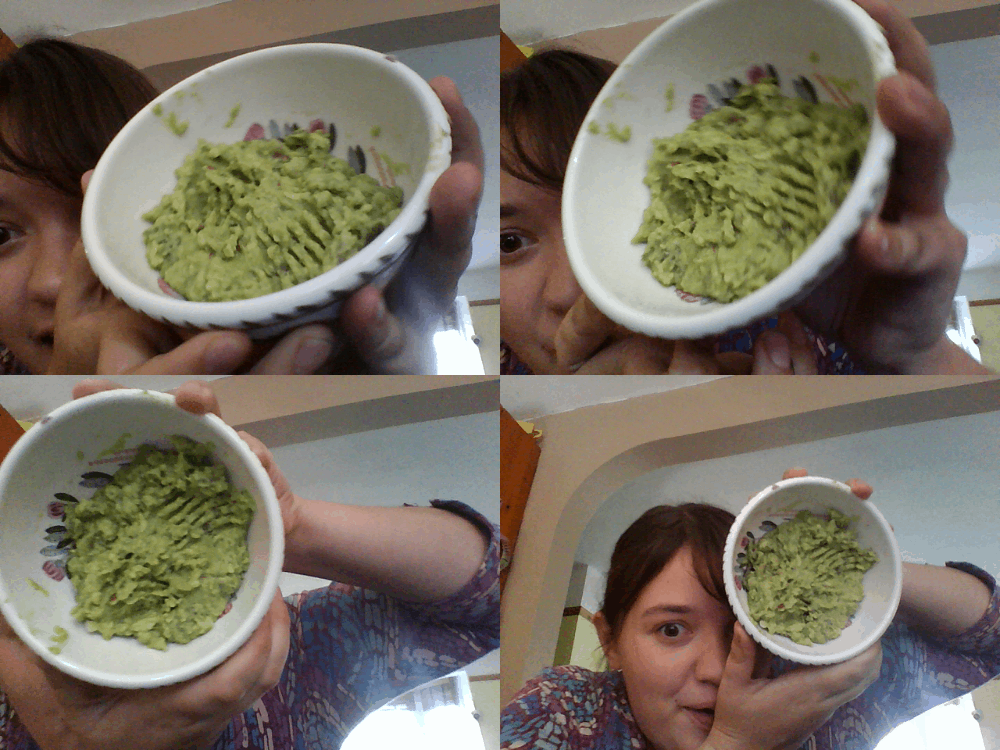 |
| Guacamole! |
Week 1 of 30-day blogging is over. Tune in every day next week for more of... whatever this is.
Monday, 29 July 2013
Bitesize blogging
I've got no big insights or pressing feelings that I wish to share with the world today, so instead here's a roundup of marginally interesting but unconnected things. Using headings!

Allow me to introduce the future.

Adrienne's Day
Today I went to Sainsbury's, and also to the jobcentre. Later, two men came to the house to deliver a flatpack wardrobe. During my interactions, none of the strangers I dealt with were rude or condescending even though some of them were men! A true victory.
The dog is depressed. The chickens appear to be as happy as ever. I am still learning linear algebra for fun. For "fun".
Is That Thing That Was Happening Still Happening?
That thing that was happening on Twitter is still happening. At least one man has been arrested for harassment. It is time for the world to learn that "Freedom of speech" does not mean "freedom to violently silence others."
I am still supportive of the long term goals but suspicious of the short term ones. Just in case anybody needed an update on my super important opinions on the thing.
A Video Of A Jar
China Continues to Suck if You Want to Get Married
Women aren't cheap to maintain, folks. It's not like having sea monkeys. They need feeding and regular baths and worst of all they buy shoes. If you wish to own marry a woman in China, you will first need to prove yourself worthy by completing a series of trials designed to ascertain your manly manliness.
All of the above paragraph is meaningless nonsense. The moral of the story is that everything you read on marriage in China will be excruciatingly awful.
The Pope Has Said A Thing that is Strangely Inconsistent With What You Would Expect His Worldview To Be
I mean, this is a brilliant step forward for the Catholic Church, but isn't the Pope's answer to his own rhetorical question "I am the embodiment of God's Will on Earth"? Isn't that, like, kind of a big deal?
The Food I Ate Whilst Writing This
Scratch cooked Sag Aloo.
 |
| Yum yum yum yum yum |
Sadly I ate it alongside half a Sainsbury's ready meal Rogan Josh which spoils the victory somewhat.
Tomorrow, I will be making burritos with slow cooked pork and handmade salsa and guacamole. I might even have some other people to give some to.
While My Camera is Plugged in
You might as well also look at this picture of spiders in my room.

The fat one that is in focus is in fact two spiders: one fat one and one much one sort of stuck to the bottom of the fat one with its legs sticking out. I am not sure if this is spider sex or spider post-sex or just spider fun. Aren't spiders fascinating? I put the fat one outside (after putting it in a glass and inspecting the potential spider sex, as any sane person would) but the other one is still up there, keeping me mosquito-free.
In about a month's time, my entire room will just be spiders. Then I will be less accommodating towards the little bastards.
The Telegraph Wrote About My Gap Year Company
Sunday, 28 July 2013
Stuff I like Sunday! Avatar: The Last Airbender
As this is a reasonably dull planet and we can't expect new things to happen every single day, I thus declare Sunday to be the day in which I fail to learn and interpret anything new about the world and instead witter excitably about things I already know about and like. Today's iteration of this idea is about my favourite cartoon and possibly my favourite TV show: Avatar.

 |
| No no NO. Not this one. |
 |
| This one! |
I first discovered Avatar: the Last
Airbender through the method that is probably any pre-2010 fan’s worst
nightmare: I saw the movie. It was a transatlantic plane ride in August, I was
tired, bored and a little despondent (rather like the Bright Eyes song except
without the life-affirming aquatic crash sequence) and for some reason, M.
Night Shyamalan’s version of “magical warrior monks save the world” was the
best thing on the in-flight entertainment. So I sat through 3 hours of muddy,
sanctimonious, racist rubbish, saved only by the deadpan use of the word
“bender”, and at the end of it came out thinking “there might be something in
this.”
I went home and, as I still had a month of
holiday left before starting my incredibly important finals year, spent the
time wisely downloading and watching all three seasons of the cartoon, as well
as learning exactly how racist the film was. Seriously, don’t watch the film. What
began as a harmless resolution to watch a couple of episodes a day quickly
turned into a several-day marathon. I returned to college with an A:TLA
obsession and a 30” Appa plush toy, determined to share the Avatar world with
as many people as possible.
I quickly converted two of my
besties/Doctor Who watching buddies, but we didn’t get too far through the
series due to the pressures of the term. We then went on a college ski trip
with some other friends and took the series along, hoping to watch a couple of
episodes in between trips on the pistes. Two of our roommates subsequently
became so obsessed with watching the series that they blew off one of our
evenings out to sit and watch this cartoon instead. We returned several hours
later to discover them sat in exactly the same positions, surrounded by
takeaway, midway through Season 2.
 |
| Never too old for toys! |
Luckily, it’s a pretty satisfying obsession
to indulge. The action unfolds in a neat three seasons with barely a poor
episode among them (even the widely-hated ”the Great Divide” isn’t that bad… and you can learn the Chinese
words for “clean” and “dirty” while you watch!) When so much TV is so clearly
compromised through scheduling and casting and being dragged out endlessly for
profit, it’s refreshing to sit down and watch something that’s almost entirely
unaffected by those problems when watched in boxset form. The tone is also
amazing, especially for a children’s show: the humour gets quite lowbrow and
silly (with a few “how the hell did they get that in there?” moments), but the
overall plot and its implications are pretty deep and definitely interesting no matter what your age.
But let’s talk feminism for a while. This
series is amazing, but is it good to
watch as a woman? Well, it is the journey of a boy. It’s a
sad fact that even now (and I’ll get onto A:TLA’s sequel in a minute), it would
be impossible to pitch an adventure like this as a story fronted by a girl. But
as boy protagonists go, our hero Aang is pretty refreshing to watch. He is
(spoiler!) the Avatar, the only person in the world who can control the four
elements of air, fire, earth and water. People in the A:TLA world are born into
nations which each correspond to one of these elements, and Aang is from the
Air Nomads, meaning that his original element is air. He’s also a pacifist
vegetarian who doesn’t really want the status thrust upon him and has to learn
how to cope with his destiny whilst remaining true to his own values, which is
a good portrayal of non-standard masculinity in my book.

What is his destiny? Ask anybody who has
watched the series and they can probably narrate it to you word for word:
The world is out of balance! Aang has been
trapped in an iceberg for a hundred years and in that time the Fire Nation have
ruined everything with their fiery
ways. They kill all of the air nomads except Aang, hence why he's the last Airbender.
Luckily, Aang has met two plucky kids from the Southern Water Tribe
(waterbenders live at the north and south poles, although the north is significantly
more developed for Reasons) to help him on his way.
This is where it gets good. Aang’s main two
allies through the entire series are a brother and sister called Sokka and
Katara. Sokka is a brilliant character in his own right (who has a feminist
awakening in episode 4, no less!) so it pains me to gloss over him, but oh my
goodness his sister. Katara is a
waterbender, which means that she can control water in all its forms (ALL of
them… *ominous foreshadowing*). Her desire for training is a plot motivation in
the first season and by the end of it, she’s overcome sexism and worries about
her inadequacy to become one of the most powerful waterbending masters in the world, all in record time. She
then continues to be consistently one of the best fighters right up to – and including
– the finale. On top of this awesome fighting the series also gives a lot of
time to her feminine traits, particularly her maternal attitude towards her
brother and friends. Rather than suggesting this is her natural place, the
series actually explores the positives and negatives of this trait and allows
her and other characters to react and grow because of it.
 |
| Classy classy |
The second season introduces several more
exciting women (and… no exciting men, ha ha). The “Gaang” is expanded with the
introduction of an earthbending master for Aang, who is a twelve-year-old blind
girl whose character development process was literally “we are going to think
of a hilariously stereotypical disgusting, brash twelve-year-old boy and then
make him blind and female”, and whose crowning glory in the series is inventing
a form of earthbending that had been thought literally impossible since the
dawn of time. Meanwhile, the antagonist stakes get upped from “angry but
traumatised teenage boy” (I’m so sorry that’s all you’re getting here about
Prince Zuko) to “sad, deep teenage boy’s psychotic sister and her two powerful
friends.” Said sister, Azula, is
probably the most powerful firebender on the series, meaning that aside from
Aang himself all three of the consistently strongest fighters on the show are
girls. That’s quite exciting!
So, Aang and his friends kick arse all the way across the four nations,
meeting freedom fighters, mad kings, sexists, deadpan hunter ladies with crazy
giant starmole mounts, brainwashed clones, fortune tellers, painted warrior
women, schoolchildren, a spirit panda and a recurring cabbage salesman. As you
can probably tell from the fact that this is a finite, ended series aimed at
children, in the end the day is saved by both male and female characters, romance
blossoms and balance is restored to the world again. And when it’s finished,
you can read the comics! Then you might finally get your life back.
 |
| Did I mention the completely accurate Chinese characters and distinct martial arts styles? Those are pretty great too. |
Despite having great quality female
representation, and avoiding the tokenistic approach to quantity that so many
stories seem to fall into, A:TLA isn’t the perfect feminist fable. Whilst there’s brilliant parity and subtle emphasis on female
strength among the younger cohort, the older characters – those in authority
who shape the world – are almost exclusively male. The final antagonist is the Fire Lord, who is attacking the Earth King’s realm while his usurped
older brother acts as mentor to the
angry but traumatised prince. The brother is also a member of an all-male transnational
secret society of old people who play a big role in the finale, and Katara and
Sokka’s father also plays a significant fighting role. Meanwhile, Aang is
guided through his journey by the spirit of the male avatar before him. Although
there are one-shot older women who are important and awesome, and some consistently
relevant mother figures, representation of women in the non-teenage cast is
depressingly closer to the default crowd scene ratio where having 17% women seems
like equal representation. This gets worse in Avatar’s sequel, The Legend of
Korra, where the ensemble focus and updated setting makes it screamingly
obvious that everyone with authority and agency in the world are old men. It’s depressing
that the only strong older woman in that series is also the only older
character to fall prey to the season’s Big Bag (whose M.O I won’t ruin because
you should still go watch it even with its flaws). As Legend of Korra is about
the woman avatar who comes after Aang, it’s sort of sad that they seem to have
created a female lead and then decided that to even things out, everyone who
influences her life will be male. Even more depressingly, Korra’s interactions
with her iteration of the “Gaang” are completely overwhelmed by a very rushed
romance plot, meaning that she barely has any interactions with the other young
woman character as it would apparently ruin the “rivalry”.
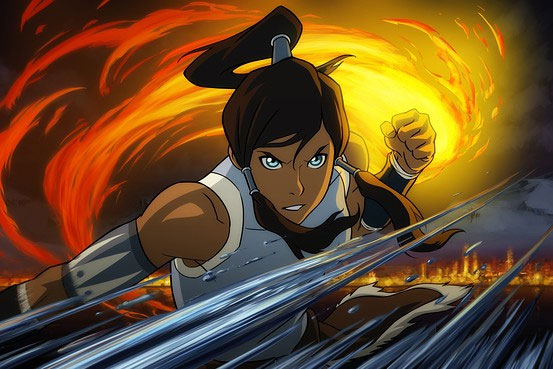 |
| Also everybody got really upset about Korra's biceps, because women trained daily in several martial arts form the age of 4 should still look feminine goddamnit. |
Avatar: The Last Airbender doesn’t turn
cartoon gender representation on its head, and to be honest you wouldn’t expect
it from a mainstream Nickelodeon cartoon. What it does provide is a brilliant,
well-told story that’s worth watching even if you’re not a habitual cartoon
watcher. The show is beautiful, it has a clear ending, the story is good and
the women are incredible, even if as ever there aren’t quite enough. Go watch
Avatar! You won’t regret it.
Subscribe to:
Posts (Atom)