Friday, 9 August 2013

Words and pictures

I feel like I have an odd, underformed relationship with my geek side. On the one hand, I adore a lot of what the subculture produces ‒ media which introduces entire alternate universes to play in, and often the explicit mechanisms to do so, alongside a general sense of awe and excitement regarding some of the most amazing parts of our own universe. I love video games, I love fantasy and sci-fi, I have already gushed about online roleplaying. I have even had brief experiences with tabletop gaming and card games which made me wish the communities surrounding them catered to me more. Despite this affinity, however, I feel like I've never devoted the correct amount of time to reading and watching to really be a geek, whatever that means. I've written before about feeling like a general culture failure because the things I like are usually too few, too specific and too far away from the "things you must watch/read/play or you are not a proper lover of media" list that people like to compile and then wave in your face. With "geek things", the problem is compounded by the way in which men attempt to protect the subculture, which has been well documented in the phenomenon of the "fake geek girl".

So, last week, for reasons which were part semi-geek identity crisis and part "I will do a thing that I can later write a blog about, how virtuous", I asked my friends at my local comic shop which comics they would recommend for an unrepentant feminist who wants to read Things About The Womens. I mentioned my friends on Tuesday but that was a very quiet blog post so let me do so again: a couple of years ago, against the backdrop of Recession and The Death Of Local Shops and Amazon Ruining Everything, a friend of mine from school and his little brother refurbished a gorgeous 16th century shop in the middle of Huntingdon, filled it with books, comics, tabletop games, action figures and imported sweets (and a Mass Effect art book which will one day be mine...), and have been quietly and successfully running Niche Comics since the beginning of 2012. If you ever find yourself in Huntingdon for any reason, I guarantee that visiting them will be the highlight of your day, because they are amazing and because Huntingdon is... not. They are down the non-pedestrianised end of the High Street, near the Samuel Pepys pub, or whatever it has rebranded itself to these days. You should also follow them on Facebook even if you never intend to set food in Huntingdon.

My friend is also very well-informed both about comics and about women's representation, so it was no surprise when he came back with a fascinating list of things for me to try out. The most prominent feminist discussion around comic books tends to focus exclusively on female body shapes, and particularly the Strong Female Character pose, here illustrated by the Hawkeye Initiative (which redraws female superhero poses done by Hawkeye, who is... some guy. I don't know. I'm not a real geek!) but what I ended up with was a very different impression. I'm not feeling desperately prose-y (perhaps because of all these comic books rotting my mental faculties?) so I'll bullet point what I've read so far.
  • The New York Four, by Brian Wood and Ryan Kelly (the first one wrote it, the second drew it), is a quite Scott Pilgrim-esque book about four women college students at NYU. The main one is socially awkward, love texting (zeitgeist alert!) and is trying to develop a relationship with her estranged older sister. The other three are a Fiery Latina with Cleavage (and a secret heart of gold), an Asian-Canadian who starts stalking her professor after she gets a B in one of her classes, and someone from the West Coast who skates and Can't Understand Boys! Despite this all being a bit stereotypical, New York Four (and the sequel, New York Five) is actually pretty decent at giving its characters satisfyingly melodramatic but not entirely unrealistic lives. It didn't replace Scott Pilgrim in the section of my heart reserved for "fun youth life story comics" but I did enjoy it.
  • Local, also by Brian Wood and Ryan Kelly. This is supposed to be their magnum opus or something and it's therefore bound in a super fancy hardcover book (which cost me the remainder of my Shakespeare tutoring money, oh the things I do for blog). It's supposed to be twelve stories that represent twelve years in the life of Some Woman who lives in twelve different US cities during this time. All the reviews on the back say it will be the most inspiring thing I ever read but I only read the first two and was... not that hooked. Maybe I just don't understand poignant woman stories.
  • Mara, by Brian Wood (that guy again!), Ming Doyle* and Jordie Bellaire. It's about a superstar volleyball player (not beach volleyball!) in a grim dystopian future. Yes, you heard. Bad things start to happen to her, made worse by the whole grim dystopia thing, and we get to read on as her whole existence falls apart. It's actually very good, although I hated two things: first, all of the comic covers use Super Arty Colours which hide the fact that Mara is a WOC (the first one makes her face literally white, although everything else has colour). Second, the comic itself uses a lot of in-universe news reports which constantly represent her using this picture:
Grim dystopian future where women (NOT BEACH) volleyball players are super famous, but still mostly famous for being pinups. Thanks...?
  • The first book of Strangers in Paradise, one of two things on the list by Terry Moore. I started off really sceptical about this, because it appeared to be about a Hilariously Angry Lady getting unwanted stalker attention from a Nice Guy despite telling him she's a lesbian, and pressuring her Heterosexual Female Friend into a relationship. It then goes through a load of what I can only call male fear-of-women fantasies about rejection and castration and people knowing you have a small penis, which did nothing to improve my mood. Also it has Hilariously Angry Lady crying in handcuffs on the front cover. But! The fact that it managed to win me over from this beginning is probably the best recommendation I can give to anything ever. It vacillates wildly between "cute slice of life" and "everybody is getting shot by the mob wtf" which shouldn't work but does, and while the Nice Guy overstayed his character's welcome, I completely loved almost everything after the initial castration/small willy story. Conveniently, this lines up with the moment when Heterosexual Female friend puts on thirty pounds and is drawn for the rest of the strip as a canonically gorgeous woman with a bit of a double chin and realistically distributed fat and a complicated relationship with her body type that doesn't boil down to any stereotype. Because not everything is Hawkeye pose, guys. It also lines up with the point where almost everyone important to the story is female ‒ mob boss, mob boss's dapper assistant, mob boss's giant silent muscled type, Angry Lady's dead mentor figure... statistically, the character gender ratio probably isn't far off 50:50, but women get all the good parts.
This cover is only marginally less awful than the weeping handcuffs picture on the front of volume 1, but oh! Double chin, waist fat-fold and belly on woman who several other characters find gorgeous and irresistible, drawn even in the picture where we are supposed to think she is gorgeous and irresistible. I FORGIVE YOU FOR THE NICE GUY STORYLINE, MOORE (nah actually that's not actually how it works, but if it was, I would).
  • Rachel Rising, which is what Terry Moore is doing now he's finished writing about Hilariously Angry Lady and company (there is also something in between, apparently). Again wins no points by beginning with a frightened, scantily clad young woman digging herself out of her own grave, but it hits all the good points of Strangers in Paradise but more cleanly. It mixes the exploration of relationships with some seriously crazy shit, the good character roles all go to women, and the women (and the men) are all easily distinguishable from each other through drawing alone. Whilst there's a lot of violence, including scenes of violence against women which always make me instinctively wary, it's interesting that the women victims are the ones who return and continue to have agency, whereas the men who die just... die. Often brutally. I think there's a whole complicated thesis in here on gendered victimhood which is way beyond the scope of this blog, but suffice to say it's... interesting.
I also have one of the Love and Rockets books sitting here waiting to be read, but I didn't get to that one. Maybe it will have its own post later?

Anyway, those are things I read! All of them were good. If you listen to things I tell you to do, you should definitely read Strangers in Paradise. But most of you don't listen to things I tell you do to. So. What did I learn from my little comic book binge?

Well, there's no getting around it, these sure are a lot of stories about women by men. The only comic with significant female creative involvement is Mara, which has two women artists ‒ one to draw, one to colour. It's also interesting that it's the same men, although this might also be related to my friend's opinions on what I would be interested in as much as a comment on the state of the industry in general. I've got him to put some Alison Bechdel on order so I'll be rectifying my man overload soon!

That's Alison Bechdel of the Bechdel Test fame, whose comic which introduces the Bechdel Test (which only about 50% of modern movies pass, and it becomes much fewer if you have requirements for two named female characters). This picture is going to break my blog frames, watch me not care because it is important and awesome.

In general, this was OK. There were a few gratuitous "camera" angles here and there, the worst being that picture above of Mara, but most of the time women looked like actual real life different types of women ‒ not everything is Hawkeye! Everyone in Ryan Kelly's art, male and female, has big pretty eyes and luscious pouty lips, so I put that down to style rather than female stereotyping (and they do make varied facial expressions with their big facial features so that's nice.) Everybody acts like you would expect a comic book version of a real life person to act, which is pretty much like real life except everybody talks in complete clauses and sometimes bolds their important words. 

What it means to me, though, is that I'm much less likely to be sympathetic when women do start doing things that are, to me, Man-Fantasies and not actual woman things. New York Four has a bit of professor seduction by Fiery Sexy Latina, which is portrayed as her being predatory and him being weak, and the implications we are supposed to draw are 1) she is a Strong Confident Woman and 2) Strong Confident Women get what they want through preying on poor squashed men. Now I'm sure that this has happened in the history of the human race, but I'm equally sure that it happens far more in the minds of men who are afraid of women being inappropriately Strong and Sexy at them than it does in actual real life. Similarly with the castration "fantasy". I think this is why all these stories are, perhaps surprisingly, at their best when it's women talking to other women. Even with the best will in the world, it's apparently hard to escape unconscious worries of what might strong women do to men?

As you would expect (we've all seen Joss Whedon's Strong Female Character rant, right?), Terry Moore has been asked about the whole Writing About Women business more than once. His answer (in one of the relatively few interviews I read, I've no doubt there are many, many more) was not quite what I was hoping:
"Well, if you'll notice, when I write female characters, I don't have them doing anything that's actually very feminine. There's no scenes of women having lunch together or shopping or talking about guys.
So what I'm actually doing is using female characters and putting them in situations that are typically male, just because I find that that incongruous setting is so much more intriguing.
Put a man in a dangerous situation, and we automatically just assume he's either going to go commando or wimp. We've seen it so many times.
But if you put a woman in there, you're just not quite sure what's going to happen... Usually women are portrayed as victims of male predators. In my story, the woman is usually fighting against her own genre. I just find that a little more interesting. Instead of lions attacking penguins, what if penguins attacked each other?" (Source) 
There's a sympathetic and an unsympathetic reading of this quote. The unsympathetic reading would be to pick up on the "women only have lunch and shop and talk about guys, and men do literally everything else, what the hell", and that's definitely what first sprang to mind. But I think he's talking about tropes, not men and women themselves. As the "typically male" scenes he puts his women in are things like "get involved in mob shootout", it's pretty clear he's not actually equating "typically male" with "things that real men actually do regularly" (unless he's a really dangerous dude...) but instead pointing out that, yeah, we expect male characters to be in those situations and to react in one of those two boring ways, but when you write an unexpected character into the scene, the audience has fewer expectations for what might happen next. Unfortunately I cannot put a generous spin on the lions and penguins thing, but it's absurd enough that maybe it can be quietly ignored. I hope he doesn't actually think of women as penguins or men as lions?

In this metaphor, both the alarm clock and the women are penguins. Or... something. Let's really just leave it.

Stating that using women is great because it avoids stereotype is a risky business, because it risks denying that stereotypes of women can be problematic even when characters are written away from the most restrictive ones. I enjoyed learning about another little corner of geekdom, where men are creating stories of biologically accurate, well rounded human women doing awesome stuff. But while it's great that there are men who think these stories need telling, I'm not sure if I can fully get behind them as stories about women if using women is purely an act of subversion. Being a woman is not a subversive act, it's a fact about us as people, and that needs to be recognised by creators and, more fundamentally, by the gatekeepers of creative industries, because they're the ones who really make it so that the only comics my friend can recommend are men writing about women. Sort it out, geeks. And give me more comic recommendations whilst you're doing it, I may be addicted. Whoops.

Day 17. Tomorrow is probably going to be Adrienne's feminist autobiography. Sunday will be me gushing about the most important women's fantasy author ever, no arguments allowed. Mark it in your diary! Seriously. Just write "ADRIENNE'S BLOG" across all the pages. Doesn't your life look so much fuller now?

----------------------------

*I hate to act as if this is at all relevant because it completely isn't, but I was super amused to discover that Ming Doyle is, or was, dating Neil Cicierega, who made Potter Puppet Pals and Lemon Demon music and this thing that was super cool on the internet, like, ten years ago. That guy!)

Thursday, 8 August 2013

Women and money: highbrow very serious non-fictional policy circles

(This post can also be read as an article on Femusings)

While I continue to think deeply about the political structure and founding myths of fictional desert city-states, and the British liberal commentariat slowly destroys itself over complex questions of whose opinions are the most profound and important, the USA is in the process of replacing one of the most important people in global political economy: the dude who runs the Fed.

To increase the production values of this blog, I intend to increase the number of pictures I source from hilarious political conspiracy websites. This, and the source, are both extraordinary.
That's right: the international household name that is Ben Bernanke (nice beard) is stepping down as the Chairman of the Federal Reserve, which is the US equivalent of the Bank of England or European Central Bank, which means that it prints money and does exchange rates and is regarded with constant scepticism from the segment of society who remains confused about why we don't still pay with everything using gold doubloons (inflation! Fiat money! What are these crazy ideas! Money was much less confusing when it was cowrie shells). Bernanke's most obvious successor is Janet Yellen, who is currently vice chair of the board of governors. Unfortunately, things are not straightforward, for the simple fact that Janet is a woman.

Yeah Janet, I'm wearing that face about it too.
Having spent too long recently in the mire of "not-sexist-BUT" reactions to Twitter and freedom of speech and and all that business in this country, it's almost refreshing how straightforwardly sexist the backlash against Yellen is. Sure, there's some political and economic reasons people don't like her, which are boring because the US political process is so obsessed with legitimising right-wing libertarian weirdness which wouldn't fly anywhere else, and also with explaining their political differences using bird metaphors, meaning that everything boils down to comparing Yellen's "economic dove" policies to "economic hawks" or "economic ostriches" (I hope somebody somewhere invented those before I did) and really, who cares that much about those words. But mostly the argument seems to be a good old fashioned doubt of female capabilities.

What is the problem with women and money? Well, having a woman in charge would force everything to devolve into gender politics and "female dollars", and also it is impossible to separate her brilliant credentials and work history from the fact that some people think giving the position to a woman would be a good break from hundreds of years of men. Also, she doesn't have gravitas, which I assume is code for "white men cannot help but imagine she is about to offer them delicious baked goods, because she's a little old lady". To be fair, I have spent almost a quarter of a century wondering if every man who looks vaguely like my grandfather is going to force me to play renaissance-era recorder duets, so I sympathise. It was very hard to survive both a politics degree and a development degree with Henry Purcell playing in my head every time tall white old men became relevant to the conversation. And it is naturally so much harder to take women seriously, so I can see where... nah enough pretending about that actually, what a load of nonsense. Not the bit about Purcell, that was legit (he was baroque, not renaissance though. WHERE IS THIS GOING).


It's incredible how economics sets itself up as so hostile to women ‒ and, I would argue, to most of us social scientists who want to spend our time thinking about people as people and not Trying to Look Like Physics. There's a brilliant section in Deirdre McCloskey's Economic Writing about how much academic economics is made impenetrable by economists deliberately writing to look "scientific", as if the only way to legitimately study "how do societies distribute stuff?" is to ensure that the distribution looks as natural and divorced from human agency as possible. If I were getting my own conspiracy theory on I would point out how this seems to help a lot of people accept why the answer to "how do societies distribute stuff" is so different from "how do we think stuff should be distributed in society", but although I will one day make good on the pun in calling myself a "class feminist", now is not the time. Although part of my undergraduate degree is in economics, I have never got on with a subject that aims to represent as much human experience as possible in equation form, whilst ignoring the fact that these equations are based on the same mythmaking and storytelling and collective beliefs as all other human experience. Even before I connected my general feminist leanings with my academic interests, making reductive science out of people honestly all seemed a bit... masculine. It's hard to get behind Objective Social Science when your life experiences all demonstrate how nonsensical the assumption is for the vast majority of people.

I don't want to suggest that Yellen, or any women in policy circles, are somehow betraying the feminist cause by being where they are, knowing what they do or even for having the priorities they do (the idea that Yellen will actually have "female dollar" policies and close economically-based gender gaps is laughable ‒ even if she wanted to, or if her role was about those things, she wouldn't have the power). I wouldn't get very far even as a rampaging negative armchair lefty without understanding the need for economics and for understanding how it impacts society. But the fact that "being generic" is considered an important characteristic for being able to understand and manipulate economic policy is sort of terrifying. It's the opposite of what we saw in Doctor Who casting last week, where cries for diversity were drowned out by "CAPALDI IS THE BEST MAN FOR THE JOB" (brilliant article on that here by the way). This is a mantra which ignores the fact that rarely is there only one person who could do a given task, and the reason we only see one is usually because we are biased against the rest in some way. For Yellen, her opponents are arguing the other way around: sure, she could do the job, but can we really not find an equally qualified white man to do the same thing? If he's a "hawk", metaphorically or literally, so much the better. It's just too risky to let the liberals win, even on the agenda of "not everybody in charge of money ever has to be a man".

Or like, a superhero hawk. With a superhero dove partner. I don't really know or want to know about what this comic is.
It'll be interesting to see how the nomination process pans out, and whether Yellen actually does find her way to the top. Her main rival still appears to be Larry Summers, the man who once suggested that women weren't really smart enough to be university professors in large numbers (whilst running to be president of Harvard, no less!) which to my mind does not seem to be the kind of person we should hold up as "brilliant generic homo economicus". If she does get it, I've no doubt the right wing inflation-fearing conspiracy theorists will grumble on, and bring us some grade A sexist commentary for a while. But honestly, I'm hopeful that they'd then return to just criticising "OMGWTFBBQ YU NO GOLD??" and "socialist conspiracy with the Rothschilds" and "Obama wants to sell us all to China" and not so much "... but she's a woman?" I don't often argue that "gender blindness" is a good end goal for something, but in the case of "things that tinfoil hat folk want to criticise about successful political figures", I'm all for it.

It's day 16 and that means "only" 14 more blogs to go. Tomorrow: comic books!

Wednesday, 7 August 2013

Women and money: histories and fantasies (30 days of blogging day 15)

So, as most people who know me are aware, my last two years in China weren't my only two years in China. Back in 2007, when I was even younger and much stupider and not nearly as feminism-conscious as I am today, I spent a year teaching in far west China, in a province Autonomous Region called Xinjiang. I went to central asian style discos a lot, ate pilaf, did a fair amount of hiking, was a background extra in a Pepsi advert, rode camels, figured out the routes for almost every bus in the city, and survived a -40 degree winter with only my dreams to keep me warm. I also lived in an apartment which didn't have a reliable internet connection and therefore spent my large amounts of antisocial downtime either watching very cheap illegal DVDs or reading stacks of books that I had sent, traded with others or on rare occasions actually bought from the terrible English language selection in Urumqi's bookshops.

I remember some of these books quite well. Because it was usually my mother on the other end of the post process, I ended up reading a lot of things she had been recommending for years, like Jasper Fforde's Thursday Next series (which are incredible by the way) and Mr Norrell and Jonathan Strange (also brilliant). When I was at the mercy of bookshops, I ended up reading a lot of horrendously dry "classics" like Doctor Zhivago and the Red and the Black and only narrowly avoided slogging through every Sherlock Holmes story ever. The low point was probably reading the simplified memoirs of a random CCTV 9 news anchor, who told "hilarious" stories about life in Beijing as a foreigner that were clearly aimed at Chinese audiences who wanted to reinforce how incapable foreigners are of ever adapting to Beijing.

One of the books that's stayed with me the most, however, is probably one of the most obscure: Forgotten Kingdom by Peter Goullart, which you can download in its entirety from that link. I picked it up during one of my periods of travelling, when I was in the southwest part of China in a town called Lijiang. These days, Lijiang is a bit of a tourist disaster, having seen its Old Town "restored" as an overly bright and twee maze of identikit tourist shops. Before this, however, Lijiang was the home of the Naxi, one of China's 55 official minorities and a really interesting example of a society where women dominated, at least within the economic sphere. Goullart spent a few years living in Lijiang just before the Second World War reached the mountains, and Forgotten Kingdom was his memoir and record of the culture he left behind.

The only way I have of explaining the Naxi is to paraphrase a book I haven't read in six years, and I have not checked how good a historian or anthropologist Goullart seems to be, so what follows may be my misremembering of a misrepresentation, but bear with me. The book's representation of Naxi culture (which is repeated by the Lonely Planet and Rough Guide, so what more reputable sources could you need...) states that although men hold official political offices, at some point in their culture the people of Lijiang had decided that women held a status so much lower than men, that it was unreasonable to expect men to do very much work at all, and that it would be better for lowly women to deal with all of the economics of household maintenance. Women were so unclean they were kept from sitting to eat at the same tables as men, and forbidden from being on the upper level of a house when men were downstairs (the only justification I can think of for this is period related, which if it's correct is a pretty hilarious example of male overreaction to menstruation. The unending fear that a woman might be upstairs and then drip on you. It must be very tricky being a man!) but they also had all the money, did all the trade, and eventually ended up leaving their kids behind with their relaxed men, because a woman's place is in the shop. 

The society apparently ended up in a situation where men were officially on top, but in reality had to beg their wives for a fiver every time they wanted to go out with their mates because men were not supposed to have money of their own. Power relations were complicated! There was some more stuff in the book about rates of arranged marriage and teen suicides and I feel like if I go back to it now as a more critical, self-identified feminist, I'll find a lot of interesting gender representations and author impositions that 19-year-old me would have passed right by. 

I am reminded of this for two reasons. First is the potential appointment of Janet Yellen to the Fed (CREDIT TO STEPHAN for ongoing commitment to the cause of sending Adrienne links), but we'll get to that tomorrow. The second is the time I spent in Oxford discussing alternate universe fantasy RPG worldbuilding with two of my most brilliant friends. I am the kind of person who knows other people who invent vastly complex, fully populated cities complete with their own crazy religion and crusading past (and plague, there's always a plague), then invite other people to come and invent power hungry (or in my case, stunningly ignorant but perpetually good-natured*) factions to interact in intricately plotted text adventures - and also sometimes real dungeons and dragons style stuff with dice and everything, I think? Anyway, said RPG and my place in it both take up a lot of my creative energies at the moment, and it's a nice low-maintenance way to keep in touch with my, er, fictional side

Being A Feminist always poses interesting questions when it comes to fantasy and science fiction. Most of the discussion around women in geekery tends to focus on the behaviour of audience and creators, and how the community handles its feminine side (A: badly...), but to me it's equally as interesting to consider how, when we are effectively given a blank slate to draw our worlds on, we imagine gender to come about in those worlds. I've already discussed this a bit in Mass Effect, and how disappointing it is that the creators chose Invisible Women and "embodies cosmic traits of Fundamental Female Traits and Life Cycle" as its two dominant gender tropes. But if we're not dismissing women or assuming they're just there to Be Women, what should they do? Do we invent a world where gender (and race and sexuality and and and...) Really Doesn't Matter, and everybody is just a big utopian rainbow of everything humanity has to offer? Or do we assume that all sexism in our society would be natural in all societies, and give women in fantasy/sci-fi the same problems to overcome as real women have to in the real world? Where are the interesting stories at?

The answer I went for when dealing with my friend's city (which itself has a complicated mix of gender representation, because he is awesome at thinking through this stuff just as much as I do, hurrah for feminist men because even though it's annoying when they sometimes take over our spaces and platforms, the world is just much better when they exist) was to dig out the mental marker I always start from in worldbuilding like this: take the Naxi as an example of how a (possibly!) fundamental "men are strong and women have periods and babies, so men are better" bias can lead to a society of strong, independent, powerful women. If men are strong but have no jobs at home, perhaps they all leave the city for long periods of time, and the entire property rights system slowly becomes the preserve of women alone? Perhaps at some point they built a big wall around everything and had a little Lysistrata style gender war about who is on top, and unlike Lysistrata the women weren't written by men into saying "oh we're weak and just want you really"? Throw in a slight "everybody in city X has one profession" bias because, hey, it's fantasy and motifs like that are fun and make dialogue easier, and boom! Female driven fantasy that, to me, is a bit more satisfying than having to revert to either "strong woman fights The Man and also The Man Is A Wizard" or "woman exists because everyone exists and is beautiful, woop woop!"

I spoke a bit on Monday about how much I like the idea of getting to know the underrepresented women of history, because the depth and range of women we know nothing about is both inspiring and disturbing. Perhaps my message for today is to expand that to the worlds of women in general (wow, that's in the subheading of my blog and everything. This is a thematic post!) 19-year-old me wholeheartedly recommends Forgotten Kingdom, and whilst 24-year-old me doesn't automatically do the same, my continuing love and nostalgia for that side of China (or at least, my perception of it) mean that I'd love for more people to know more about the Naxi, and about how narrow our version of "natural gender roles" is when we compare it to other ways of organising the world. Women can do everything, even money! Tomorrow, we cross the Atlantic to talk about how modern America is coping with this concept.

*I wonder if anybody else who plays Shareen reads this blog? I know we are all supposed to be hidden from each other to greater or lesser degrees and I'm sure now if you meet me, you'll know who I am, but honestly my faction's motivations are such that I can't see how this matters. Use this secret knowledge for your own nefarious ends if you must, secret people of the city!

Tuesday, 6 August 2013

Our hero goes to Oxford, then takes stock.

I am so tired I almost got confused between the "new post" button and the "new blog" button and put this entry onto a whole new website all of its own. I slept for about three hours last night (and not even for any interesting reasons), have been on two three-hour bus journeys, fended off three drunk street harassers on my way up and down Abingdon road, ate an incredible refried bean and nacho bake, introduced the chocolate ripple teabread (this iteration was slightly more chocolatey and less rippley) to the world at large, and have generally been enjoying the wonderful world of my undergraduate days. Ah, Oxford, with your large buildings and delicious cafes and your new graduate centre of my college. What have you done to me, and how did it only take 30 hours?

I have several things to tell you about as a result of me being in Oxford, like the story of my grand feminist awakening and the musings I had about Naomi Wolf and Andrea Dworkin and the ownership of female bodies at 4.30 in the morning when sleep turned out to not be a thing I wanted to do. After that, (or maybe before, I'm all about the suspense) I am going to tell you all about the possibility of a woman running the federal reserve, share with you my feelings about the quality of representation of women in post-2005 Doctor Who, muse on now being a member of Association of Women in Development and the interesting stuff they send me, and share my thoughts on some comic recommendations from my fabulous shop-owning friends. Unfortunately, these things are going to have to wait until I can type more than ten words without my brain literally (orig. "litarelly") shutting down (orig. "dovn") and refusing to spell (orig. "smell") even the most basif ("basic"?) of words.

It's been two weeks and fourteen posts. Tomorrow marks the halfway point, and I hope you're excited as I am for the second half of this endeavour. For now, I'm going to lovingly leave you with Vienna Teng's grandmother song, and have some long, exquisite sleep. That is my feminist recommendation for the day, all: sleep. Nothig quite like it. Nothing. Ugh.


Monday, 5 August 2013

Another bitesize Monday (with added navel-gazing)

So this is day 13 of 30 blogs 30 days and I don't feel ashamed to admit that, on top of everything else I have going on right now (which is a cocktail of jobseeking weirdness, ridiculous self-imposed academic targets and the continuing rearrangement of my room so that I can have a music corner, yes a music corner oh my god how exciting), I am well into mid-project stress on how to keep this up. So many people have given me some really excellent ideas but I am currently devoid of research time. What can be done?

The answer for today is "leave you all hanging and go to Oxford, ha ha ha ha ha". I think the answer for other days is to start serialising some more, like I did on Thursday/Friday last week (although that was two full-sized posts with a tenuous common thread)? Whatever happens, things are going to become much easier when furniture assembly becomes a less significant part of my life.

For today, let's do a rundown of a couple of generic things apropos of nothing:

I saw Hyrule Historia in the local bookshop and it made me 1) start my AJ-mas wishlist and 2) think of this awesome thing

For those who are not Zelda fans, Hyrule Historia is the epic english-translated artbook of ALL THE ZELDA EXCITEMENT and ownership of a giant hardcover book about videogame timelines is pretty much the only thing I need to complete my collection of things-that-sound-absurd-when-you-put-it-that-way. Sadly, spending £25 on majestic nerdy coffee table books is an activity for a different life phase, so I must put it in the "ONE DAY" category and hope that that day is this year's Annual Present Time. We shall see!

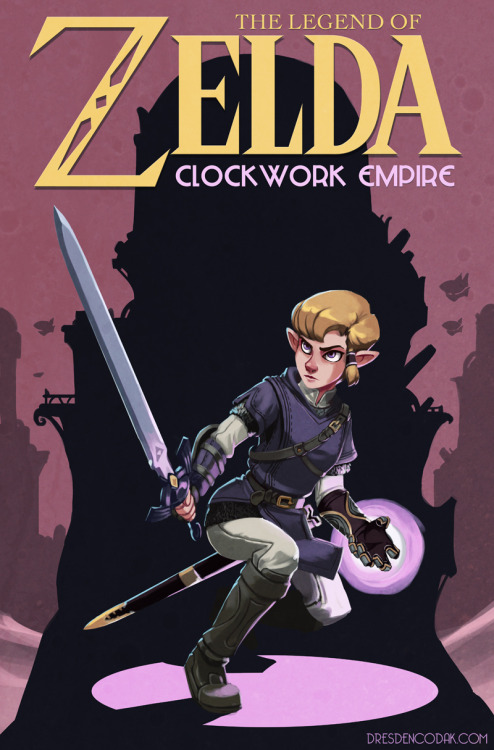
Zelda isn't very feminist though (no video games are! alas) because apparently even more than American studios, Japanese video game makers are a bit perplexed about the idea of female protagonists or non-stereotypical gender representations being possibly a good thing? That's why, even though I'm not an enormous Dresden Codak fan (how can you do a webcomic full time and still update it that slowly), I absolutely love his concept art for an actual Zelda-driven Zelda. If you haven't seen it, look at it, if you have seen it, look at it again and be reminded of it and how awesome it is.


It's *steampunk* because Aaron Diaz is *steampunk* but we can forgive that. I think.

Anyone with a freezer can make ice cream

After Wednesday's cake baking experiments left me with a large burn in the shape of a Geth dreadnought on my wrist (not even exaggerating), I decided to abandon the idea of heating food in favour of making really cold things instead. To be specific, I have been making ice cream! It turns out that even without a fancy machine, this is very easy to do (total credit to an awesome artist's tumblr for teaching me how). You need 3 cups combined of double cream and whole milk (more cream is better but also more expensive, I tend to use 1 1/2 cups cream and 1 1/2 cups milk), around 1/3 cup sugar, exciting things for flavour (suggestions: peppermint extract, vanilla extract, chocolate chips, fancy honeycomb pieces from the ridiculous Waitrose baking section, dried fruit, cocoa powder, Bailey's Irish Cream, sweet potato, beetroot, wasabi...) and a freezerproof bowl.

Put everything EXCEPT any "heavy" ingredients (like chocolate chips or fruit pieces) into the bowl, whisk like crazy for a bit, put in freezer. 30 minutes later, remove from freezer, stir with wooden spatula, return to freezer. 15 minutes later and then for every 15 minutes after that until FOREVER, stir again. You'll eventually get something which looks like mousse but super cold (same viscosity as soft serve ice cream, pretty much). When this happens, add any chocolate chips or whatever you want, then leave it in the freezer until you get an actual properly frozen thing.

Remove and eat! You'll have something that will be denser and icier than shop bought ice cream but will also have the expression of your personal flavour ideas in every bite. TOTALLY worth it. If you do this, let me know what exciting (or generic but amazing) combinations you come up with!

#inspiringwomen was, in the end, a better hashtag than #twittersilence

Honestly, I'm not quite sure why "not being on Twitter for a day" needed a hashtag, it's not like anybody could actually use it seeing as how they weren't on twitter, so all that happened was it got filled up with criticism from people who were still on Twitter. But aside from serious questions about whether not doing a thing for 24 hours really constitutes a meaningful boycott, as somebody who did use twitter yesterday I have to say that I enjoyed the people filling it up with awesome stories about women much more than I enjoyed the people who weren't there.

One of the best timelines, that's now a storify for your post-#trolliday viewing pleasure, was Fern Riddell's 12 women, 12 hours. I don't know how I feel about her ending with Queen Victoria but other than that that it's fabulous history that includes a mixture of well-known and depressingly obscure 19th century figures. I think it's always worth going out of one's way to learn about awesome women from the past, because history has an enormous male bias that a lot of people assume is because men have just done more things worth remembering. Nope, it's because history has an enormous male bias. Damn you, history!


A man has become a welder

In times of writer's block, when it feels like absolutely nothing in the world is worth writing about or that you are not qualified to write about anything, it's nice to know that journalists at the China Daily often have the same problem.

This actually turned out surprisingly long! Expect tomorrow's post late, Oxford is not going to visit itself.

Sunday, 4 August 2013

Stuff I like Sunday: Of Monsters and Men, Metric

Gosh is it that time of day already? I've spent almost all day putting together flatpack furniture and moving things around my room to make it look more like a twenty-something's bedroom and less like a closing down sale in a next-millennium antiques shop. I have still not figured out where my extensive collection of Doctor Who figures is going to live, but perhaps I should wait until I find out whether I will need room for expansion after today's announcement.

As anybody who knows me in real life has probably guessed, I definitely have some Things to Say about said announcement, but honestly today I am tired of that sort of nonsense. And Sunday is a day for unapologetic fangirling! So, combining the themes of "I spent all day putting up a flatpack wardrobe" and "things I really really like", here are gushing reviews of the two things I have been listening to a lot to get me through the day. Both are female-fronted! And in more than just a figureheady "we would like to sell albums to teenage girls, here is a song I wrote for a woman now sing it" way.

First is "Of Monsters and Men", who, like Kerry Katona, come all the way from Iceland!

Apologies to my international audience for this completely impenetrable joke.
Nah not the supermarket really, they're from the country Iceland, the one with the volcanoes and the population smaller than Luxembourg.

So they have more excuse than most bands to take posey nature pictures...
So I am unapologetically not a music journalist. In fact, having spent many of my high school years being a Girlfriend to a Boy in a Band, I have found myself with a mild allergy to the entire scene of Supercool Musical People. Needless to say being a Girlfriend and not a person in my own right did not really suit me, but being a person in your own right in Boy in a Band World involved more effort and talent and inherent coolness than I could muster. The combination of not liking things I am not automatically good at and accepted into, and the mildly traumatising nature of anything that happens at high school, means that knowing things about music all just feels a bit inherently depressing for some reason. But anyway, now I am a single accordion-playing feminist so perhaps it is time to move on! I'll start by reading the Wikipedia page of this band I like.

Of Monsters and Men! Their lead singer is that epic woman on the right and she is called Nanna Bryndís Hilmarsdóttir because people from Iceland have epic names with gendered surnames that I am not inherently enamoured about but because it's feminine and Viking I am wholeheartedly behind that name in general. She plays the guitar, and another one of them (the one called Raggi, probably but not definitely the one in the leather jacket, not looking it up because men, pah) plays the guitar and sings also so they can sing awesome duets like Little Talks. They are quite new and therefore only have one album, My Head is an Animal (that's a Spotify link Eff Why Eye) but it is brilliant slightly-but-not-overly twee folky guitar stuff. Also they have an accordion which is like plus a million points and the only way it could possibly be better is if Nanna Hilmarsdottir played the accordion. Unfortunately, their accordion player left the band to go to university instead, but they have a session playing accordion for when they go on adventures tour.

The song that got me into them that you should all listen to is King and Lionheart, which was one of the most important tracks on my unofficial "leaving Beijing" soundtrack. Turns out it has this super weird video to go with it too!


The other thing I have been listening to ‒ and only a year late! ‒ is Synthetica, the 2012 album by Metric. I've loved Metric unintentionally ever since watching the Scott Pilgrim movie in 2010, where they provided "Black Sheep", the song the Clash at Demonhead perform at their gig. Good movie, great comics, epic song. 


That's the Brie Larson version, which is not as good at the original, but has the added bonus of invoking Scott Pilgrim feels and we all need more Scott Pilgrim feels in our life. It took another six months for one of my friends from the Staircase of Feminine Awesomeness to introduce me to the band behind Evil Ex Number Three, in the form of Fantasies, Metric's 2009 album. This was a turning point in my life. Seriously, I'm not somebody to say something like this lightly, because telling people what to like even as a joke always rubs me up the wrong way, but here's the thing. If you are the kind of person who has an unofficial (or official!) list of songs that would be in the biopic of your life, and you haven't got a single song from Fantasies on said list? I'm not sure you're living your life right. I'm sorry, I know Differences In Musical Taste is a thing, and not everybody's life is an epic feminine indie drama, but... seriously. This album is literally all our lives, no exceptions.

If you're not sure which Fantasies song would be on your soundtrack, it's probably Gimme Sympathy:


(Also if you really don't want a thing from Fantasies, I will also accept "Monster Hospital" as an acceptable substitute. Video is a bit violent, you have been warned.)


The woman doing the singing (and the drumming, guitaring and synthing in the above video, and also actual keyboards and composing for the band) is Emily Haines, and she and her man-band are all Canadian and she's friends with Lou Reed which is basically an enormous stamp of approval right there.

Despite thinking this album is the best thing since "The Second Sex", new music comes to me slowly (a byproduct of actively wanting to be disconnected from any sort of Scene), so I... only just discovered there was a "new" album a couple of days ago. I do not have quite the same visceral attachment to Synthetica but it is pretty darn great. "Wanderlust" has Lou Reed doing vocals, which is strangely jarring but in the best possible way. I am already a very big fan of "Speed the Collapse."

So that is my very very short roundup of women in bands! Women. Who knew they had things to sing about, and that they can even compel men to help them sing those songs by playing fun instruments in the background? And they can wear nice clothes and take fun photoshoots in nature, just like the men. Wish somebody had told me this when I was fourteen...