NSFW NOTICE: This post
contains medical diagrams of willies and vajayjays. People who are in a
location where they cannot safely giggle like little schoolchildren at these
naughty pictures should probably hold off reading for now.
Last week I decided, more or less on a whim, to reactivate my old Twitter account. This is not a decision to be taken lightly when one
lives in China, land of annoyingly blocked internet, and means that I now spend
an unreasonable amount of time on an artificially slow connection, writing topical
insights on my life and then desperately clicking the “tweet” button over and
over whilst the website tells me “it did something wrong” before finally
putting them up ten minutes later. Ah well. A woman’s got to have a hobby, no?
Interestingly, it has also put me more in touch with some of
the big issues in UK feminism today than I was when I was actually back in the country last month. See, when I plugged back into the twit-o-sphere, I discovered
that most of the feeds I follow are either of Oxford radicals or joke versions of
Nick Clegg, both of which continue to be very relevant to my life in a
nostalgic way but which I didn’t really want to be the sum total of my Twitter news.
So I went off to find some more topical things to follow, and ended up tuning
in to two accounts in particular: the Everyday Sexism Project, and the No MorePage 3 Campaign.
I imagine the vast majority of my readership already knows
what these two things are, but let me explain for the benefit of the remainder.
The Everyday Sexism Project, in its own words, “exists to catalogue instances
of sexism experienced by women on a day-to-day basis”. This covers everything
from violent criminal offences and big institutionalised inequalities in areas
like sport to the waiter in Pret who stared openly at your breasts whilst
making your coffee or the plumber who refused to talk to you until “your
husband gets home”. The idea is to delegitimize a lot of the silencing that goes
on when sexism is discussed, particularly on the internet- the reams of “that
happens to men too!” or “you need to have thicker skin!” or “that was just a
compliment!”- by pointing out the sheer volume of nonsense that goes into being
female every day. It’s an interesting read, and judging by some of the
publicity, it’s having the right effect.
The No More Page 3 campaign is aimed at tackling just
one of these everyday sexisms- namely, the 47 year tradition of Britain’s
most popular tabloid, the Sun, which puts a topless young woman (sorry, “girl”)
on page 3 (or occasionally elsewhere) for… what purpose exactly? To remind the
world that boobs still exist and are regularly attached to “girls” (women) with
nice hair and Sexy eyes. And because men like boobs, and men like newspapers,
and it’s always been that way, right? The feature apparently tries to justify
its inclusion in a newspaper by
featuring a little text box called “news in briefs”, where the topless woman
(“girl”) is quoted as saying something about a topical issue in today’s news-
except the joke is that what she says is always far too erudite and highbrow to have come from the mouth of a
topless “girl”. Because the only thing stupider than a thing with boobs is a
thing that we tricked into letting us see its boobs. Silly thing.
Why does this matter? I do wonder, for example, how many of
the 36,000-odd signatures that No More Page 3 has right now are actual Sun
readers trying to change their favourite newspaper. The phrase “if you don’t
like it, don’t buy it” has been bandied about (and well-discussed) elsewhere,
and although it’s a completely inadequate response, I strongly suspect that the
people swayed by this campaign are mainly those who have already been voting
with their wallets against the Sun for quite some time. And I for one am not
against the existence of boobies in entertainment, or any people in any state
of undress for that matter!* The “girls” of Page 3 know what they’re signing
themselves up for, and must know that jokes are made at their expense, so
surely they don’t need our big moral guiding hand telling them what to do. And
Cosmopolitan magazine, may it live a thousand years, has a completely naked man inside every month! Covering up the really
naughty bits, of course, but sometimes
not very well. So why should we care what is going on in this one particular
newspaper?
To answer that question, I want to take you back to school
sex education. In my case, we did sex education twice in secondary school. The
second time was in year 9 when our already worldly class of 14-year-old British
state school kids asked our rather old, Daily Mail reading “Personal
Development” teacher to answer our sex-related questions for a term, and then
proceeded to harangue her about double fisting. The first was back in Year 7
biology class, when we learned biology. Sounds very objective, right?
Here is what Year 7 biology looks like if you’re a boy:
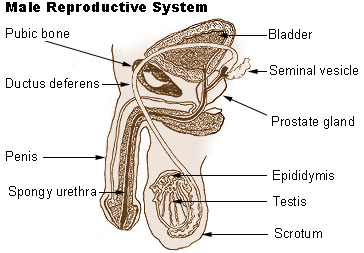
Now, I have never been male, so I can’t
speak with any authority on how a bisected man-willy might affect a 12-year-old
boy. But, despite the adult(?) proportions and the weird squiggly bits drawn all over
it, this appears to include a reasonable representation of what most males can personally
find in their undies. And it has a biological action associated with it, an
active purpose- again, not one that the vast majority of 12-year-olds can
relate to, but one which most of them already know can be simulated in other
ways.
Now here’s what year seven biology tells girls is important:
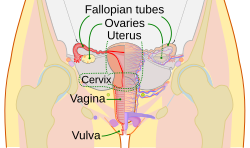
It’s the uterus. What a great and noble piece of equipment
that is, the very origin of the human race. And where is this great and noble
piece of equipment? Oh, it’s inside of me, where I will never ever see it
except in grainy ultrasound scans of my future baby (which I will have, to make this great and noble
organ inside me worthwhile) or if I get in a really bad swordfight (which I won’t,
because I’m a girl and swordfights aren’t girly). And what can I do with it?
Well, based on what I learned in year 7 biology class, I can let a man put his
penis in the bit at the bottom, then sometimes a baby will grow in it and come
out of it.. Of course, there’s also whispered playground talk about these
naughty things called dildos, but I
put it to you that a 12-year-old girl with a dildo is a fair bit rarer than a 12-year-old boy with a pair of hands. There’s
also a general sense that girls can also use their hands, but in my school that
was pretty quickly appropriated by creepy-before-their-time boys who went
around talking about “fingering”, probably a good decade before they actually
got anywhere near a real vagina. But in general, the good things that are
supposed to happen to this version of female anatomy happen to it, not with it.

Here, by the way, is what a medical picture of a vulva looks
like. I saw one of these for the first time about eighteen months ago, when H.
from the Staircase of Feminine Awesomeness inspired me to get a copy of “OurBodies Ourselves.” It’s not really relevant to this blog post but hey, I
thought I’d share the vulva love.
You will probably be wondering at this point what on earth all
of this has to do with Page 3 girls, who are not getting their uteri or their penes (hey, let’s not make
assumptions!) out for Sun readers. It’s rather simple, really: from that moment
in Year 7 when girls are told their sexuality rests in their uteruses and not
their vulvas, women’s bodies become Someone Else’s. Sex, that most important
function of the human animal, is for women about being evaluated as attractive
enough that somebody will eventually put a baby in that womb. And, importantly,
you cannot evaluate yourself. You can’t
evaluate your own uterus, because it’s inside of you. You can’t evaluate your own
vulva, because there is nothing to compare it to. And you can’t evaluate your own
body, because that is the job of people who might put babies inside you. From
there, it’s a depressingly easy step to the world we live in: where there
exist, if not actual objective standards for female beauty, at least some very
pervasive cultural myths about their existence and what they might be.
And that’s where Page 3, and all it represents, comes in. A
topless woman can be in a newspaper because topless women can be objectively
considered worthy of sexual evaluation, independent of anything else about them
as a person. Cosmo’s men, on the other hand, appear in a magazine specifically
for heterosexual women, are famous in their own right anyway, and are often presented with at least some sort of prop related to them as a person- usually
to cover the crown jewels with. Across the world, pictures of anonymous pale
women in various states of undress sell pretty much every consumer product
imaginable, to both men and other women. It’s why this breast cancer campaign,
aimed at both genders but primarily at women, can be called “Coppafeel”-
because breasts are objectively sexy, so touching your own boob is just as sexy
as somebody else touching it. Yes, groping one’s own boobs can be a very
gratifying experience, but sorry, excited male readers, it’s not objectively sexy. And certainly not sexy enough for me to
want to refer to it in dirty old man language. Oi, love, nice tits! Let’s cop a
feel then, eh? No.
And as if the media weren’t bad enough, this all bleeds
over, into the world where people are just being normal people and not trying
to sell things using naked ladies. You see this so much in the Everyday Sexism
page- the apparent progression, in some men’s minds, from “I am attracted to
women” to “I have a right to evaluate women’s bodies” to “I have a duty to
evaluate women’s bodies and tell them all
about it”. It’s the place where wolf whistling comes from, and why some
people still apparently can’t see it as anything other than a nice compliment-
they just told you that you are worthy of being impregnated, what’s so wrong with
that? Every day, everywhere, women are subjected to male commentary about how
they look and how they make said men feel, as if it has any bearing whatsoever
on our lives, and because of the way we have been brought up to evaluate
ourselves, it does take on meaning.
For most women**, attractiveness is about 1) evaluation by [male] strangers
and 2) self-evaluation compared to objectively sexy women in pictures, from the
perceived perspective of [male] strangers, rather than 3) having a good look at
yourself in the mirror and going “Oh alright then”, or even 4) having somebody
who is subjectively attracted to you
as an actual human being go “you is well fit, let’s be individuals together”.
Yes, women and men get around the constant awful messages every day in order to
have non-awful relationships with each other, but it certainly doesn’t make it
any easier! It is, as we feminists say, the Male Gaze, and it’s really not necessary
or helpful to anybody’s life.
I
want to finish up with the saddest comment I read on the Everyday Sexism
Project, from somebody called Ruby:
“Told I look more feminine now I'm seriously ill and lost weight. 'Girls look better frail'. At least I'll die as a lady!”
The culture that Page 3 represents causes this, and it’s not
right. If you love boobs, please also consider loving the people they are attached
to. Go sign the damn petition.
--------------------------------------------------------------------------------------------------
*Although being a fan of pornography and being a fan of the
pornography industry are very
different things. I spend a lot of time on the parts of the internet that are
full of young female nerds drawing pictures and writing smutty stories about
fictional people shagging, and despite the fact the people are often not even
human I think they’re probably more realistic than a lot of the “sex” that goes
on over in Real Person Pornland.
** And I don’t doubt for many men as well, although
culture doesn’t train us to see male worth or sexuality as intrinsically based
on attractiveness in the same way.
