Wednesday, 26 September 2012

The biology of objectification


NSFW NOTICE: This post contains medical diagrams of willies and vajayjays. People who are in a location where they cannot safely giggle like little schoolchildren at these naughty pictures should probably hold off reading for now.

Last week I decided, more or less on a whim, to reactivate my old Twitter account. This is not a decision to be taken lightly when one lives in China, land of annoyingly blocked internet, and means that I now spend an unreasonable amount of time on an artificially slow connection, writing topical insights on my life and then desperately clicking the “tweet” button over and over whilst the website tells me “it did something wrong” before finally putting them up ten minutes later. Ah well. A woman’s got to have a hobby, no?

Interestingly, it has also put me more in touch with some of the big issues in UK feminism today than I was when I was actually back in the country last month. See, when I plugged back into the twit-o-sphere, I discovered that most of the feeds I follow are either of Oxford radicals or joke versions of Nick Clegg, both of which continue to be very relevant to my life in a nostalgic way but which I didn’t really want to be the sum total of my Twitter news. So I went off to find some more topical things to follow, and ended up tuning in to two accounts in particular: the Everyday Sexism Project, and the No MorePage 3 Campaign.

I imagine the vast majority of my readership already knows what these two things are, but let me explain for the benefit of the remainder. The Everyday Sexism Project, in its own words, “exists to catalogue instances of sexism experienced by women on a day-to-day basis”. This covers everything from violent criminal offences and big institutionalised inequalities in areas like sport to the waiter in Pret who stared openly at your breasts whilst making your coffee or the plumber who refused to talk to you until “your husband gets home”. The idea is to delegitimize a lot of the silencing that goes on when sexism is discussed, particularly on the internet- the reams of “that happens to men too!” or “you need to have thicker skin!” or “that was just a compliment!”-  by pointing out the sheer volume of nonsense that goes into being female every day. It’s an interesting read, and judging by some of the publicity, it’s having the right effect.

The No More Page 3 campaign is aimed at tackling just one of these everyday sexisms- namely, the 47 year tradition of Britain’s most popular tabloid, the Sun, which puts a topless young woman (sorry, “girl”) on page 3 (or occasionally elsewhere) for… what purpose exactly? To remind the world that boobs still exist and are regularly attached to “girls” (women) with nice hair and Sexy eyes. And because men like boobs, and men like newspapers, and it’s always been that way, right? The feature apparently tries to justify its inclusion in a newspaper by featuring a little text box called “news in briefs”, where the topless woman (“girl”) is quoted as saying something about a topical issue in today’s news- except the joke is that what she says is always far too erudite and highbrow to have come from the mouth of a topless “girl”. Because the only thing stupider than a thing with boobs is a thing that we tricked into letting us see its boobs. Silly thing.

Why does this matter? I do wonder, for example, how many of the 36,000-odd signatures that No More Page 3 has right now are actual Sun readers trying to change their favourite newspaper. The phrase “if you don’t like it, don’t buy it” has been bandied about (and well-discussed) elsewhere, and although it’s a completely inadequate response, I strongly suspect that the people swayed by this campaign are mainly those who have already been voting with their wallets against the Sun for quite some time. And I for one am not against the existence of boobies in entertainment, or any people in any state of undress for that matter!* The “girls” of Page 3 know what they’re signing themselves up for, and must know that jokes are made at their expense, so surely they don’t need our big moral guiding hand telling them what to do. And Cosmopolitan magazine, may it live a thousand years, has a completely naked man inside every month! Covering up the really naughty bits, of course, but sometimes not very well. So why should we care what is going on in this one particular newspaper?

To answer that question, I want to take you back to school sex education. In my case, we did sex education twice in secondary school. The second time was in year 9 when our already worldly class of 14-year-old British state school kids asked our rather old, Daily Mail reading “Personal Development” teacher to answer our sex-related questions for a term, and then proceeded to harangue her about double fisting. The first was back in Year 7 biology class, when we learned biology. Sounds very objective, right?

Here is what Year 7 biology looks like if you’re a boy:
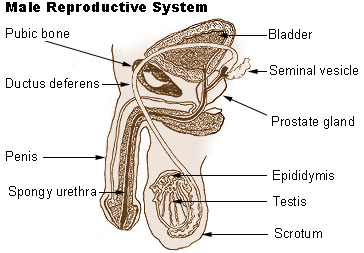

Now, I have never been male, so I can’t speak with any authority on how a bisected man-willy might affect a 12-year-old boy. But, despite the adult(?) proportions and the weird squiggly bits drawn all over it, this appears to include a reasonable representation of what most males can personally find in their undies. And it has a biological action associated with it, an active purpose- again, not one that the vast majority of 12-year-olds can relate to, but one which most of them already know can be simulated in other ways.

Now here’s what year seven biology tells girls is important:
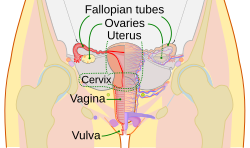

It’s the uterus. What a great and noble piece of equipment that is, the very origin of the human race. And where is this great and noble piece of equipment? Oh, it’s inside of me, where I will never ever see it except in grainy ultrasound scans of my future baby (which I will have, to make this great and noble organ inside me worthwhile) or if I get in a really bad swordfight (which I won’t, because I’m a girl and swordfights aren’t girly). And what can I do with it? Well, based on what I learned in year 7 biology class, I can let a man put his penis in the bit at the bottom, then sometimes a baby will grow in it and come out of it.. Of course, there’s also whispered playground talk about these naughty things called dildos, but I put it to you that a 12-year-old girl with a dildo is a fair bit rarer than a 12-year-old boy with a pair of hands. There’s also a general sense that girls can also use their hands, but in my school that was pretty quickly appropriated by creepy-before-their-time boys who went around talking about “fingering”, probably a good decade before they actually got anywhere near a real vagina. But in general, the good things that are supposed to happen to this version of female anatomy happen to it, not with it.


Here, by the way, is what a medical picture of a vulva looks like. I saw one of these for the first time about eighteen months ago, when H. from the Staircase of Feminine Awesomeness inspired me to get a copy of “OurBodies Ourselves.” It’s not really relevant to this blog post but hey, I thought I’d share the vulva love.

You will probably be wondering at this point what on earth all of this has to do with Page 3 girls, who are not getting their uteri or their penes (hey, let’s not make assumptions!) out for Sun readers. It’s rather simple, really: from that moment in Year 7 when girls are told their sexuality rests in their uteruses and not their vulvas, women’s bodies become Someone Else’s. Sex, that most important function of the human animal, is for women about being evaluated as attractive enough that somebody will eventually put a baby in that womb. And, importantly, you cannot evaluate yourself. You can’t evaluate your own uterus, because it’s inside of you. You can’t evaluate your own vulva, because there is nothing to compare it to. And you can’t evaluate your own body, because that is the job of people who might put babies inside you. From there, it’s a depressingly easy step to the world we live in: where there exist, if not actual objective standards for female beauty, at least some very pervasive cultural myths about their existence and what they might be.

And that’s where Page 3, and all it represents, comes in. A topless woman can be in a newspaper because topless women can be objectively considered worthy of sexual evaluation, independent of anything else about them as a person. Cosmo’s men, on the other hand, appear in a magazine specifically for heterosexual women, are famous in their own right anyway, and are often presented with at least some sort of prop related to them as a person- usually to cover the crown jewels with. Across the world, pictures of anonymous pale women in various states of undress sell pretty much every consumer product imaginable, to both men and other women. It’s why this breast cancer campaign, aimed at both genders but primarily at women, can be called “Coppafeel”- because breasts are objectively sexy, so touching your own boob is just as sexy as somebody else touching it. Yes, groping one’s own boobs can be a very gratifying experience, but sorry, excited male readers, it’s not objectively sexy. And certainly not sexy enough for me to want to refer to it in dirty old man language. Oi, love, nice tits! Let’s cop a feel then, eh? No.

And as if the media weren’t bad enough, this all bleeds over, into the world where people are just being normal people and not trying to sell things using naked ladies. You see this so much in the Everyday Sexism page- the apparent progression, in some men’s minds, from “I am attracted to women” to “I have a right to evaluate women’s bodies” to “I have a duty to evaluate women’s bodies and tell them all about it”. It’s the place where wolf whistling comes from, and why some people still apparently can’t see it as anything other than a nice compliment- they just told you that you are worthy of being impregnated, what’s so wrong with that? Every day, everywhere, women are subjected to male commentary about how they look and how they make said men feel, as if it has any bearing whatsoever on our lives, and because of the way we have been brought up to evaluate ourselves, it does take on meaning. For most women**, attractiveness is about 1) evaluation by [male] strangers and 2) self-evaluation compared to objectively sexy women in pictures, from the perceived perspective of [male] strangers, rather than 3) having a good look at yourself in the mirror and going “Oh alright then”, or even 4) having somebody who is subjectively attracted to you as an actual human being go “you is well fit, let’s be individuals together”. Yes, women and men get around the constant awful messages every day in order to have non-awful relationships with each other, but it certainly doesn’t make it any easier! It is, as we feminists say, the Male Gaze, and it’s really not necessary or helpful to anybody’s life.

I want to finish up with the saddest comment I read on the Everyday Sexism Project, from somebody called Ruby:
“Told I look more feminine now I'm seriously ill and lost weight. 'Girls look better frail'. At least I'll die as a lady!”
The culture that Page 3 represents causes this, and it’s not right. If you love boobs, please also consider loving the people they are attached to. Go sign the damn petition.

--------------------------------------------------------------------------------------------------

*Although being a fan of pornography and being a fan of the pornography industry are very different things. I spend a lot of time on the parts of the internet that are full of young female nerds drawing pictures and writing smutty stories about fictional people shagging, and despite the fact the people are often not even human I think they’re probably more realistic than a lot of the “sex” that goes on over in Real Person Pornland.

** And I don’t doubt for many men as well, although culture doesn’t train us to see male worth or sexuality as intrinsically based on attractiveness in the same way.

Wednesday, 19 September 2012

Guns, germs, steel and really poor casting decisions

Last week was the start of a new term* for me, and with the start of a new term comes that most wonderful event, the first classes. An entire week of unusually high attendance, earnest professors, self-introductions and my personal favourite, the mystical marking schemes and course outlines that appear once embedded in a PowerPoint and then are never referred to again. The sense of ennui that this whole process inspires was exacerbated by the fact that most of the people in most of my classes are people whose self-introductions (and more…) I have been subjected to for over a year now, so whilst we all continue to find each other fascinating in oh so many ways, hearing for the eighteenth time where somebody was born or went to university is not one of them.

Fortunately, to counter this, many of my professors have apparently decided to be “hip” this term and punctuate their teaching with multimedia experiences! And so it was that at 4.00 on a Friday afternoon, after sitting through a couple of hours of questions about our lives and preferences which nobody should be asked an hour before the weekend, we all got to watch the first part of Jared Diamond’s “Guns,Germs and Steel”. The documentary is all online, so here's a link in case you have an hour to kill watching National Geographic adaptations of development classics.

This isn’t a development blog, so I won’t go into too much detail about Diamond’s theories**, but the basic premise is that all of human inequality can be explained by recourse to- yes, you guessed it- guns, germs and “steel”, i.e. technology. The part of it we were watching concerned the initial development of humankind, and how the development of wheat and barley farming and the domestication of goats in the Middle East, technologies which then spread across Eurasia, led to Europeans becoming colonising douchebags thousands of years later and screwing every other continent over despite only being superior by geographical accident. In other continents, where there weren’t good animals to domesticate or nutritionally balanced crops to exploit, communities didn’t have the people to spare to become technological specialists rather than food producers and technology therefore went nowhere.

It’s an interesting theory which makes good intuitive sense right up until one asks oneself why, if both Europe and Asia benefited from the same favourable conditions, it was specifically Europe who became the colonising douchebags and not East Asia. China was, after all, technologically superior for most of human history!*** I honestly don’t know if Diamond has an answer to this or not in the rest of the TV show or the book (although it’s a pretty glaring oversight if he’s not thought about it at all), but it does seem to me the book ought to be called “Guns, Germs, Steel and Poor Life Choices Made By Western Europe”, for accuracy’s sake. Although, to be fair, Jared Diamond is a published author and I am writing feminist tirades on Blogspot, so perhaps I should defer to him on the subject of book titles. He seems to know what he’s doing.

I’m getting severely sidetracked here. The point is, I watched the video with my classmates, and it was very interesting, even though it is narrated by an American and therefore very hard to take seriously. But it also made me extremely mad, in a way that has nothing to do with half-baked oversimplified approaches to history and development. In order to help us understand global inequalities, the movie regularly juxtaposed scenes from modern Papua New Guinea, where being asked a question about inequality by an angry man one day provided the inspiration for Diamond’s search for truth, and acted-out scenes from Back In The Day, when mankind was first learning to farm and building settlements in the Fertile Crescent. And yes, I used mankind deliberately just then, because the makers of this video (or, at least, their casting directors!) seemed pretty clear on the fact that it was mankind who made these great initial leaps in human history.

To make my point, I decided to take a foray into the world of screencaps. I learned two things from this little endeavour: the first is that taking screencaps is quite hard, and everything seems to be blurry; but unfortunately we’ll all just have to live with that. The second thing is that National Geographic needs to have a serious think about its casting directors, because these things do not line up.

So the video starts off with hunter-gatherers doing hunting and gathering, both in modern Papua New Guinea and in Cinematic Prehistory. These dudes are all men, which makes sense because I suspect it’s quite hard to be a hunter whilst pregnant (though having never tried either, I would welcome evidence to the contrary). Then we’re told that hunting doesn’t really provide enough food, so pre-agricultural communities also had to rely a lot on gathering! Here are the modern gatherers of Papua New Guinea, felling and processing a sago tree:

Women and axes!
Women carrying stuff!
Women and a stick!
            This all looks very difficult and time consuming, and we therefore get a shot of Diamond sitting in a swamp pontificating on the scarcity of these trees and their nutritional inadequacy. Whilst he is doing this, he is surrounded by hard-working New Guinean women, because as the voice over explicitly points out, it is women who do this work.

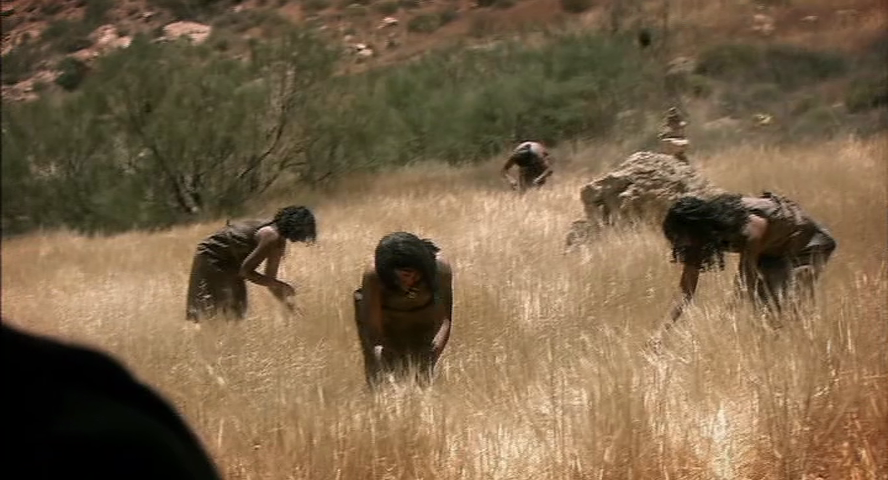
Meanwhile, in Cinematic Prehistory, the gatherers of the Fertile Crescent had easier and better things to gather, namely wheat and barley. Here are the people of Cinematic Prehistory gathering wheat and barley.

Hey guys, I lost my wedding ring!
Face shots are for posers.
Prehistoric silhouette dude
The video is more coy than I remember about actually showing these people clearly, but it's my contention that over 50% of the actors, and all of the prominently featured ones, are men. Which is interesting, because it was also the men of Cinematic Prehistory who were chasing that deer through the forest earlier. Our cinematic male antecedents must have been extraordinarily resourceful people if they were able to find more than twice the necessary calories for their individual survival, just so they could keep their women and children alive whilst said women sat around looking photogenic on a rock somewhere.

(I’m joking, of course, because standing around looking photogenic on a rock was a non gender-specific activity in Cinematic Prehistory.)


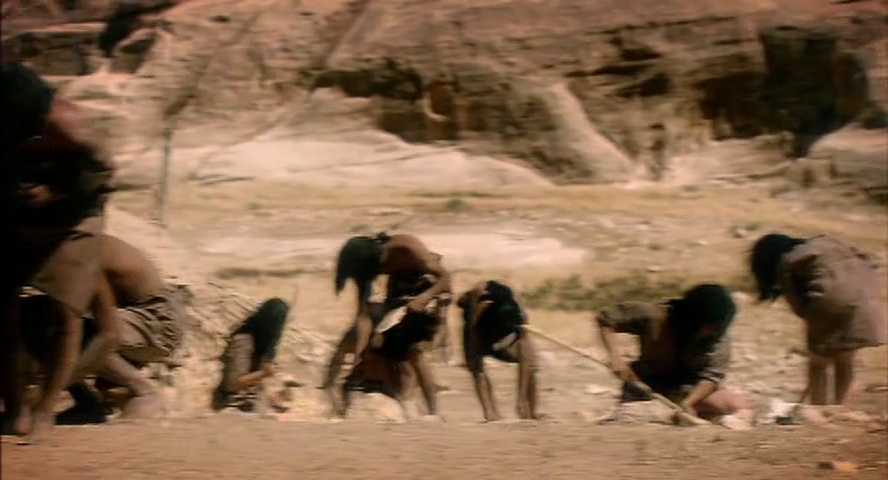
This difference continues into the discussion of agriculture. You see, the real reason that the people of Cinematic Prehistory were on that rock was to survey the terrible effects of Cinematic Prehistoric Climate Change. It turns out that existing so temporally close to an ice age really wreaks havoc on one’s Cinematic Prehistoric life plans! But we must remember that Cinematic Prehistory is very full of resourceful people men, and these men are about to do something amazing, i.e. farm those grasses from earlier! Here is Cinematic Prehistoric Man learning to farm.

Important men doing important manly activities. Like progress.
Manly man sowing. Not sewing, that's for girls.
... Women? Is that you?
Someday, son, you too will have an awesome Cinematic Prehistory beard.
SO HARDCORE.
Yes, I accept those people at the back of a couple of shots might be women, and that child with the goats may in fact be Arya Stark. I spent a long time looking at these scenes and I played a lot of “spot the female”, and I accept that they probably do exist in these shots. But they are not foreground in any of them. Sure, Prehistoric Cinematic Woman helped out a bit in the most revolutionary lifestyle change in human history, but there’s no way she was the main event!

For comparison, here’s modern Papua New Guineans farming.

Women! There you are!
A man is helping here. Good on you, man.
A man in a tree. Yep.
Pigs are not helpful livestock, alas.
            The roles are literally reversed. Apart from the man in the banana tree, who I will admit is pretty prominent, these are “spot the male” photos. Women are getting this stuff done in this society which is supposed to be parallel to Cinematic Prehistory in every way but the type of plants and animals being used.

            What does this say about how we think about human development? I’m sure that when National Geographic were thinking about how to present Cinematic Prehistory, they weren’t sitting in a board room going “well we all know women didn’t do anything, so we don’t need to show any of them prominently”. But, apparently, despite probably knowing how things were done in Papua New Guinea, it made perfect intuitive sense that the people to depict as innovators of the human race should all be male. Because Papua New Guinea is, the video takes pains to tell us, stagnant.  It produces no “cargo” (the New Guinean word for “cool stuff from abroad”, apparently). And maybe, on some level, it makes sense to us that this stagnant society is one that relies so heavily on womanpower, and that this aspect of its agriculture could not possibly be one of the hallmarks of a society that innovates. I mean, we live in a society where it is apparently not insane to believe that the entire of human civilisation was built by men so thatsexy women could sit around looking pretty and getting adored***! How could a society where women were playing these roles have the same level of progress?

            I sincerely hope that to most of my readers, the above looks like bullshit- if you’ll pardon my French. Certainly the little I know about prehistoric innovation (which basically comes from this one article that doesn’t cite its sources) suggests that this view of prehistoric human history is bullshit. But I also suspect that to a lot of people, this also looks like a total non-issue. Cinematic Prehistory is not real prehistory, after all, so does it really matter what gender the actors in it are?

            Perhaps not, as an individual case. But one of the strangest things about being A Feminist is how regularly things start to look this way- designed by people who almost certainly had the best intentions, but for some reason just couldn’t avoid unconsciously making these incredibly stupid decisions. Doctor Who is like that, these days, and for all it is still my favourite television show ever and I will love it, and Amy Pond, until the day I die, it still hurts that it’s apparently being helmed by people who just won’t think. My previously mentioned Favourite Writer Ever, Caitlin Moran, has a chapter in which she mentions how women have never ever done anything of artistic or technological worth, complete with a “feminists will try to tell you this isn’t true but think about it ladies, you know it is”, which just goes to show how I couldn’t even cover half the nonsense that got through the editing process in that book. We live in a world now where most of us know beyond a shadow of a doubt that women are supercool awesome powerful terrifying people capable of moving mountains (and, most importantly, for reasons other than babies), and yet when we retreat into culture, or start making culture of our own, we come up against all of these odd tropes and prejudices that too often have nothing to do with reality or how we experience it.

Like Diamond, I carry my own set of “statements made by [sometimes] angry men” which spur me on to figuring out what the truth about our human world and the people in it actually is. One of them is the assertion by a classmate, R., that he will never be a feminist because “feminism is a reaction, and women deserve better”. He is right on both counts, though obviously I don’t agree with his implied causality or his conclusion. I would love to live in a world where I can watch a stupid development video on Friday afternoon without going into a blinding feminist rage; my feminism will be pretty much useless when these unconsciously depressing gendered decisions stop being made. I very much look forward to that moment. Until then, annoying people like me are going to keep reacting to and pointing out these things, hoping that someday we might not have anything left to react to.

"History is a commentary on the various and continuing incapabilities of men. What is history? History is women following behind. With the bucket."

---------------------------------------------------------------------
*They’re technically “semesters” but as I am British (and so are the vast majority of my readership), I refuse to bastardise my language any more than is necessary in a world which mostly doesn’t know what a “chip” is. So let’s stick with “terms”.

**I also haven’t read the book or seen the rest of the TV show. So please direct all your sophisticated Jared Diamond-related questions elsewhere.

*** There are loads of fascinating theories about why this pre-modern superiority didn’t lead to an Asian industrial revolution which might have at least prevented China from its own nasty experiences with colonisation. Unfortunately they’re completely off-topic for this blog, so I’ll keep myself in check.

Wednesday, 12 September 2012

I read a book!


            About eighteen months back, when I lived in the Staircase of Feminine Awesomeness*, a friend of mine- in fact, let’s stop coyly referring to “friends” every time I have to speak about someone, affect a silly Victorian letter-writing convention and call her H.- had a birthday tea party and invited a bunch of people around. Being a totally hardcore Feminist Fitty herself, H. had received several Books About Women as presents, including a book called “How to be a Woman”, by Caitlin Moran, from fellow staircase denizen E. . Now, at the time my familiarity with Caitlin Moran was entirely through a story about her once appearing in a BBC English textbook which I had to teach from in China, so I was highly amused to discover a work of feminism written by this extraordinary TEFL superstar. As we sat on H.’s sloping floor stuffing ourselves with various baked goods and herbal brews, somebody got the bright idea to read a bit of an extract out of this new female instruction manual.

            I don’t really remember what bit we read, although we probably didn’t get past the first few pages, where she’s being chased across a council estate by yobs and communing with a stupid dog whose vagina is more integral to the plot for the first ten pages than Moran’s own. The point is, at some point very early on, we stopped reading, looked at each other, went ‘I don’t think this is really a feminist book,’ and got on with our lives. And by ‘got on with our lives’, I mean ‘started reading extracts from “The Sex Diaries” instead’. Great party book, that one. And that was the end of the feminist importance of Caitlin Moran.

            Except, alas, it wasn’t. Fast forward to this summer, and S., another coolkid of my acquaintance, sends me a link to an article about the US launch of “How to be a Woman”, along with the words ‘a compatriot of yours, perhaps?’ Yes, it turned out that Caitlin Moran, TEFL superstar, had apparently written a very influential book back in those heady days in the Staircase of Awesome, and we had been so preoccupied with the bit about dog vaginas that we hadn’t noticed that this magnificent being had single-handedly re-energised our movement! I disguised this earth shattering moment in my existence with some highly intellectual musings on Birmingham City Centre, and promptly resolved to discover more about this mysterious tome. My very maturity as an organism was apparently at stake.

            A stroke of luck was upon us that day. S. had unwittingly chosen to enlighten me about the movement of feminism (not to be confused with the feminist movement) on a day when, not only was I in London, hangout of most of my awesome British acquaintances, but H. had also just come back from her bohemian Vienna lifestyle to grace said hangout. I purchased some patriotic M&S snacks and went to talk to my fellow expat about the magic of our lives and the fate of our ideology. Many were the insights had on that day over a therapeutic cat-petting session**- we compared linguistic abilities, leg hair***, awesome foreign lifestyles and how best to pet a cat. On Caitlin Moran, however, H. had only one thing to say: ‘If she’s going to write a book saying “here’s the facts”, it would have been really nice if she’d looked up some actual facts first.’

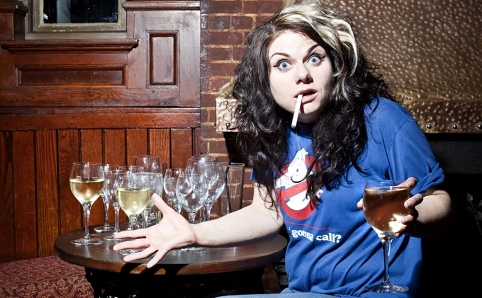
            So then I stopped faffing around and actually read the book. And there’s an interesting habit I’ve picked up recently when reading books about feminism, where I cannot help but make corresponding facial expressions when I’m reading along. Sometimes, like with the bits of The Female Eunuch I dipped into**** a couple of weeks back, this involves wearing a smug smile and nodding slowly along for several hours; when making my way through Catharine MacKinnon the effect is more of a full-face twitch as her reasoning lurches (in my indoctrinated mind, anyway) from brilliant to deranged and back again in the space of a paragraph. I was going to see if I could emulate some of the faces I pulled during “How to be a Woman”, but then I Google image searched Moran and I discovered that the faces I pulled whilst reading it were probably very similar to the faces she wore whilst writing it. So, at first it was like this:


And then it went a bit like this:


And once or twice this:


And by the end, I was like this:


No, wait, that’s Benedict Cumberbatch. Let’s try again:


That’s quite unfair, of course. This was a pretty hilarious book, and the memoir parts of it (which is in fact most of it) were fascinating. See, it turns out that the textbook-approved story about the plucky teenager who wrote a book about her homeschooling experiences was actually a slightly desperate, lonely teenager who wrote a book about being very poor in a huge family in Wolverhampton. Having done so, she proceeded to create one of the biggest life turnarounds ever managed by an impoverished teenager in Wolverhampton, moved to London where all the awesome people are, and went on to write hilarious newspaper columns and throw drinks on members of Blur, or something along those lines. It’s all very heartwarming. But my goodness, whoever thought you could write a book on feminism in a five month blaze of glory needs a punch in the gonads.

Because, you see, for me the deal breaker wasn’t the bits where the existence of facts was casually ignored in favour of a sort of Edgy Modern Feminist reinventing of the wheel. I raised my eyebrows (figuratively and literally, see above) when Moran starts musing on whether we are in the fifth wave of feminism by now- show your working at least, Caitlin!- and again when I was co-opted into the Edgy Modern Feminist movement of “strident feminism”, but “How to be a Woman” is pretty unapologetic about not being an academic text of any sort so I figured I’d let this kind of postulating slide. Similarly, I am not so far gone into my little bubble of feminist theory that I don’t recognise that for some women, it may be new and exciting to be told that waxing your “foof” and wearing high heels every day despite the pain are not an inalienable part of the female condition. Full disclosure: I even quite liked some of the things she said which fell well outside what passes in feminism for a Party Line- so hey, don’t feel guilty for being bitchy or flirting at work because men don’t have to feel guilty about being bitchy or flirting at work! Obviously, being Manly Hunter Mans means that men never do anything as feminised as bitch or flirt anyway, but if they did, they sure wouldn’t feel as guilty about it as you probably did before Caitlin Moran told you feminists shouldn’t tell you not to. I was even in favour of the moral of the book, which is that we’re all just trying to be one of “the Guys”; a bit linguistically unfortunate that, seeing as “guy” is definitely not as gender neutral as I’d like it to be, but sure. Feminist bestseller, whatever.

No, all of those things were just fine. But there are a few glaring moments of “excuse me, what?” which possibly moulded my face into whole new shapes with their depressing badness, mostly because none of them needed to happen. The first major one of these was the moment the “what should we call vaginas” chapter descended into a prescriptive list of things we should and should not call our vaginas. There I was, smirking along at the thought of a teenage vagina called “Rolf Harris”, doing a little fistpump of recognition as “Birmingham City Centre” entered the story for real, putting on my sceptical face for the whole sequence involving babies… and then Caitlin Moran told me not to call my vag “vag”. It sounds like a middle aged woman, apparently (which is fitting, because so does my vag*****). Not “here are names which make me cringe”, which would have been functionally equivalent given the whole book is based on one woman’s personal adventure, and allowed all the same jokes. Just, ‘I know what feminism is, don’t call your vag “vag”’. I may have in fact said “Piss off, Caitlin” out loud.

And this happens a couple more times. These occasional jarring moments where, in the name of being funny and down to earth and feminist at a bar and we’re all friends here it’s just a laugh innit mate, these things just burst out of what could otherwise be a pretty darn amazing book. The real killer for me was the chapter on strip clubs (I think it is aptly titled “I go to a strip club!”) in which Moran, in the heady days of the early noughties when apparently going to strip clubs was a Thing (even the Spice Girls did it! The Spice Girls went to strip clubs! My childhood is ruined!), goes to a strip club, doesn’t think much of it and then gets kicked out by a bouncer who mistakes her for an ugly Russian prostitute. This prompts a long discussion about how awful strip clubs are, because everyone in them is a bit serious and angry, and then the assertion that strippers are letting the rest of women down. No, sorry Caitlin, you don’t get to make that claim. You got to leave home at 16 with an enormous vocabulary and a published book and become a magazine-person-and-TEFL-superstar; other women leave home with just their bodies and also do what they can.

This bit I almost forgave, however, after the following bit about burlesque, which as we all know is Good Stripping: turns out that the real clincher in favour of Good Stripping is that it is stripping frequented by gay men, and women should pay close attention to the things that gay men like as gay men are effectively a better version of women. Now, I’m not in the habit of filming myself whilst reading (yet) but I’m fairly convinced that my eyebrows actually left my head, anime-style, after I discovered this little gem in the Feminist Manual of the Century. I know gay men who are experts in linguistics, a capella, being amazing boyfriends, hipster fashion, misanthropy, the music of the Final Fantasy video game series and taxidermy, among other things, but perhaps I don’t know the Right Sort of gay man because none of them have been even slightly good at being women. In fact, it is possible that suggesting that the best type of woman is in fact a type of man with their own set of societal prejudices to tackle might be incredibly obnoxious to both parties involved! Yes, it’s just one little part of your book, that you made as a bit of a wry joke, and you did basically get your point across about burlesque, but now this thing you have written is being read by people around the world who are taking it exactly as seriously as “hey women, you don’t need to shave your pubes into the shape of Sicily!” i.e. very seriously. I’m afraid I can’t see this as progress.

And it’s sad, because it’s unnecessary. Proudly writing your feminist magnum opus in five frantic months, like a modern lady Kerouac with less substance abuse, is only a good thing if you’ve got enough people in those five months to read the thing over and, on occasions, point out that you don’t need to say that. It’s not censoring your edginess to suggest you don’t slut shame just to have a wham line at the end of your tragic strip club experience. It’s making your book better, so that maybe next time we can have a New Awesome Feminist Book that actually makes me grin like an idiot all the way through (then buy a hundred copies and give them to everyone I know). Also, you would really save my poor aching face muscles. Think about it.

------------------------------------------------------------------------------------------------- 

*I’m not sure whether “staircases” as a university living arrangement is self explanatory or not? It’s basically a small group (5-15) of vertically arranged rooms. The Staircase of Feminine Awesomeness was actually a couple of old townhouses converted into student rooms, and there were 6 of us altogether, although only 4 on the officially Awesome bit.

**I know this entry is about a book where that would be a euphemism but honestly, here it’s not. There really was a cat. It bit me.

***Yes, my best feminist sis had not seen me with fully grown-out leg hair until this summer. This fact is going to come as quite a surprise to some people and that is probably my own fault.

****Not a euphemism!

*****This is possibly the opposite of the kind of content I should be populating my serious feminist blog with, but it’s impossible to discuss the sounds of vaginas without including the opinion of a different Moran:


Misandry! And misogyny! Together! Comedy!

Wednesday, 5 September 2012

Murky musings on Julian Assange


So yesterday I hopped a couple of time zones to get back to my termtime home in charming Beijing. I’ve got a half-unpacked suitcase staring me in the face, my jetlag coping mechanism is frankly bordering on narcolepsy, and many of the things I wanted to write about are becoming progressively less and less relevant as time continues its tyrannical march forwards. A perfect time, in other words, to write about the timelessly tiring case of Julian Assange.

Now I’m aware that this blog has, thus far, not exactly been a multimedia experience. And that also, although I may spend several hours every day meditating on the feminist puzzles presented by Assange and his like, others may be less clear on who this man dude is and what he has got up to recently. In order to kill two birds with one stone, therefore, I present a mood board which should refresh your memory on everything Assange in one easy visual step:


This hopefully absolves me of having to actually go through all the nuances and idiosyncrasies of What’s Up With That Wikileaks Guy (transcontinental edition!), because frankly I’ve been going over the whole thing for hours and I still have no idea how to make a coherent story of this whole case. The basic tale is that Australian “Rockstar Journalist” Julian Assange, head of controversial news agency Wikileaks (which famously got hold of a whole load of US diplomatic cables a few years back thanks to a certain B. Manning- the USA was not pleased), went off to Sweden in 2010 and found himself in bed with a couple of women. Said women then went to the police, initially to force Assange to take a HIV test, but processes led to charges of rape being filed. Sweden filed extradition requests with the UK, who complied; Assange, however, had other ideas- fearing extradition to the USA, where he might face the death penalty for treason (or whatever Americans have that is treason but different, I can’t be bilexical all the time), he goes through various appeals against extradition, during which time he was placed under house arrest. Appeals fail, man takes logical next step and goes to Ecuador. Or, at least, the next best thing in London city centre, which is the Ecuadorian embassy. Ecuador, for its part, gets to be a paragon of upholding the values of human liberty, at least among certain circles. How novel.

It’s all a bit murky, even before one gets into the sex bit. For instance, there have not yet been any formal charges by Sweden against Assange, because these can’t be filed before a second round of questioning with the man, and prosecutor Marianne Ny refuses to do this until Assange is extradited. Fair enough, but Assange doesn’t need to be extradited for these interviews to take place, as arrangements between the UK and Sweden are in place to allow the whole thing to take place in Britain- but for reasons of her own, Ny hasn’t. Meaning the case drags on, Assange remains in “Ecuador” and the Wikileaks website gets to put up the number of days Assange has been arrested without charge in angry black letters at the top of its homepage.  And the whole business regarding potential extradition “onwards” also seems weird, given that Sweden does not habitually send people to countries where they face the death penalty. The part of the story where Ecuador- a country currently trying to outlaw protest so the state can acquire resource-rich land with less social uproar- becomes the chosen land of diplomatic freedom is probably more darkly amusing than confusing, although it does give me a fabulous reason to hate Rafael Correa, who publically sympathised with Assange’s plight by basically saying “that’s not rape in Ecuador”.

Yes, here we go, onto what you knew was going to be the subject of this Most Feminist Inquiry into the Life And Sexytimes of Julian Assange. I mean, we’re hundreds of words in and yet I’ve only mentioned three or four women, right?* So let’s move on to the murkiest, and most disturbing, and, As A Feminist, most depressing, part of this story: rape. Or “surprise sex”. Or “sexual assault”, or “harassment”, or “molestation”, or whatever words we want to use to get out of applying that rather unpleasant r-word to a case which, really, we’d rather just be about the politics.

Because that word is scary, and we therefore want it to be narrow. If anything, I’d say that the vague obsession with talking about Swedish rape law as “surprise sex” is because whatever happened in two Swedish apartments in 2010**** was emphatically not, to throw another silly descriptor into the mix, “attack sex”. It wasn’t a Bad Man standing in a dark alley waiting to attack an innocent virgin girl; it was a meeting between two adults that turned bad. The women even wanted him there to begin with, and say that they engaged in consensual sexual acts before the non-consensual ones. In other words, this was the kind of sex that Republicans think you can become pregnant from (for the record, just typing that hurt me a little). Throwing a rape allegation into a case about freedom of information and the legitimacy of secret intelligence networks is extremely discomfiting, so we are offered all these “softeners” to help it go down easier. It wasn’t really rape, it was surprise sex- and what an odd law that is, eh?

No. Hell no. It seems that this is a point where my feminist goggles truly do make me different from quite a lot of the world, because despite the apparent prevalence of the above opinion I cannot fathom how any intelligent, humanity-respecting individual can’t process something as simple as “no consent = rape”. We’re not in caricatured feudal Europe here, where roving castle lords get to take lusty maidens whenever and wherever they want. Women are not “asking for it” every time they wear an outfit that reminds men that they are a woman. Sex slavery might still an awful reality, but it’s not legal. I’m sorry to say- and I really, truly hope that this is not coming as news to you- that you cannot buy a season ticket to a vagina. Not even a full-day pass. Consent is a moment to moment thing, and without consent, sex is rape.*****

It’s really, truly, not rocket science. After all, in this day and age sex is supposed to be fun! Many women have freed themselves from semi-compulsory babies and semi-compulsory marriage, and whilst it’s still not an equal playing field out there in terms of gendered social stigma, things have got better for women who like shagging. If sex isn’t fun, then the prevailing opinion is that you’re doing it wrong. People who advocate consent aren’t suggesting that sex partners sit down beforehand and thrash out a legal contract- just to be crystal clear on what is no (the word “no” is a good start) and what is yes (again, the word “yes” works wonders, at least in the English speaking world), and to have enough respect for the other person (or people) to ask what’s going on if the signals aren’t clear. So why are we not automatically, as humans, condemning people who are fully aware that their partners don’t want to have sex, but are carrying on regardless (or even enjoying the lack of enjoyment)? How can that be anything, ever, except rape? Why are we trying to turn it into something decent- not how we’d want sex, of course, but if that’s what they’re into, and if person B didn’t like it then they shouldn’t have let person A into their house in the first place, and so on? After all, men aren’t werewolves (and nor are women)- no amount of horniness in a impairs judgement to the point where one “cannot stop”. We can all stop, if we’re decent human beings. Rapists choose not to.

None of this has anything specificity to Julian Assange. If he did what his two accusers said he did- use his body weight to pin down a woman so he could have sex with her after she’d asked him to stop, or initiate condomless sex with a sleeping woman he’d only known for a day (after she’d been arguing with him the entire previous night about using condoms every time, because STIs are kind of a thing Assange, and so are babies)- then under Swedish law and under what I truly wish were commonly held standards of interpersonal decency, he raped them. If that’s not true, he didn’t. Unfortunately, there’s a whole deeper level of murkiness which throws doubt on whether this will ever play out in a court of law. Naomi Wolf (more on her later!) made the feminist world cringe with a lot of her reaction to the rape allegations, but her remarks about the weirdness of the case are pretty insightful. The depressing take-home message is that the case isn’t being prosecuted like a rape, because on some levels it’s being taken seriously, and even in “feminist paradise” Sweden that’s not a normal state of affairs for a non Bad-Man-In-Dark-Alley rape. Maybe that’s a necessary evil in a realm of law which is so tied up in people’s most private lives, where almost every case is going to be one person’s word against another. The percentages of deliberately misreported rape- these “honey pots” that various men in power just tragically seem to fall into on occasion, pretty women put there just to tempt weak silly men, poor things- are on a par with other misreported crimes, at around 2-4%, but it’s always going to be hard to prove things that happen (usually) between two people in very intimate settings. But surely that just makes it more important to stress what consent is and how we can police ourselves.

And that’s why Assange’s case is so depressing. Because behind the murk and the politics, there’s just a whole lot of doubt about these rape charges and why they’re around. Maybe this individual instance really is a honey trap, a cunning ploy by a CIA agent to get Assange double-extradited to the USA where he can sit in a jail cell for revealing what the world’s dictators eat for breakfast. But that wouldn’t change what they would mean if they were true. Focusing on Sweden’s “odd” rape laws rather misses the point of what they are trying to achieve- even if Swedish authorities have little interest in enforcing them. Whatever happens here, we’ve tied up what should be a progressive definition of rape into a web of skulduggery and intrigue that throws scepticism on the entire process. And unfortunately that means, whatever happens to Assange, women lose.


-------------------------------------------------------------------------

*Although I’ve also only mentioned two or three men**, so my closet misandrist ratios aren’t suffering too much. Plus an excellent picture of William Hague on a waterslide! His throwing of that little diplomatic wobbly where he threatened to revoke the sovereignty of the Ecuadorian embassy didn’t make it into my earlier summary, which is a very tragic state of affairs. I hope you are nobody is relying on this blog as a sole news source***, you would be missing out on a fair bit of important contextualisation…

**If my counting is confusing you, this may be of interest.

*** Related: I’d just like to extend a very special welcome to the six visitors who apparently found their way here through a Russian sex site earlier today. It’s great to see my audience getting so cosmopolitan this early in the blogging process.

****And I’d just like to stress at this point that we don’t know what happened, Assange is not a convicted rapist or even a charged one. He is, however, a man taking a lot of pains to avoid being charged and brought to trial.

***** This goes for people of all genders, but I think bias towards rape as a women’s issue is somewhat justified both in terms of statistics (i.e who gets raped) and through the simple fact that there are fewer men who find themselves in bed with women who can physically coerce them. But of course it happens, and we should take it just as seriously.


Thursday, 30 August 2012

The night time worries of the Y chromosome


It would seem that we reached an important milestone in gender equality last week: August 24, 2012 marked the first time that a trite feminine platitude became important enough to write a New York Times opinion piece about. Or, at least, it marked the first time I became aware of a New York Times opinion piece inspired by a trite feminine platitude, which in my selfish little universe is basically the same thing. I refer, of course, to “Men,who needs them?”, by biology and criminal justice man dude Greg Hampikin: an intriguing piece of literature sent to me as faux pacification after I went on a Caitlin Moran related reading strike of all poorly-thought-out woman-related media* (more on that in a few days). The big controversy raised here is that the answer to “Who needs men” may in fact be “not babies”, an answer which, as controversies go, seems a bit surreal given the way gender stereotyping has traditionally divvied up the whole childcare business anyway. In other news, it turns out that pears may not be necessary to the process of cider making! There, I just turned thousands of years of human history and the brewing traditions of charmingly-accented western folk on their head. I think I’ll reward myself with some of this new-fangled apple cider.

I am being disingenuous of course. It’s not yet possible to write an article as glaringly superfluous to the human condition as “Women are better than men at growing small humans and feeding them milk!” But it does seem like this, and the existence of sperm banks, and an apparent lack of ideas about what fathers might do that might complement the whole physical baby-farming business, is supposed to lead to a sense of futility about the entire male gender. A large portion of this is based on the absence of men in what must be the ultimate anti-choice fable about the origins of life: our identity apparently begins not at conception or even at ovulation, but at the formation of our ovum inside our mother’s foetus. That’s right, you were once inside two reproductive systems at once, like a little unicellular Matryoshka doll. Then you came out of one vagina, hung out in an ovary for a while, went on a rocking waterslide for a couple of days, possibly saw an enormous penis which is even now the root of many of your subconscious insecurities** and then you met a sperm which, for the purposes of this story, was not very relevant because men are not very relevant. After that complete non-event, you ruined your mother’s body, came out of another vagina, ruined your mother’s body some more, and that’s the end of all meaningful stories about where babies come from. I’m so glad a New York Times sanctioned biologist was around to share this profound origin story with me!

To be fair, I think Hampikin’s only fundamental flaw is that he fails to situate this narrative of the human condition in its natural home: in the kind of pseudo-profound metaphysical worries one gets at 3am when you accidentally make yourself a non-decaf coffee before bed and then discovered your pillows have, to all intents and purposes, been replaced with sandbags. For instance:

“What is my purpose in life? Should I have been born? What if I hadn’t been born? Will I find love? Will I be reincarnated? Was I reincarnated before? Did I find love when I was reincarnated before? What if I am supposed to find love with the same person I was in love with before I was reincarnated, but then he was really bad and got reincarnated as a jellyfish? Or a dragonfly? And then maybe I will be a jellyfish when he’s back to being a man and we’ll never meet again. Or wait- what if he never got born? Maybe he’s sentient somewhere as a gamete, but unable to find me! What if the person I am supposed to find eternal reincarnating love with is trapped in an ovary????”

 When I consider that the likes of Greg Hampikin have to contend with “What if men are less biologically necessary to the continuation of the human race than women?” on top of all that nonsense, I do have to wonder how men manage to sleep at all.

A skim of the article’s comments shows that this is serious threat to certain invidivuals’ masculinity- perhaps the social construction of male-as-first-sex might not be completely justified from nature? Hampikin doesn’t offer any alternatives to sperm in terms of fertilisation, thus saving the male organism from complete obsolescence, but it seems it genuinely is jarring for anybody who isn't accustomed to being referred to as “the weaker sex” or “the second sex” or “the fairer sex” to suddenly confront even the theoretical notion that they might be… “The extra sex”. “The questionably relevant sex.” “The sex which just needs to wank in a cup (and technically not even that but let’s not push this too far).” Suddenly, thanks to the night time worries of a biologist with a Y Chromosome (and True Feminist Ally) the really obvious truth that men don’t grow babies inside them has become a deeply subversive issue at the heart of gender relations! Again, I am blown away by this novel and profound conclusion. I can just hear the machine of gender discrimination grinding into reverse with this bombshell- we’ll be writing World Bank reports on male infanticide and missing men before the decade’s out.

Mocking male egos is a cheap shot, however, especially when the egos in question are those of people who habitually comment on online news opinion pieces. The interesting thing about the whole thing is, for an article that is ostensibly about child-rearing, this article has nothing whatsoever to do with child-rearing. It’s true that babies have to come from somewhere in order to be reared, and the storks are probably all busy catching fish and sitting on stork eggs or whatever it is storks do when they’re not posing for “you just had a baby!” greeting cards. I can’t help but note, however, that I’ve got two parents who are both very important in my life, who have done a little more in the past twenty-four years than just contribute genetic material and ensure I got born. My memory is a little hazy on some of the details, but I distinctly remember some passing on of important life skills happening there. Learning to walk and talk and read and ride bicycles and do cross stitch and scuba dive, for instance. Some assistance in getting nutrients and resources. General love and encouragement as well, that sort of thing. In fact, the only thing not provided by a parent is practically the only post-womb activity the article mentions- a long-running supply of breast milk. I’m sure this oversight was second only to the pre-conception penis exposure in irrevocably scarring my poor infant psyche. I have been, in both the traditional and the important senses, very lucky- traditionally because I was raised by my two direct antecedents, who still spend a statistically significant amount of time living under the same roof and have been married 26 years today (go parents!), and importantly because I got to spend my childhood being looked after by loving adults, who were interested in raising children, in a secure environment.

And that’s where this whole 3am-male-irrelevance-nightmare seems to miss the point in quite an important way. Sure, the production of babies requires more direct involvement from females than males, but as a conception of parental responsibility that’s a starting point at best. Human reproduction needs men because human children are rubbish an incapable and need responsible adults to stop them from falling off mountains or getting eaten by wolves. And aside from the semi-necessary involvement of women in breastfeeding there is nothing to stop these all-important caretakers from being men. In fact, As A Feminist I’d say it’d be positively encouraged! Perhaps it could even help us poor woman people to collectively move on from the whole work/child/”supermum”/double burden business that keeps popping up and confusing us and making stupid people question if "feminism has gone too far?" now that women have to make life choices. Which then keeps me and my X chromosomes up at night: not worrying if feminism has gone too far, but worrying about how exactly I am going to be able to convey to the people talking about it just how stupid and misguided and utterly ridiculous they are.

Of course, there’s far more to this whole child-having business than I can realistically cover here (which is probably why it's consumed rather a lot of humanity's collective energy for a very long time). For instance, I am dimly aware of (and Hampikin briefly alludes to) swathes of sociological research on whether one’s caretaker humans should indeed be those all important direct antecedents, or whether being raised by four men, a non-binary femme and a talking mongoose would have the same impact. There’s also the matter of how society differentiates between mothers and fathers: paternity leave and custody laws and a whole host of issues which, bizarrely, are a prime stomping ground for that wonderful beast, the Men’s Rights Activist- the kind of charming gentlemen who tend to concern themselves more with finding submissive women to give them blowjobs without expecting reciprocation than fighting for the right to blow noses and change nappies. I’m going to leave ideal family structure to the experts and MRAs for another time, however, and finish with a plea for us all to think about the real victims in all this: unfertilised ova people. Having to live for 10-50 years in a cramped ovary, seeing two vaginas but both of women related to you and from the wrong side, and they don’t even get to be a fully chromosomed person at the end of it! Now there’s a thought that can truly cross gender boundaries and keep us all awake at night.

--------------------------------------------------------------------


*The astute reader will note this is an excellent justification of my lack of proofreading. It’s always good when one can disguise ones laziness with “principles”.

**  NOTE FOR BIOLOGICAL ACCURACY: You never saw this penis. It was on the other side of the cervix to you. But Freud never let little problems like realistic female biology get in the way of his psychological theories, and neither shall I.

Wednesday, 29 August 2012

“Don’t cross me, or I’ll loose the Beast that’s kennelled here”- Lysistrata and Togo


I awoke yesterday to two notable occurrences. The first was that I was back, at least for a week, in my parents’ home in rural Cambridgeshire (or “The Shire” as we hip non-London youngsters tend to call our respective counties of origin- so ironic! So amusing!). I’d spent the previous week on Zakynthos, on a family holiday for the first time in 8 years, so the lack of 30 degree morning heat and the prospect of spending an entire day without going anywhere near salt water was a pretty depressing thing to wake up to. The second was that a friend of mine had sent me an article about the women of Togo, who have gone on a week-long sex strike to pressure their husbands into pushing for political change- including the resignation of Togo’s president, Faure Gnassingbe. What, As A Feminist, did I make of this?

Well, having one of the best educations that money didn’t buy, and keeping as I do some very erudite company, my first thought was of course to go “Oh my god, this is just like that Ancient Greek play I heard about once with the boners!”* A Google search (with Safesearch on) of “Greek play with boners” informed me that the title I was looking for was “Lysistrata”, an Aristophanes comedy about… well, about men with boners. And women on sex strike. Just like in Togo!

I duly responded to the e-mail with my As A Feminist thoughts as well as my new As A Smarmy Git classical Greek literature namedrop. I think it’s a product of some of the other stuff I’ve been reading recently that, after the “ooh, ancient Greece!” thought, my thoughts ran to worries about the potential for gender-based violence and whether spousal rape is recognised in Togo (answer: nope). Thus far, coverage of the Togo sex strike has focused on the call to strike, rather than the response from women. Perhaps the lack of legal protection will affect the number of women who feel they can safely participate? (Answer: probably.) In which case, the action becomes a rather limited and symbolic one by women at the top (who, to be fair, are more likely to have husbands capable of pushing for political change anyway); or, if widespread, it turns the action into something rather more complex and meaningful than just withholding a week’s worth of sexytimes. My friend was more interested in the implications of using gender relations for political purposes, suggesting that “whatever works” is probably acceptable in this case- and I think we were both a little bemused by the implication that a week without sex could be an unendurable hardship for a man.

But aside from these, the standard As A Feminist concerns about male entitlement and objectification of women and all that jazz, something else was bothering me about the women of Togo’s sex strike. Having covered the politics of Togo for a class assignment last semester, I am probably more informed than the average person about the politics of this small African country- which is to say, I know next to nothing, rather than nothing. So it didn’t really surprise me that there wasn’t much specificity about the Togolese political situation in the article I was sent, or in any of the ones I looked up afterwards- the general story is that Togo under the Gnassingbes (Gnassingbe senior, or Gnassingbe Eyadema, ruled through various coups and “elections” from 1967 until his death in 2005, and his son Faure Gnassingbe has been president since then) has been getting progressively less successful, and the awesomely named “Let’s Save Togo” coalition have had enough of that sort of thing. So, no sex until it’s sorted out (as long as it’s sorted out in a week). The initial article had several quotes from Isabelle Ameganvi, the leader of “Let’s Save Togo”’s women’s wing, explaining how the strike would help women to combat the political problems which they all-too-often bore the brunt of. But I still felt there was something in this I wasn’t quite grasping.

Perhaps, I thought, the answer lay in Aristophanes. The wonders of modern technology meant that I could get a free copy of Lysistrata direct to my Kindle with about a minute (and that’s including time to fiddle with the Wifi settings, which were apparently still in (modern) Greek Mode), although unfortunately free books which have been translated tend to translations old enough to be out of copyright themselves, and therefore subject to the inexplicable literary whims of stupid Victorians. In this case, all Spartan dialogue had been translated into thick Scottish dialect, which means that the following literary analysis will have nothing to do with anything the Spartans said.

I don’t know what I was expecting from my first ancient greek play, but Lysistrata was a pleasant surprise in that it was both short and absolutely choc-full of references to genitalia. It is about an Athenian woman, Lysistrata, who has called together representatives of all the other women of Greece. Unfortunately, aside from her BFF Calonice, nobody has turned up- because it is hard for women to get dressed in the dark, apparently. Also they may be too busy having sex. Lysistrata and Calonice proceed to discuss dongs, then everyone else rocks up and Lysistrata proceeds to explain her foolproof plan to stop the cities of Greece from warring- the women are going to stop having sex until their menfolk get it together and sign a peace treaty.

The other women are horrified! How can they possibly give up sex, even for causes as lofty as peace, unity and making men look stupid (good to see this important feminist cause represented even in ancient Greece)? It is only after a lot of persuasion that everyone agrees- they will all get dressed up and sit around looking beautiful, then refuse to give it up. The possibility of rape is discussed- Lysistrata says that women should give in to force, but lie absolutely still and look bored so that men don’t get any enjoyment either. And absolutely no doggy-style (or, rather, “lion style”. Rawr.) Incidentally, the woman-to-woman dialogue in this is some of the worst I’ve seen since I had the misfortune of watching “Showgirls” a couple of years back- luckily, there’s no more significant man-free scenes after this.

The rest of the play concerns the chaste sufferings of both the men and the women of Greece; the women, holed up in some building or other to give each other strength in solidarity, start defecting one by one to go home and “spin their flax” (whatever that means), whilst the men all have to modify their clothes to hide their enormous hard-ons. A lot of the dialogue happens between two choruses, the “old men” and the “women”, where the women make, to the modern eye, quite reasonable demands to be respected based on their knowledge of homemaking and child rearing , and the old men call them idiots and sluts (sound familiar?) In the end, the men are dragged by their boners (metaphorically and literally!) to the negotiating table, where they discuss their desire to stop warring and go to “plough their fields”. Then everybody gets drunk, the men get back in charge and presumably a lot of babies are born approximately 9 months later. Incidentally, the duration of the Lysistrata sex strike is also given as just over a week.

It goes without saying that Lysistrata is more overtly sexual than any highbrow news account of an African political event- it is, after all, a play about boners. But what’s surprising is the way that female sexuality is portrayed- or ignored. In ancient Athens, women were not seen as capable of the same levels of self-control as men, and are therefore characterised by wanting sex more- the great female victory of the play is that enough women are able to hold out long enough for the men to give in. The sex strike is about abstaining, not withholding- control of men is never assured, because women’s self-control is being called into question.

Reports about Togo, on the other hand, don’t seem interested in the sexuality of the women in their story. Isabelle Ameganvi, whose picture regularly appears, is a fat, middle aged, traditionally dressed African woman- not the kind of person to whom we are accustomed to attributing an autonomous sex drive. This is what is missing from the story, for me- an acknowledgement that the women of Togo are not just disgruntled suppliers erecting (ahem) a picket line in front of their vaginas, but people making choices which are motivated in part by the same sexual instincts they are seeking to manipulate.

Missing, that is, with one exception: a quote from participant Abla Tamakoe, who says: “For me, it's like fasting, and unless you fast, you will not get what you want from God.” Not quite the bawdy lament of Aristophanes’ women, but an acknowledgement of loss nonetheless. Women’s sexuality might be absent from the story, but that doesn’t mean it’s not there in reality.

----------------------------------------------------------------------------

*In fact, I didn’t get this knowledge from my (explicitly classics-free) education OR my cool friends. I’m pretty sure I was told about it by some pretentious person at an “educate the plebs” week at Eton that my school sent me on back when I was still young and impressed by pretentious people. Although I suppose all she ever explained to me was “it’s about Greek men who all have boners!” so she can’t have been that pretentious.

**Speaking of! When I googled Lysistrata Togo, one of the first results that came up was from the Daily Mail of all places. Some fellow with a beard he probably draws on in felt tip every morning had used the parallels between the cases to argue for classics in schools, because the main barrier for the average British person to understand the politics of Togo is that they have not read enough Greek comedy. Nothing to do with the fact that 99% of people probably don’t even know what continent Togo is on- it’s definitely about Latin in schools.