Wednesday, 10 October 2012

Thinking like a feminist

A couple of weeks ago, I got rather angry. This is not in itself a gripping news event, both because I am a relatively uninteresting young woman of no particular importance to the rest of the world and because I spend a significant amount of my life getting rather angry about things. I was an easily enraged person long before I identified as a feminist, and I hope to be one long after the patriarchy comes crashing down around our heads and feminist identification is no longer necessary (which is going to happen any day now, right?) However, this was the first time that getting angry led to my getting to speak at a conference right after the UN Deputy Secretary General, so in the context of my life it was a relatively important event.

What happened was, my school, who are not known for giving significant notice of important events at the best of times, decided to e-mail my class during the week when we were all busy working to a thesis deadline, asking for proposals for a two minute slot talking about China’s development in Colombia’s State of the Planet conference (there are various school related reasons about why this was a Thing which are very dull and irrelevant). The evening before the deadline- which just so happened to be a Saturday evening, just to add insult to injury- S. told me that he was preparing a proposal of majestic proportions. After reminding myself of what he was actually talking about (thesis deadlines are pretty all-consuming sometimes!), some remarks on bad timing and the importance of not being lame on a Saturday night ensued; then I jokingly suggested that, As A Feminist, I should write one about “teh Wimminz” to defeat his manly well thought out “triple bottom line” approach.

To which he told me that, if I wanted women’s concerns to be included in the Sustainable Development Goals, I could always write a paragraph that he could put in “in one form or another”, but he didn’t really see how I’d be able to write a whole proposal from my own perspective.* Development is about people, after all, not women. Needless to say (it is what I started the post with after all), this did not go down well in the Land of Adrienne. What followed was an incredibly lame Saturday evening of coffee, feminist inspired socially based sustainable development goals and a monologue of “I’ll show that twatbag, girly paragraph in his manly proposal is it, why don’t we see which other manly places I can stick this feminist paragraph, bloody wanking tosspot” &c. &c. By the end, I was too caffeinated and rage-addled to sleep and ended up sinking into a vague stupor of feminist developmental rage until the morning.

Upon rousing, I had another look and it turned out that my anger-induced views on sustainable development goals were actually not too bad, although to be fair they were nothing particularly groundbreaking either. I submitted and through various- largely luck-based- mechanisms, ended up landing the slot. Then, ironically, I ended up having to cut the thing down so heavily to fit into the time slot that I almost ended up losing the explicit references to gender-related targets entirely. As it is, to the casual observer, my feminism kind of does look like a paragraph in the middle of someone else’s socialist idealism. A fitting end to a misinterpreted joke, perhaps.

Except that’s not the right distinction. The ten seconds of my two minute speech where I explicitly make reference to breaking down stereotypes about female leadership in China through international goals about female representation do not represent my feminism hanging out in the middle of a bunch of totally objective other stuff about social development in general. The reason all of that other stuff is in there, is also because I’m a feminist. I could have just as easily written an hour long speech about the same subject, still from a feminist perspective, and it would have contained the same proportion of specifically gendered stuff. That’s why it’s so infuriating for people to mistake “being a feminist” for “having a narrow focus”- even beyond the fact that women are 50% of the human race, and therefore talking about women ought to cover half the relevant things about humankind, which is also about as much as you can cover by using “people” as a proxy for “men”.

No, it’s more than that. The day I signed up for my feminist license (totally a thing), I didn’t stand there and swear an oath that the only thing I would ever talk, write or think about from that day forth would directly involve uteruses, boobs, bras, Judy Blume, bell hooks, yoga, skimmed milk or a combination of the above. I just looked one final time at how the majority of the world likes to generalise from “men” to “people”, and to use the word “girly” like it’s some sort of degrading insult… and I decided to stop framing things that way. All of the things. Given a bit of knowledge on the subject, I could literally talk about everything from breakfast cereal to cartography to East Timorese politics using this lens- some of it would come out looking the same as if I’d framed it using the patriarchy, of course, but I would still be applying feminism to it and I wouldn’t have to just refer to women in order to do it. To bring out a ridiculously outdated and overused move reference, the day I started being a feminist was the day I took the red pill**. Now I am outside the Man-Matrix, looking in, and let me tell you it’s an interesting view.

Of course, putting this way makes the whole thing sound a bit edgier and more awesome than it is. Once one has taken the step- conscious or otherwise- to not look at things from a patriarchal perspective, there’s a sense of incredible freedom, but it comes at the price of nobody back in the Man-Matrix really understanding where you’re coming from any more. It’s particularly prevalent when talking about actual “women’s issues” like birth control and abortion, where discussions are too often characterised as feminists vs. other people (they’re not). Most of my information about this comes through the lens of listening to other people talk about US politics, which I have no more than a general interest in, but when blustering Tory moron Jeremy Hunt decided to weigh in on UK abortion law a few days ago, I had my feminist fury activated with the stupidity of the debate. How can they be talking about survival ages when the entire point is about not forcing human beings to use their bodies to support the lives of other organisms! And yet perhaps, without being outside the Man-Matrix, it really is just accepted that some humans will have to do this and some will not and the way we draw that distinction is of no interest to society. It’s what my old Philosophy tutor used to refer to as the War of Incredulous Glances- how can we get anywhere near a political debate when it’s not being held anywhere near our own terms?

So, are feminists really doomed to be the human equivalent of the 52 Hz whale, wandering the earth singing our high pitched lady songs whilst the rest of the whales hang out in different registers? Women and feminine people have been banging on about our own value and rights as more than just ornamentation for centuries, in one way or another and there’s been significant scholarship on the issue for a rather long time too; yet here we still are, being asked to be paragraphs in the books of men. I guess the only way forward is to keep demonstrating that we are talking about it. I’ve no great love for Australia’s Julia Gillard (because, did you know, it’s possible for different people to see things through a feminist lens and come to different political conclusions, another thing the rest of the world seems to struggle with at times- although maybe it’s just because it’s more entertaining to view disagreements between feminists as bitchy irrelevant catfights!), but like many women I was incredibly excited by her sustained attack on the misogyny of Tony Abbott, the leader of the opposition, simply because it forced a patriarchal institution to at least listen to a feminist criticism of a man’s*** behaviour in a realm which isn’t traditionally “female”. Because maybe then we teach people that feminism is relevant to that realm, and we can actually move on to talking about the real issues as a society, rather than whether or not women should just shut up and move back to the kitchen.


(Transcript here)

 It’s imperfect, of course. For every person who goes “wow that was an inspiring instance of behaviour”, there’s another one going “haha, stupid woman” and yet another going “but she opposes gay marriage and literally cut benefits to single parent families on the same day as this happened, which negates all value of this speech”. If you’re reading this at the time of writing and really want to appreciate how enormously diverse (and largely stupid) reactions to feminism are, try looking at the #sorryfeminists hashtag on Twitter- something which started as an in-joke mocking stereotypes about feminism which has now been co-opted to perpetuate stereotypes about feminism, mock feminists from an MRA perspective, give non-feminist women a space to vent vague confusion about feminism and give the occasional wit the space to make a blowjob joke to an unreceptive audience. To be fair, it was a vague joke to start with, but the speed and aplomb with which the majority of people have completely missed the point is pretty depressing from this standpoint. Especially talking over the internet, where people can express quickly and rudely about their point-missing, knowing that the only way forward is to talk to those who literally don’t have the mindset to interpret what you’re saying in the way you mean it is an extremely depressing thought.

Still, we keep going, largely because we all kind of have to. The point of the Matrix is that you don’t get to plug back in- that bad guy who tried to ended up getting horribly electrocuted, remember?- and, in the same way, once you start thinking about things from a feminist perspective, I don’t think it’s possible to ever go back to not caring (unless it really is about breakfast cereal in which case yeah I’m pretty sure I think about that in the same way as everybody else.) Tomorrow, I’ll give a feminist speech about sustainable development that nobody will really know is feminist, because it’s really not possible for me to write any other kind of speech without regarding it as an exercise in fiction. I’m sure plenty of people in the audience will automatically disagree with my being too idealistic, too socially focused, too uninterested in easily measured goals. That’s OK, they don’t understand why it’s important to me. Maybe one day they will.

(Want to watch me take Columbia University by storm? Go to http://stateoftheplanet.org on October 11 and watch the live webcast at about 9.40am New York Time. That’s 9.40pm Beijing time, 2.40pm British Summer time. If you live somewhere else, you do the maths!

-------------------------------------------------------------------------------------------
*I’m being a bit disingenuous, to be fair- the implication was that it would be impossible to write a comprehensive two-minute speech about the topic from a feminist perspective, rather than that I would be incapable of doing it. It’s still wrong, of course, but not actually a personal insult.

**It’s red because menstruation. Really.

*** Though if Australia’s parliamentary behaviour is anything like the UK’s, it should more strictly be “institution’s”. 

Monday, 8 October 2012

Useful Chinese for hopeless romantics


So it’s October already. Leaves are changing, Beijing is shifting all too quickly from “revoltingly humid sticky season” to “painfully dry frostbite season”, and consumer havens all over the western world are gearing up for Halloween and then (or, in the UK these days, simultaneously) for Christmas.* But not in China! Here, we’ve just had two of the big three autumn/winter holidays smushed into a compact two day package- it’s an occupational hazard when your country reckons some of its holidays by the lunar calendar and some by the Gregorian- and with it, a week’s holiday for pretty much everybody in the country. Despite having only been back at university for three weeks, my entire class were fully in need of this break, myself included.

However, where the rest of my acquaintance were off to do terribly uninspiring things like visit their faraway loved ones or hang out on tropical islands or cycle through the desert, I was off to prove my extraordinary strength and sporting prowess and general Waterbender street cred in my first ever dragon boat race, down near Shanghai. Sure, I’d only taken up dragon boat racing three weeks earlier, but that was not going to stop me from paddling to victory in the Wujiang Rural Business Bank Cup! As it transpired, pitting Beijing’s international dragon boat team (heavily padded out by a group of hilariously immature 18-year-olds from a local university) against several groups of tall, muscular, men-only university crews meant that the only victories we won were moral ones, and there were a couple of near-death experiences with the steering which left me missing the days of eights rowing, where it is nearly impossible for a boat to twist 90 degrees within ten strokes and plough through all of the adjacent lanes** before grinding to a halt beside an island full of local dignitaries.

Things off-water were equally hilarious and a little less fraught with danger. As I mentioned, I’d only been paddling with this crew for about three weeks but luckily I had happened across what must be China’s most welcoming and entertaining dragon boat team, so I got to skip the usual several week process of standing on the edge being awkward and weird and go straight to imposing my awkward weirdness directly onto others. Much of the “banter” (I know, sorry) of the weekend revolved around H., our male boat club captain and one particular female member of our team, M., whose entire relationship apparently consists of finding ways to abuse each other, and particularly the former’s attempt to find a “shuaige” (帅哥,fittie) or preferably a “zhangfu” (丈夫,husband) for the latter. This desire was then extended to the rest of the single women on our team, and led to various jokes about searching the hotel we were sharing with various other teams in search of marriageable shuaiges to proposition.

Whilst outside the hotel, the main effect of the marriage joke was H. marching up to various teams in whom M. may or may not have expressed a vague interest, saying “that foreign woman there finds you very attractive”, and then getting the whole team over to take photos or swap shirts (an endeavour with interesting implications for women in a public place in China) or generally stand around and admire the foreigners. Given that we were already the star attraction of the races- never mind who was actually winning the darn things, hilariously slow foreigners are here!- this involved a lot of reserved and largely gender neutral curiosity from the propositioned teams; to China’s credit, whilst it has its fair share of creepy entitled men of all ages, they are outnumbered at the university level by a lot of shy and well-intentioned young guys.

I learned several things from this. One, that it’s probably quite telling that none of our largely bilingual team were able to translate the word “subtle” from English to Chinese in order to explain why marching up to strangers and going “please come and take pictures with that admiring foreigner” might be slightly strange. Two is that H. has terrible taste in Chinese men, and kept invariably bringing over the wrong ones. Three, a Beijing XL shirt is significantly bigger than a Jiangsu XL, and the latter looks less good on me than it did on the six-foot tall ripped man who gave it to me. Most interesting, however, is four, which came across through various comments throughout the weekend: even when finding your future husband amongst the dragon boating undergraduates of south China is a joke, it should also be a mubiao.

Mubiao (目标) is the Chinese word for “target”, both in the literal sense of a thing you might shoot arrows at, and also in the sense of a life goal. It literally means “thing you have your eye on”. As a twenty-three year old expatriated masters’ student, my personal mubiaos, in order of importance, can be summarised as follows:

1)      Be awesome
2)      Learn more Chinese
3)      Get strong enough to crush a human skull with my bare hands***
4)      Get a decent degree

As a female existing in China, however, I am missing that most important mubiao of all- the importance, magnified by my advanced age and insistence on pursuing advanced education, of finding a sexy and appropriate life partner before I join the ranks of one of China’s most interesting and, on the surface, paradoxical phenomena: the shengnv**** (剩女) or “leftover women”.

The paradox is, of course, that in a country with about 116 male births to every 100 (thanks, sex selective abortion!), where there are about 24 million men of marriageable age who literally do not have an equivalent woman, there are a growing number of successful urban women who have not settled down with a before their, uh, “expiry date”- which can be either 27 or 30 or even 25 depending on who you ask. The societal view of this is of course that these women must have in some way priced themselves out of the market and therefore been passed over by men, even those who will also otherwise be facing permanent single life- the “leftover” concept. There’s societal evidence of this, for example in the Chinese equivalent of that most horrible dating show, “Take Me Out” (although I literally cannot imagine anything worse from either a gender or an entertainment perspective than the British version of Take Me Out, so the Chinese one surely must be a step up), there’s also physical evidence of the “plight” of Shengnv in unlikely places, like the enormous outdoor dating agency that is Shanghai People’s Park. I found myself there a couple of days after racing, and here’s what it looks like:


First I found a few personals...

Then I found all these stalls of the things...
Then I found this enormous tunnel full of them!
And here's what they all look like.
As you can just about see on the last picture, the character 女,which denotes woman, is on about 95% of these posters- the others are 男, which means STRONG AGRICULTURAL LABOUR or, as we like to call them, “men”. I made the mistake of stopping in front of one of the male posters for thirty seconds to see how good my personal ad Chinese is (answer: not too bad!) and was immediately accosted by a woman trying to get me to also “make an introduction”, although whether this meant to get introduced to the handsome 30-something divorcee whose poster I was trying to translate or to generally try my luck getting matched, I don’t know. In some of the more informal corners of the pseudo-meat market, there are paper bags being watched over by hopeful looking elderly women who are apparently trying to advertise their hopeless granddaughters. Pretty much all of the adverts show years of birth as 1982 or earlier, making these all 30-something women looking for love with men of approximately the same age, whilst the few men are apparently being matched up with hapless 23-year-old foreign women trying to find blog material.

Poor Shengnvs! Trapped alone in a society which is even more attached to gender roles than the UK or other western countries, where their qualifications and high-paying jobs and general life success has also translated into a life of loneliness, because what man would ever choose to spend his life with a woman who is his superior? They got their mubiao wrong, believed in gender neutral success when they should have been women attracting men, and now they will pay the price. One of the staff on my program once berated me for not having secured a mate before coming to get a graduate degree, telling me “there are three types of people in this world: men, women and female doctors.” A lot of articles about Shengnv blame “hypergamy”- the idea that women need to marry up in China, perhaps even more so than in most cultures. So the most successful men in China marry slightly less successful women, and the most successful women have no one to go to and thus have no choice but to remain unwed and unhappy.

That doesn’t seem to be the whole story, however. The hopeful grandmas in the park and the walls of hundreds of personal adverts tell one story, but they hardly tell the story of seven million women. In a lot of cases, it seems like the implications of being passively “left over” are rather misleading- many of China’s successful women are also defining their own destiny when it comes to love, and the message is that if there isn’t a suitable man, why settle?


Take, for example, this song- actually identified in the title as “by Shengnvs”, good word reclamation there dudes- in which the message is “if you do not have a car or a flat (like I do), you are a girly-man and unworthy of the love of beautiful women (like me).” That’s a really strong message and it’s certainly not passive. Or the quote from Chinese author and Cosmopolitan writer, Wu Di in this article: "Those who can bear the shortcomings and sufferings of men will get married. Those not, single." The problem here doesn’t look like hypergamy, it looks like a simple balancing of an equation: men need to offer more material possessions in order to be masculine and worthy enough to marry attractive and materially successful women. It is implausible that just being a pleasant and interesting person who is attractive to your potential life partner and wants roughly the same things from the future might be enough to build a marriage around- we must also balance Sexy and Successful and Manly/Womanly (or, let’s be honest, Manly/Girly to the kind of people who make these equations) and Does My Mother Like You.

It sounds empowering, in a way. It’s nice to know that the dream of achieving your gender neutral mubiao is out there, being lived by Chinese women who then go home and put on the nice clothes they bought with their own money and make internet videos for nobody’s entertainment but their own. But it also sounds like an exhausting calculation, especially for the many women for whom material success does start to ring hollow. Suddenly, the act of searching for somebody you love becomes some sort of weird Mating Bingo- it’s no longer just that men don’t want successful wives, it’s that you as a woman have failed if you cannot find an unsuccessful husband. No, I don’t care if you want to spend every minute of every day with him having sex and doing Sudoku, if his job title doesn’t sound as good as yours you shouldn’t be settling. In the end we just empower women to reinforce the same stereotypes about relationship power distributions that have kept them on the back foot for centuries.

So, maybe this is one of those moments where we go “oh, so that’s just how gender relationships should be”! But that doesn’t seem like the right conclusion. Perhaps it is just my age, or perhaps I am too inexperienced to make such judgements,***** but two Venn diagrams spring to mind. One is the Venn diagram of “absurdly satisfied coupley people who give me hope for humanity” and “coupley people I know who have carefully balanced their individual material and sexual assets in making a relationship commitment”. That one has no overlap whatsoever. The second is “people I know with flats and cars” and “people I have idly considered spending the rest of my life with”, also with a complete lack of overlap- which is frankly the least of my problems. Generalising about the human condition from the experiences of millions of Chinese is one thing, but I’ll stick with my friends on this one. Self-improvement can be a mubiao, but let’s keep love as just A Thing.

(NOTE OF IMPORTANCE: Yeah so I screwed up quite badly on timing this week, even compared to the late schedule I set myself. I'm all ready to go for this Wednesday though so fear not!)

-------------------------------------------------------------------------------------------------

*If you think I missed something out there, I point you firmly to the fact that I am English, and Thanksgiving does not exist in my world. Deal with it.

**We were saved from actual carnage by the fact that we were so slow that all the neighbouring crews were 
already a boat length ahead of us.

***Or, perhaps also with other body parts. I’m thinking of two in particular.

**** “v” in pinyin, the standard Romanisation system for mainland Chinese, is actually pronounced “ü”- it was originally written with the umlaut as well but as “v” is the only English alphabet letter not otherwise used in pinyin, the rise of typed Chinese on American keyboards has made this a logical substitution.

***** And perhaps I have spent too  much time today helping a friend of a friend with her UCAS Maths personal statement, hence the following example…

Wednesday, 26 September 2012

The biology of objectification


NSFW NOTICE: This post contains medical diagrams of willies and vajayjays. People who are in a location where they cannot safely giggle like little schoolchildren at these naughty pictures should probably hold off reading for now.

Last week I decided, more or less on a whim, to reactivate my old Twitter account. This is not a decision to be taken lightly when one lives in China, land of annoyingly blocked internet, and means that I now spend an unreasonable amount of time on an artificially slow connection, writing topical insights on my life and then desperately clicking the “tweet” button over and over whilst the website tells me “it did something wrong” before finally putting them up ten minutes later. Ah well. A woman’s got to have a hobby, no?

Interestingly, it has also put me more in touch with some of the big issues in UK feminism today than I was when I was actually back in the country last month. See, when I plugged back into the twit-o-sphere, I discovered that most of the feeds I follow are either of Oxford radicals or joke versions of Nick Clegg, both of which continue to be very relevant to my life in a nostalgic way but which I didn’t really want to be the sum total of my Twitter news. So I went off to find some more topical things to follow, and ended up tuning in to two accounts in particular: the Everyday Sexism Project, and the No MorePage 3 Campaign.

I imagine the vast majority of my readership already knows what these two things are, but let me explain for the benefit of the remainder. The Everyday Sexism Project, in its own words, “exists to catalogue instances of sexism experienced by women on a day-to-day basis”. This covers everything from violent criminal offences and big institutionalised inequalities in areas like sport to the waiter in Pret who stared openly at your breasts whilst making your coffee or the plumber who refused to talk to you until “your husband gets home”. The idea is to delegitimize a lot of the silencing that goes on when sexism is discussed, particularly on the internet- the reams of “that happens to men too!” or “you need to have thicker skin!” or “that was just a compliment!”-  by pointing out the sheer volume of nonsense that goes into being female every day. It’s an interesting read, and judging by some of the publicity, it’s having the right effect.

The No More Page 3 campaign is aimed at tackling just one of these everyday sexisms- namely, the 47 year tradition of Britain’s most popular tabloid, the Sun, which puts a topless young woman (sorry, “girl”) on page 3 (or occasionally elsewhere) for… what purpose exactly? To remind the world that boobs still exist and are regularly attached to “girls” (women) with nice hair and Sexy eyes. And because men like boobs, and men like newspapers, and it’s always been that way, right? The feature apparently tries to justify its inclusion in a newspaper by featuring a little text box called “news in briefs”, where the topless woman (“girl”) is quoted as saying something about a topical issue in today’s news- except the joke is that what she says is always far too erudite and highbrow to have come from the mouth of a topless “girl”. Because the only thing stupider than a thing with boobs is a thing that we tricked into letting us see its boobs. Silly thing.

Why does this matter? I do wonder, for example, how many of the 36,000-odd signatures that No More Page 3 has right now are actual Sun readers trying to change their favourite newspaper. The phrase “if you don’t like it, don’t buy it” has been bandied about (and well-discussed) elsewhere, and although it’s a completely inadequate response, I strongly suspect that the people swayed by this campaign are mainly those who have already been voting with their wallets against the Sun for quite some time. And I for one am not against the existence of boobies in entertainment, or any people in any state of undress for that matter!* The “girls” of Page 3 know what they’re signing themselves up for, and must know that jokes are made at their expense, so surely they don’t need our big moral guiding hand telling them what to do. And Cosmopolitan magazine, may it live a thousand years, has a completely naked man inside every month! Covering up the really naughty bits, of course, but sometimes not very well. So why should we care what is going on in this one particular newspaper?

To answer that question, I want to take you back to school sex education. In my case, we did sex education twice in secondary school. The second time was in year 9 when our already worldly class of 14-year-old British state school kids asked our rather old, Daily Mail reading “Personal Development” teacher to answer our sex-related questions for a term, and then proceeded to harangue her about double fisting. The first was back in Year 7 biology class, when we learned biology. Sounds very objective, right?

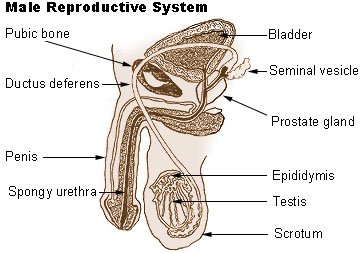
Here is what Year 7 biology looks like if you’re a boy:


Now, I have never been male, so I can’t speak with any authority on how a bisected man-willy might affect a 12-year-old boy. But, despite the adult(?) proportions and the weird squiggly bits drawn all over it, this appears to include a reasonable representation of what most males can personally find in their undies. And it has a biological action associated with it, an active purpose- again, not one that the vast majority of 12-year-olds can relate to, but one which most of them already know can be simulated in other ways.

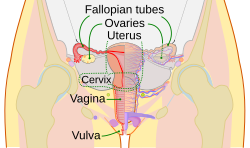
Now here’s what year seven biology tells girls is important:


It’s the uterus. What a great and noble piece of equipment that is, the very origin of the human race. And where is this great and noble piece of equipment? Oh, it’s inside of me, where I will never ever see it except in grainy ultrasound scans of my future baby (which I will have, to make this great and noble organ inside me worthwhile) or if I get in a really bad swordfight (which I won’t, because I’m a girl and swordfights aren’t girly). And what can I do with it? Well, based on what I learned in year 7 biology class, I can let a man put his penis in the bit at the bottom, then sometimes a baby will grow in it and come out of it.. Of course, there’s also whispered playground talk about these naughty things called dildos, but I put it to you that a 12-year-old girl with a dildo is a fair bit rarer than a 12-year-old boy with a pair of hands. There’s also a general sense that girls can also use their hands, but in my school that was pretty quickly appropriated by creepy-before-their-time boys who went around talking about “fingering”, probably a good decade before they actually got anywhere near a real vagina. But in general, the good things that are supposed to happen to this version of female anatomy happen to it, not with it.


Here, by the way, is what a medical picture of a vulva looks like. I saw one of these for the first time about eighteen months ago, when H. from the Staircase of Feminine Awesomeness inspired me to get a copy of “OurBodies Ourselves.” It’s not really relevant to this blog post but hey, I thought I’d share the vulva love.

You will probably be wondering at this point what on earth all of this has to do with Page 3 girls, who are not getting their uteri or their penes (hey, let’s not make assumptions!) out for Sun readers. It’s rather simple, really: from that moment in Year 7 when girls are told their sexuality rests in their uteruses and not their vulvas, women’s bodies become Someone Else’s. Sex, that most important function of the human animal, is for women about being evaluated as attractive enough that somebody will eventually put a baby in that womb. And, importantly, you cannot evaluate yourself. You can’t evaluate your own uterus, because it’s inside of you. You can’t evaluate your own vulva, because there is nothing to compare it to. And you can’t evaluate your own body, because that is the job of people who might put babies inside you. From there, it’s a depressingly easy step to the world we live in: where there exist, if not actual objective standards for female beauty, at least some very pervasive cultural myths about their existence and what they might be.

And that’s where Page 3, and all it represents, comes in. A topless woman can be in a newspaper because topless women can be objectively considered worthy of sexual evaluation, independent of anything else about them as a person. Cosmo’s men, on the other hand, appear in a magazine specifically for heterosexual women, are famous in their own right anyway, and are often presented with at least some sort of prop related to them as a person- usually to cover the crown jewels with. Across the world, pictures of anonymous pale women in various states of undress sell pretty much every consumer product imaginable, to both men and other women. It’s why this breast cancer campaign, aimed at both genders but primarily at women, can be called “Coppafeel”- because breasts are objectively sexy, so touching your own boob is just as sexy as somebody else touching it. Yes, groping one’s own boobs can be a very gratifying experience, but sorry, excited male readers, it’s not objectively sexy. And certainly not sexy enough for me to want to refer to it in dirty old man language. Oi, love, nice tits! Let’s cop a feel then, eh? No.

And as if the media weren’t bad enough, this all bleeds over, into the world where people are just being normal people and not trying to sell things using naked ladies. You see this so much in the Everyday Sexism page- the apparent progression, in some men’s minds, from “I am attracted to women” to “I have a right to evaluate women’s bodies” to “I have a duty to evaluate women’s bodies and tell them all about it”. It’s the place where wolf whistling comes from, and why some people still apparently can’t see it as anything other than a nice compliment- they just told you that you are worthy of being impregnated, what’s so wrong with that? Every day, everywhere, women are subjected to male commentary about how they look and how they make said men feel, as if it has any bearing whatsoever on our lives, and because of the way we have been brought up to evaluate ourselves, it does take on meaning. For most women**, attractiveness is about 1) evaluation by [male] strangers and 2) self-evaluation compared to objectively sexy women in pictures, from the perceived perspective of [male] strangers, rather than 3) having a good look at yourself in the mirror and going “Oh alright then”, or even 4) having somebody who is subjectively attracted to you as an actual human being go “you is well fit, let’s be individuals together”. Yes, women and men get around the constant awful messages every day in order to have non-awful relationships with each other, but it certainly doesn’t make it any easier! It is, as we feminists say, the Male Gaze, and it’s really not necessary or helpful to anybody’s life.

I want to finish up with the saddest comment I read on the Everyday Sexism Project, from somebody called Ruby:
“Told I look more feminine now I'm seriously ill and lost weight. 'Girls look better frail'. At least I'll die as a lady!”
The culture that Page 3 represents causes this, and it’s not right. If you love boobs, please also consider loving the people they are attached to. Go sign the damn petition.

--------------------------------------------------------------------------------------------------

*Although being a fan of pornography and being a fan of the pornography industry are very different things. I spend a lot of time on the parts of the internet that are full of young female nerds drawing pictures and writing smutty stories about fictional people shagging, and despite the fact the people are often not even human I think they’re probably more realistic than a lot of the “sex” that goes on over in Real Person Pornland.

** And I don’t doubt for many men as well, although culture doesn’t train us to see male worth or sexuality as intrinsically based on attractiveness in the same way.

Wednesday, 19 September 2012

Guns, germs, steel and really poor casting decisions

Last week was the start of a new term* for me, and with the start of a new term comes that most wonderful event, the first classes. An entire week of unusually high attendance, earnest professors, self-introductions and my personal favourite, the mystical marking schemes and course outlines that appear once embedded in a PowerPoint and then are never referred to again. The sense of ennui that this whole process inspires was exacerbated by the fact that most of the people in most of my classes are people whose self-introductions (and more…) I have been subjected to for over a year now, so whilst we all continue to find each other fascinating in oh so many ways, hearing for the eighteenth time where somebody was born or went to university is not one of them.

Fortunately, to counter this, many of my professors have apparently decided to be “hip” this term and punctuate their teaching with multimedia experiences! And so it was that at 4.00 on a Friday afternoon, after sitting through a couple of hours of questions about our lives and preferences which nobody should be asked an hour before the weekend, we all got to watch the first part of Jared Diamond’s “Guns,Germs and Steel”. The documentary is all online, so here's a link in case you have an hour to kill watching National Geographic adaptations of development classics.

This isn’t a development blog, so I won’t go into too much detail about Diamond’s theories**, but the basic premise is that all of human inequality can be explained by recourse to- yes, you guessed it- guns, germs and “steel”, i.e. technology. The part of it we were watching concerned the initial development of humankind, and how the development of wheat and barley farming and the domestication of goats in the Middle East, technologies which then spread across Eurasia, led to Europeans becoming colonising douchebags thousands of years later and screwing every other continent over despite only being superior by geographical accident. In other continents, where there weren’t good animals to domesticate or nutritionally balanced crops to exploit, communities didn’t have the people to spare to become technological specialists rather than food producers and technology therefore went nowhere.

It’s an interesting theory which makes good intuitive sense right up until one asks oneself why, if both Europe and Asia benefited from the same favourable conditions, it was specifically Europe who became the colonising douchebags and not East Asia. China was, after all, technologically superior for most of human history!*** I honestly don’t know if Diamond has an answer to this or not in the rest of the TV show or the book (although it’s a pretty glaring oversight if he’s not thought about it at all), but it does seem to me the book ought to be called “Guns, Germs, Steel and Poor Life Choices Made By Western Europe”, for accuracy’s sake. Although, to be fair, Jared Diamond is a published author and I am writing feminist tirades on Blogspot, so perhaps I should defer to him on the subject of book titles. He seems to know what he’s doing.

I’m getting severely sidetracked here. The point is, I watched the video with my classmates, and it was very interesting, even though it is narrated by an American and therefore very hard to take seriously. But it also made me extremely mad, in a way that has nothing to do with half-baked oversimplified approaches to history and development. In order to help us understand global inequalities, the movie regularly juxtaposed scenes from modern Papua New Guinea, where being asked a question about inequality by an angry man one day provided the inspiration for Diamond’s search for truth, and acted-out scenes from Back In The Day, when mankind was first learning to farm and building settlements in the Fertile Crescent. And yes, I used mankind deliberately just then, because the makers of this video (or, at least, their casting directors!) seemed pretty clear on the fact that it was mankind who made these great initial leaps in human history.

To make my point, I decided to take a foray into the world of screencaps. I learned two things from this little endeavour: the first is that taking screencaps is quite hard, and everything seems to be blurry; but unfortunately we’ll all just have to live with that. The second thing is that National Geographic needs to have a serious think about its casting directors, because these things do not line up.

So the video starts off with hunter-gatherers doing hunting and gathering, both in modern Papua New Guinea and in Cinematic Prehistory. These dudes are all men, which makes sense because I suspect it’s quite hard to be a hunter whilst pregnant (though having never tried either, I would welcome evidence to the contrary). Then we’re told that hunting doesn’t really provide enough food, so pre-agricultural communities also had to rely a lot on gathering! Here are the modern gatherers of Papua New Guinea, felling and processing a sago tree:

Women and axes!
Women carrying stuff!
Women and a stick!
            This all looks very difficult and time consuming, and we therefore get a shot of Diamond sitting in a swamp pontificating on the scarcity of these trees and their nutritional inadequacy. Whilst he is doing this, he is surrounded by hard-working New Guinean women, because as the voice over explicitly points out, it is women who do this work.

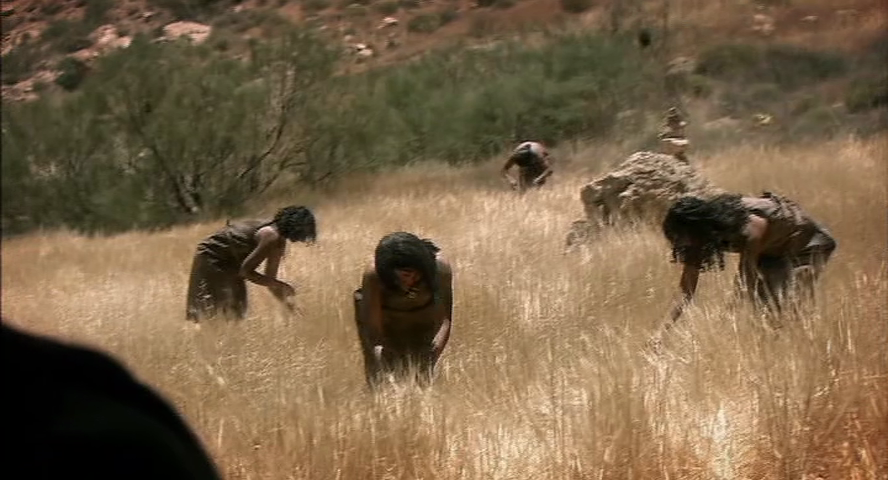
Meanwhile, in Cinematic Prehistory, the gatherers of the Fertile Crescent had easier and better things to gather, namely wheat and barley. Here are the people of Cinematic Prehistory gathering wheat and barley.

Hey guys, I lost my wedding ring!
Face shots are for posers.
Prehistoric silhouette dude
The video is more coy than I remember about actually showing these people clearly, but it's my contention that over 50% of the actors, and all of the prominently featured ones, are men. Which is interesting, because it was also the men of Cinematic Prehistory who were chasing that deer through the forest earlier. Our cinematic male antecedents must have been extraordinarily resourceful people if they were able to find more than twice the necessary calories for their individual survival, just so they could keep their women and children alive whilst said women sat around looking photogenic on a rock somewhere.

(I’m joking, of course, because standing around looking photogenic on a rock was a non gender-specific activity in Cinematic Prehistory.)


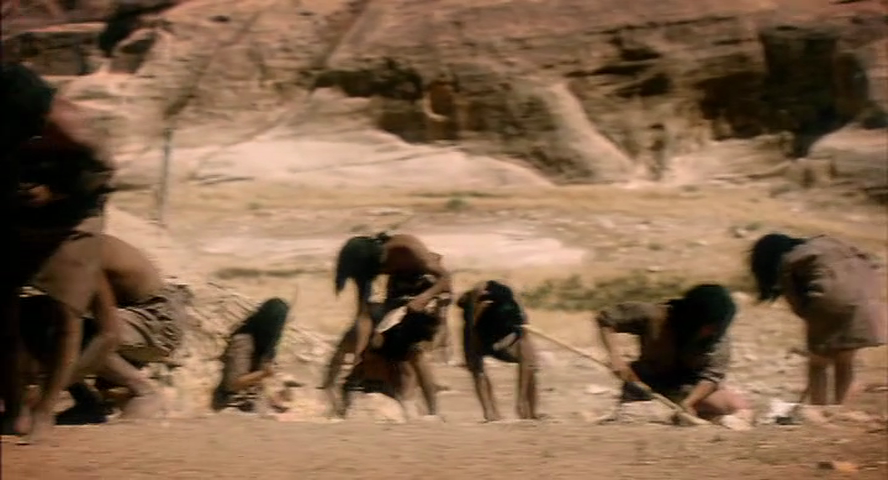
This difference continues into the discussion of agriculture. You see, the real reason that the people of Cinematic Prehistory were on that rock was to survey the terrible effects of Cinematic Prehistoric Climate Change. It turns out that existing so temporally close to an ice age really wreaks havoc on one’s Cinematic Prehistoric life plans! But we must remember that Cinematic Prehistory is very full of resourceful people men, and these men are about to do something amazing, i.e. farm those grasses from earlier! Here is Cinematic Prehistoric Man learning to farm.

Important men doing important manly activities. Like progress.
Manly man sowing. Not sewing, that's for girls.
... Women? Is that you?
Someday, son, you too will have an awesome Cinematic Prehistory beard.
SO HARDCORE.
Yes, I accept those people at the back of a couple of shots might be women, and that child with the goats may in fact be Arya Stark. I spent a long time looking at these scenes and I played a lot of “spot the female”, and I accept that they probably do exist in these shots. But they are not foreground in any of them. Sure, Prehistoric Cinematic Woman helped out a bit in the most revolutionary lifestyle change in human history, but there’s no way she was the main event!

For comparison, here’s modern Papua New Guineans farming.

Women! There you are!
A man is helping here. Good on you, man.
A man in a tree. Yep.
Pigs are not helpful livestock, alas.
            The roles are literally reversed. Apart from the man in the banana tree, who I will admit is pretty prominent, these are “spot the male” photos. Women are getting this stuff done in this society which is supposed to be parallel to Cinematic Prehistory in every way but the type of plants and animals being used.

            What does this say about how we think about human development? I’m sure that when National Geographic were thinking about how to present Cinematic Prehistory, they weren’t sitting in a board room going “well we all know women didn’t do anything, so we don’t need to show any of them prominently”. But, apparently, despite probably knowing how things were done in Papua New Guinea, it made perfect intuitive sense that the people to depict as innovators of the human race should all be male. Because Papua New Guinea is, the video takes pains to tell us, stagnant.  It produces no “cargo” (the New Guinean word for “cool stuff from abroad”, apparently). And maybe, on some level, it makes sense to us that this stagnant society is one that relies so heavily on womanpower, and that this aspect of its agriculture could not possibly be one of the hallmarks of a society that innovates. I mean, we live in a society where it is apparently not insane to believe that the entire of human civilisation was built by men so thatsexy women could sit around looking pretty and getting adored***! How could a society where women were playing these roles have the same level of progress?

            I sincerely hope that to most of my readers, the above looks like bullshit- if you’ll pardon my French. Certainly the little I know about prehistoric innovation (which basically comes from this one article that doesn’t cite its sources) suggests that this view of prehistoric human history is bullshit. But I also suspect that to a lot of people, this also looks like a total non-issue. Cinematic Prehistory is not real prehistory, after all, so does it really matter what gender the actors in it are?

            Perhaps not, as an individual case. But one of the strangest things about being A Feminist is how regularly things start to look this way- designed by people who almost certainly had the best intentions, but for some reason just couldn’t avoid unconsciously making these incredibly stupid decisions. Doctor Who is like that, these days, and for all it is still my favourite television show ever and I will love it, and Amy Pond, until the day I die, it still hurts that it’s apparently being helmed by people who just won’t think. My previously mentioned Favourite Writer Ever, Caitlin Moran, has a chapter in which she mentions how women have never ever done anything of artistic or technological worth, complete with a “feminists will try to tell you this isn’t true but think about it ladies, you know it is”, which just goes to show how I couldn’t even cover half the nonsense that got through the editing process in that book. We live in a world now where most of us know beyond a shadow of a doubt that women are supercool awesome powerful terrifying people capable of moving mountains (and, most importantly, for reasons other than babies), and yet when we retreat into culture, or start making culture of our own, we come up against all of these odd tropes and prejudices that too often have nothing to do with reality or how we experience it.

Like Diamond, I carry my own set of “statements made by [sometimes] angry men” which spur me on to figuring out what the truth about our human world and the people in it actually is. One of them is the assertion by a classmate, R., that he will never be a feminist because “feminism is a reaction, and women deserve better”. He is right on both counts, though obviously I don’t agree with his implied causality or his conclusion. I would love to live in a world where I can watch a stupid development video on Friday afternoon without going into a blinding feminist rage; my feminism will be pretty much useless when these unconsciously depressing gendered decisions stop being made. I very much look forward to that moment. Until then, annoying people like me are going to keep reacting to and pointing out these things, hoping that someday we might not have anything left to react to.

"History is a commentary on the various and continuing incapabilities of men. What is history? History is women following behind. With the bucket."

---------------------------------------------------------------------
*They’re technically “semesters” but as I am British (and so are the vast majority of my readership), I refuse to bastardise my language any more than is necessary in a world which mostly doesn’t know what a “chip” is. So let’s stick with “terms”.

**I also haven’t read the book or seen the rest of the TV show. So please direct all your sophisticated Jared Diamond-related questions elsewhere.

*** There are loads of fascinating theories about why this pre-modern superiority didn’t lead to an Asian industrial revolution which might have at least prevented China from its own nasty experiences with colonisation. Unfortunately they’re completely off-topic for this blog, so I’ll keep myself in check.

Wednesday, 12 September 2012

I read a book!


            About eighteen months back, when I lived in the Staircase of Feminine Awesomeness*, a friend of mine- in fact, let’s stop coyly referring to “friends” every time I have to speak about someone, affect a silly Victorian letter-writing convention and call her H.- had a birthday tea party and invited a bunch of people around. Being a totally hardcore Feminist Fitty herself, H. had received several Books About Women as presents, including a book called “How to be a Woman”, by Caitlin Moran, from fellow staircase denizen E. . Now, at the time my familiarity with Caitlin Moran was entirely through a story about her once appearing in a BBC English textbook which I had to teach from in China, so I was highly amused to discover a work of feminism written by this extraordinary TEFL superstar. As we sat on H.’s sloping floor stuffing ourselves with various baked goods and herbal brews, somebody got the bright idea to read a bit of an extract out of this new female instruction manual.

            I don’t really remember what bit we read, although we probably didn’t get past the first few pages, where she’s being chased across a council estate by yobs and communing with a stupid dog whose vagina is more integral to the plot for the first ten pages than Moran’s own. The point is, at some point very early on, we stopped reading, looked at each other, went ‘I don’t think this is really a feminist book,’ and got on with our lives. And by ‘got on with our lives’, I mean ‘started reading extracts from “The Sex Diaries” instead’. Great party book, that one. And that was the end of the feminist importance of Caitlin Moran.

            Except, alas, it wasn’t. Fast forward to this summer, and S., another coolkid of my acquaintance, sends me a link to an article about the US launch of “How to be a Woman”, along with the words ‘a compatriot of yours, perhaps?’ Yes, it turned out that Caitlin Moran, TEFL superstar, had apparently written a very influential book back in those heady days in the Staircase of Awesome, and we had been so preoccupied with the bit about dog vaginas that we hadn’t noticed that this magnificent being had single-handedly re-energised our movement! I disguised this earth shattering moment in my existence with some highly intellectual musings on Birmingham City Centre, and promptly resolved to discover more about this mysterious tome. My very maturity as an organism was apparently at stake.

            A stroke of luck was upon us that day. S. had unwittingly chosen to enlighten me about the movement of feminism (not to be confused with the feminist movement) on a day when, not only was I in London, hangout of most of my awesome British acquaintances, but H. had also just come back from her bohemian Vienna lifestyle to grace said hangout. I purchased some patriotic M&S snacks and went to talk to my fellow expat about the magic of our lives and the fate of our ideology. Many were the insights had on that day over a therapeutic cat-petting session**- we compared linguistic abilities, leg hair***, awesome foreign lifestyles and how best to pet a cat. On Caitlin Moran, however, H. had only one thing to say: ‘If she’s going to write a book saying “here’s the facts”, it would have been really nice if she’d looked up some actual facts first.’

            So then I stopped faffing around and actually read the book. And there’s an interesting habit I’ve picked up recently when reading books about feminism, where I cannot help but make corresponding facial expressions when I’m reading along. Sometimes, like with the bits of The Female Eunuch I dipped into**** a couple of weeks back, this involves wearing a smug smile and nodding slowly along for several hours; when making my way through Catharine MacKinnon the effect is more of a full-face twitch as her reasoning lurches (in my indoctrinated mind, anyway) from brilliant to deranged and back again in the space of a paragraph. I was going to see if I could emulate some of the faces I pulled during “How to be a Woman”, but then I Google image searched Moran and I discovered that the faces I pulled whilst reading it were probably very similar to the faces she wore whilst writing it. So, at first it was like this:


And then it went a bit like this:


And once or twice this:


And by the end, I was like this:


No, wait, that’s Benedict Cumberbatch. Let’s try again:


That’s quite unfair, of course. This was a pretty hilarious book, and the memoir parts of it (which is in fact most of it) were fascinating. See, it turns out that the textbook-approved story about the plucky teenager who wrote a book about her homeschooling experiences was actually a slightly desperate, lonely teenager who wrote a book about being very poor in a huge family in Wolverhampton. Having done so, she proceeded to create one of the biggest life turnarounds ever managed by an impoverished teenager in Wolverhampton, moved to London where all the awesome people are, and went on to write hilarious newspaper columns and throw drinks on members of Blur, or something along those lines. It’s all very heartwarming. But my goodness, whoever thought you could write a book on feminism in a five month blaze of glory needs a punch in the gonads.

Because, you see, for me the deal breaker wasn’t the bits where the existence of facts was casually ignored in favour of a sort of Edgy Modern Feminist reinventing of the wheel. I raised my eyebrows (figuratively and literally, see above) when Moran starts musing on whether we are in the fifth wave of feminism by now- show your working at least, Caitlin!- and again when I was co-opted into the Edgy Modern Feminist movement of “strident feminism”, but “How to be a Woman” is pretty unapologetic about not being an academic text of any sort so I figured I’d let this kind of postulating slide. Similarly, I am not so far gone into my little bubble of feminist theory that I don’t recognise that for some women, it may be new and exciting to be told that waxing your “foof” and wearing high heels every day despite the pain are not an inalienable part of the female condition. Full disclosure: I even quite liked some of the things she said which fell well outside what passes in feminism for a Party Line- so hey, don’t feel guilty for being bitchy or flirting at work because men don’t have to feel guilty about being bitchy or flirting at work! Obviously, being Manly Hunter Mans means that men never do anything as feminised as bitch or flirt anyway, but if they did, they sure wouldn’t feel as guilty about it as you probably did before Caitlin Moran told you feminists shouldn’t tell you not to. I was even in favour of the moral of the book, which is that we’re all just trying to be one of “the Guys”; a bit linguistically unfortunate that, seeing as “guy” is definitely not as gender neutral as I’d like it to be, but sure. Feminist bestseller, whatever.

No, all of those things were just fine. But there are a few glaring moments of “excuse me, what?” which possibly moulded my face into whole new shapes with their depressing badness, mostly because none of them needed to happen. The first major one of these was the moment the “what should we call vaginas” chapter descended into a prescriptive list of things we should and should not call our vaginas. There I was, smirking along at the thought of a teenage vagina called “Rolf Harris”, doing a little fistpump of recognition as “Birmingham City Centre” entered the story for real, putting on my sceptical face for the whole sequence involving babies… and then Caitlin Moran told me not to call my vag “vag”. It sounds like a middle aged woman, apparently (which is fitting, because so does my vag*****). Not “here are names which make me cringe”, which would have been functionally equivalent given the whole book is based on one woman’s personal adventure, and allowed all the same jokes. Just, ‘I know what feminism is, don’t call your vag “vag”’. I may have in fact said “Piss off, Caitlin” out loud.

And this happens a couple more times. These occasional jarring moments where, in the name of being funny and down to earth and feminist at a bar and we’re all friends here it’s just a laugh innit mate, these things just burst out of what could otherwise be a pretty darn amazing book. The real killer for me was the chapter on strip clubs (I think it is aptly titled “I go to a strip club!”) in which Moran, in the heady days of the early noughties when apparently going to strip clubs was a Thing (even the Spice Girls did it! The Spice Girls went to strip clubs! My childhood is ruined!), goes to a strip club, doesn’t think much of it and then gets kicked out by a bouncer who mistakes her for an ugly Russian prostitute. This prompts a long discussion about how awful strip clubs are, because everyone in them is a bit serious and angry, and then the assertion that strippers are letting the rest of women down. No, sorry Caitlin, you don’t get to make that claim. You got to leave home at 16 with an enormous vocabulary and a published book and become a magazine-person-and-TEFL-superstar; other women leave home with just their bodies and also do what they can.

This bit I almost forgave, however, after the following bit about burlesque, which as we all know is Good Stripping: turns out that the real clincher in favour of Good Stripping is that it is stripping frequented by gay men, and women should pay close attention to the things that gay men like as gay men are effectively a better version of women. Now, I’m not in the habit of filming myself whilst reading (yet) but I’m fairly convinced that my eyebrows actually left my head, anime-style, after I discovered this little gem in the Feminist Manual of the Century. I know gay men who are experts in linguistics, a capella, being amazing boyfriends, hipster fashion, misanthropy, the music of the Final Fantasy video game series and taxidermy, among other things, but perhaps I don’t know the Right Sort of gay man because none of them have been even slightly good at being women. In fact, it is possible that suggesting that the best type of woman is in fact a type of man with their own set of societal prejudices to tackle might be incredibly obnoxious to both parties involved! Yes, it’s just one little part of your book, that you made as a bit of a wry joke, and you did basically get your point across about burlesque, but now this thing you have written is being read by people around the world who are taking it exactly as seriously as “hey women, you don’t need to shave your pubes into the shape of Sicily!” i.e. very seriously. I’m afraid I can’t see this as progress.

And it’s sad, because it’s unnecessary. Proudly writing your feminist magnum opus in five frantic months, like a modern lady Kerouac with less substance abuse, is only a good thing if you’ve got enough people in those five months to read the thing over and, on occasions, point out that you don’t need to say that. It’s not censoring your edginess to suggest you don’t slut shame just to have a wham line at the end of your tragic strip club experience. It’s making your book better, so that maybe next time we can have a New Awesome Feminist Book that actually makes me grin like an idiot all the way through (then buy a hundred copies and give them to everyone I know). Also, you would really save my poor aching face muscles. Think about it.

------------------------------------------------------------------------------------------------- 

*I’m not sure whether “staircases” as a university living arrangement is self explanatory or not? It’s basically a small group (5-15) of vertically arranged rooms. The Staircase of Feminine Awesomeness was actually a couple of old townhouses converted into student rooms, and there were 6 of us altogether, although only 4 on the officially Awesome bit.

**I know this entry is about a book where that would be a euphemism but honestly, here it’s not. There really was a cat. It bit me.

***Yes, my best feminist sis had not seen me with fully grown-out leg hair until this summer. This fact is going to come as quite a surprise to some people and that is probably my own fault.

****Not a euphemism!

*****This is possibly the opposite of the kind of content I should be populating my serious feminist blog with, but it’s impossible to discuss the sounds of vaginas without including the opinion of a different Moran:


Misandry! And misogyny! Together! Comedy!