So I left you again. On a cliffhanger, no
less. Like an annoying British telly schedule from the days before Freeview, I
got you hooked on an interesting and entertaining program of feminist delights before
callously rescheduling for several weeks in favour of broadcasting the snooker
of silence. We should not dwell on why I was gone, because it is not very
interesting. What is important is that I am back, and more importantly, I got
to watch more things and therefore have even more fascinating insights to
impart- a win all around, I’m sure you will agree!
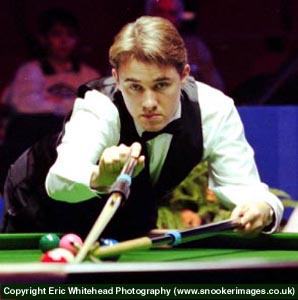 |
| I don't care if you have pretty boyband hair, Stephen Hendry, you ruined the lives of early evening TV watchers all over my country. |
Unfortunately, this also means that I am
going to have to invoke the modern pop culture equivalent of Godwin’s Law. Yes,
I’m sorry, I’m going to talk about Twilight now. I watched the final film on Monday
and now it is on my mind, and not just because I want to talk about how they
were only able to give it a decent climax by completely ignoring one of the
most important rules of the second book, what’s with that*? I know, I know- the
dead horse of Twilight hate has been beaten to a mushy pulp just as much as the
dead horse of Twilight love. Blogs have been made, t-shirts have been printed,
weird contrived rivalries with Harry Potter have played out, alt-universe BDSM
fanfictions have become standalone bestsellers. It’s all so done these days, especially now the last
movie is out and we can all move on with our lives. But hear me out. I promise
I will make this worth your while.
I first learned of Twilight the day before
my 20th birthday, when an old friend asked me to go and see the
movie with him. Neither of us really had any idea what to expect- unlike me,
he’d actually heard of the books and the fact they were a teen sensation, but
I’d not long come back from my first round in China so I was pretty out of
touch. We arrived a bit late so had only just taken our seats when golden eyed
R-Patz burst broodingly into the cafeteria, to a chorus of laughter and “wooo”
from the rest of the audience. “OK,” I thought. “So this is how it’s going to
be.”
 |
| Be still my beating heart. |
Two hours later, we emerged, looked at each
other, and went “OK, I legitimately enjoyed that.” And whilst we’ve already
established that my tastes are a bit of a mess, my friend J.’s are
significantly more developed. Sure, it’s all a bit faux-intense and having
missed the first ten minutes, I was under the impression that I was watching a
groundbreaking film about a protagonist with a legitimate motor disease rather
than somebody whose childlike clumsiness is their biggest characterisation
point. But beyond the silliness was something that actually did capture what
it’s like being an awkward teenager with feelings.
It was in many ways a perfect send-off to my own awkward teeny feeling era.
I went home to discover that my bookaholic
librarian mother had already bought the book (yes, everyone in the world knew
about Twilight before I did) and, though as we all know reading the book after seeing the film is a massive
intellectual faux-pas, I was intrigued enough to do it anyway. And, again, I
really enjoyed it, in a “yes this is exactly how it felt to be fourteen”** way.
There’s some weird shit in it, sure (I especially liked the book’s one
reference to sex, where it is called “being married” and it’s sort of implied
that Rosalie and Emmett are refraining from having sex because they’re
pretending to be schoolkids and not “married”) and it’s definitely not
portraying a healthy relationship, but there’s enough of a sense of an
unreliable narrator about Bella that it doesn’t really come across as
problematic for the book in general.
 |
| Full disclosure: I had an ENORMOUS version of this poster hanging on my wall in second year. I'm not entirely sure why. |
Then the other three books happened. And the other four movies. In all their
stalky, disturbing, Mormon propaganda filled glory. Thousands of pages of
mediocre prose about Edward’s Impossible Angelic Beauty and pissing contests over
who loves who more (is it the person who wandered off like a dickhead because
of a paper cut, or the person who literally stopped thinking after the
wandering off happened? A compelling narrative) and contrived love triangles
which are solved by having one of the parties actually be in love with an ovum
that later gets born and fulfils everybody’s predestination requirements. Pages
both loved and loathed the world over. If you’re not familiar with their
contents, and want to be, I have been recommending this summary of them for
years and I’ve never come across anything better.
So,
an objectively mediocre book achieved unintentional brilliance and went on to
resonate culturally with a large portion of a generation whilst simultaneously
getting worse in its execution and message. Why is this actually considered
novel or interesting? There have been rubbish and popular books for pretty much
as long as there have been books, after all. I spent a considerable portion of
my English literature A-level reading gothic novels, and I can personally
attest that most of them are just as pulpy and awful in their execution, and
often just as weird in their depictions of sexuality. The Mysteries of Udolpho, aka the 18th century’s answer
to Twilight (it’s the book that Catherine Morland is reading in Northanger Abbey), is one of very few
books that I have physically thrown across the room with frustration- imagine
every reference to Edward’s impossible perfection being replaced with the words
“and then we had repast and repose” and you’ve pretty much got the idea. My
copy of Dracula started with an introduction which has an entire section
wondering why the book had become so classic when its prose style is so dismal.
And if we’re worried about the poor relationship models we’re providing for our
young women in Edward’s stalkery weirdness and Jacob’s overentitled nice guy
overtures, then we should be really
worried that books like Wuthering Heights are being rebranded specifically to
appeal to Twilight-loving young women!
.jpg) |
| I suppose this is fine... |
We
can talk about almost all artistic endeavours in this way. Everything can be
criticised, and everything can be hated. There is no film, song, book or TV
show that can be held up as some sort of objective ideal of human culture. Some
things objectively come closer (real Disney movies are better than those
awful budget knockoff Video Brinquedo films) but with the majority of
stuff, we can spend just as much time picking it apart and knocking it down as
we can building it up as the Greatest Thing Ever. What’s more, even when we
believe something is objectively “better” than another thing, we still might
not get as much entertainment out of the better thing as we do from the worst!
It’s why Tommy Wiseau’s The Room will
always be one of my favourite films, and why my mother has spent countless
futile hours trying to get teenagers to read Mortal Engines or Skulduggery
Pleasant rather than Captain Underpants. Captain Underpants and Tommy Wiseau aren’t
actually wrong! Unfortunately, we tend to regularly forget this, or are told to
forget it by the various people who make a living telling us that there is a
grand canon of human artistic achievements that we should be looking to in all
our decisions.
 |
| One of these films is genuinely worth your time. |
Because, surprise
surprise, those people are men. Guardian critic Mark Kermode had a great article last month about how weird it is that we have to listen to the
“collective mooing” of a whole load of middle aged men to tell us what is good
for teenage girls. But for some reason we’ve set up that opinion as something
objective, and it’s an opinion which is far less accommodating to anything made
for young women than any male equivalent. As I said last week, I’m considered
weird because of my lack of knowledge and interest about a whole range of what,
in my head, just look like different permutations of Men Doing Things (In The Parallel World Where
Women Do Nothing). And as literally everything I directly experience in my life
involves a woman doing something, I struggle to suspend my disbelief about this
parallel world long enough to care about what exactly the men are doing. So I
enjoyed Twilight, because it resonated with a way I remember feeling***, and I
enjoyed the latter three books because I thought they were ridiculous and I
enjoy reading ridiculous things. A lot of people presumably also enjoy them
because they resonate and/or because they’re ridiculous; others dislike them
because they’re poorly written, long-winded and have some really troubling implications-
which are also important things to keep in mind, especially when talking about
media that is aimed at minors. We can respect the taste and fantasies of girls
and young women and provide
information about what healthy relationships actually look like. But it’s
really unfortunate that the discourse about these sorts of things isn’t really
run by either of these groups (or by me personally, more’s the pity) but by the
group of people to whom something that resonates with teenage girls can’t be enjoyed
without derision because teenage girls (and people who have been teenage girls)
don’t get to define what is “objectively awesome”. Old white men do.
I can only imagine how terrified these people
must be by what is happening to the world of art now that we have the
internet. Because the difference between Twilight and the gothic novels I
mentioned before is that, back in the 18th and 19th
centuries, reading was still largely the province of the wealthy and distributions
of books were, compared to now, absolutely tiny. Now, millions of people from
around the world can read and watch the same things, and in many cases they can
then go online and share their opinions on what they’ve read or watched with
fellow fans everywhere- and even creators themselves. This creates the
potential for a massive cash cow out of every vaguely popular fad- there were
no Team Heathcliff and Team Linton t-shirts back in Emily Bronte’s day, more’s
the pity- but on a less cynical note it also means that the forgotten, niche
demographic of everyone who can’t be bothered to pretend the concerns of white
men are universal to everyone for the duration of their media experience can
actually have their voices heard. Teenage girls are being listened to, and
whilst the ones doing the listening might be the same old dudes who have been
making everything forever, having the voices there in the first place can only
be a good thing.
 |
| Historical accuracy thanks to Kate Beaton's Hark! A Vagrant |
And doing so raises
another exciting possibility- that there are people who are currently wedded to
this “objective canon” who are finally being proved wrong, and embracing the
media that proves this to them. The adult fans of My Little Pony: Friendship Is
Magic- bronies- are an interesting case study in this regard. Frankly, the
fandom terrifies me with its constant pompous postulating on the nature of
their own existence (yeah, yeah, you’re “uniquely studying a fandom from its
inception”, not constantly trying to justify yourselves as Men Who Like A
Cartoon With Female Main Characters), but the fact that this postulating is
being used to celebrate their own existence rather than defending it is a
really nice step forward in my eyes.
So, having talked so
much about things that other people like, I end this on an unreserved
recommendation for my current favourite TV program- ABC’s Once Upon A Time. This program takes “Fairy Tale Retellings” and
completely avoids any irritating stereotypes, and it’s one of the first
programs I’ve watched where the gender equality is presented as pretty much
unconscious- Snow White and Prince Charming are both badasses, their child (Jennifer Morrison, who is actually the
same age as them all because of magical shenanigans) is even more badass and
rocks the whole “hardened woman with trust issues” thing without it being
stupid and stereotypical, motherhood is a key part of the story and discussed
as a complicated issue which women tackle differently, and even the women who
are subordinate to male characters have backbones and traits and aren’t just
there to prop up the storylines of the men. Fairytale land even has gender
neutral conscription, who knew! Basically, if you want to watch a TV program in
which a woman pulls a sword on another woman within the first five minutes, and
then it only gets better from that
point on, ABC has finally made something for you. Personally, I’d go for that
over Twilight any day- but hey, your choice!

-----------------------------------------------------
*I’m
talking about the “Alice can’t see the future when it involves werewolves”
thing. I can’t directly remember if it’s in the second movie or not but I can’t
imagine how they get around Jacob saving Bella and Alice not figuring it out if
not through that weird little plot point. And yet by film number five she can
project an entire hypothetical of vampires and werewolves into Aro’s mind,
right down to Jake’s salty wolfy tears when Seth dies (but not Leah because who
the hell has ever cared about Leah, come on).
**The
characters in the book are seventeen and over a hundred respectively, but they
act like I did as a year 9 and I was by no means an emotional early developer,
so I don’t know what that makes them.
***I’d
just like to point out again that I went to see the film with a male friend who
also really enjoyed it, so I’m not saying that lived experience as a teenage
girl is necessary or sufficient for enjoyment. Just that it’s why I enjoyed it.


