Showing posts with label representation. Show all posts

Monday, 11 March 2013

In which a feminist obsesses lengthily over Mass Effect


At the time of writing this, it is 7.30 on a Sunday evening and I am sitting in the second floor lobby of my university department building, “writing” my thesis, where I’ve been for three and a half hours now. Being able to use “writing” without the scare quotes would be a bit of an exaggeration- I only managed to add about 200 words to my wordcount today, although in my defence I also taught myself how to use Automap and I did write more than 200 words, I just also had to delete a lot of things. Anyway, it’s safe to say that a statistically very significant amount of my time over the past couple of days has been spent here, or in the department library (which is closed today- how I miss 24/7 library opening hours…), or for a few hours in what can only be described as a personal cell in the university’s main library. Coupled with the fact that I’m also working an internship over the other side of town (more on that at a later date), you might think I have very little time at the moment for silly time wasting.

And you’d be right, of course. But that doesn’t mean I haven’t been wasting my time anyway. Two months ago, after a fateful conversation with an old friend, I found myself coming five years late to a video game trilogy that has probably now become one of my favourite things in the entire universe. I have since sunk several weeks of my life into playing- and overanalysing!- Mass Effect.

Let me preface this by saying I love video games, but I’m also pretty selective in what I play. Like with films and TV shows, I have an enduring obsession with a few esoteric things that I’ve come into contact with, whilst having absolutely no knowledge about the “core” stuff I probably should know about if I want to identify as a gamer*. I’m also aware that I could be opening an enormous can of worms by even daring to open my mouth about video games on a feminist blog, and that there’s a whole host of awful, scary issues surrounding women in this realm of culture which I’m mostly not even going to touch this time around. Excitingly, the long-awaited “Women vs. Tropes in Video Games” series started last week, no doubt to the chagrin of game playing misogynist Youtube commenters everywhere (especially since she disabled comments oh my god how dare a woman not be open to abuse from all people at all times), so if you want to follow a series that’s going to give a way better specific analysis then I suggest you keep up to date with that. Here’s the first one!**


Because, you know what, all I want to talk about is Mass Effect. And as anybody who has ever picked up Mass Effect knows, this basically just means that I want to discuss intergalactic alien sex. This is a game which sold its final DLC off advertising stating “you will get to have sex with your favourite fictional character again!”, so rest assured there’s a lot of boning going on. Apart from this, there are two other brilliant things about it:

1)      It’s a hugely immersive space opera set in a richly populated galaxy with a really fascinating history and your interactions with this world actually matter beyond a linear plot path and you meet lots of interesting characters whose lives and struggles also become invested in over the course of the series (and you can also sometimes have sex with these interesting characters).

2)      You can totally play as a GIRL oh my god.

Yep, the Mass Effect trilogy is pretty brilliant at giving you a really wide range of customisation over who your character is. So whilst every runthrough of Mass Effect has a Commander Shepard, and Commander Shepard always saves the galaxy, pretty much everything else in the game is down to you. Right down to your gender, appearance and your first name.

Shepard! Ah-ahhh! Saviour of the universe!
This is incredibly exciting in a way it’s hard for me to fully articulate. It’s not really to do with character identification, although I can see why that would be amazing for some people. Being able to play a game where everybody completely accepts that the most famous and capable person in the galaxy is a woman who grew up orphaned on the streets of Jakarta**** doesn’t make me any closer to being a late 22nd century Indonesian space marine myself, but the fact that she exists in this universe and I can make her exist just makes me feel that much more well-disposed to the rest of the game.

Commander Shepard, like all good RPG heroes, spends most of her time wandering around solving other people’s problems, whether they want her to or not. As this is a space opera, the problems reflect this. Examples are:

·         We have accidentally unleashed a horde of extinct bug-aliens on our ice-world science facility!
·         We are being mind-controlled by a weird plant and also robots are trying to kill us.
·         I am a robot and I want to learn how to live in peace and have feelings, please kill the other robots who disagree with this aim.
·         I hope nothing goes wrong when we set up a nuclear bomb in this alien breeding facility!
·         Our space-wizard academy is under attack from guys who want us to use our space-magic for evil.
·         Humans are going missing from space!
·         Some scientists are doing morally questionable things.
·         Some mercenaries are doing morally questionable things.
·         Gosh, that’s a very big worm and it appears to be shooting acid at us.

As mentioned, this is also a very characterisation-heavy game, and you make plenty of interesting friends and allies along the way! Your squad’s relationships are also pretty important to the game:  

·         My daughter is a sex vampire who I have dedicated four hundred years of my life to hunting down.
·         My dad is trying to kidnap my clone sister who I already kidnapped away from him once.
·         My mum got seduced by a spaceship into helping the bad guy.
·         My dad has spent the last ten years sexually abusing mentally degenerate young women on a remote planet.
·         My dad is dead from robots.
·         My son seems to think that becoming an assassin is a good career path, I can’t imagine where he got that bright idea from.
·         My parents are Canadian and also Canada Canada Canada [not much you can do to fix this one]

 There’s also an overarching plot about saving the galaxy from giant robots but honestly, the game never cares about that as much as it probably should. If you want to hear more flippant summaries of Mass Effect plotlines you should check out MSPixel, which does it much better and with more pictures.

Actually I'm pretty sure I just shot her.
So! Off Shepard goes, swanning around the galaxy with her adorable cheesy space husband (optional) asking inappropriate questions of strangers, either being pathologically nice or pathologically rude to everybody she meets***** and passing the Bechdel test with flying colours whilst she’s at it. In the meantime, the rest of the galaxy exists in a super weird mix of gender tropes. I think it’s probably fair to say that because this is a game that gets so much right so much of the time, the moments it gets wrong become that much more frustrating, and their treatment of women is no exception. One moment, annoying gender stereotypes are being magnificently subverted (your first two squadmates in ME1 are a straightforward shoot-everything soldier woman and a male space-wizard), and then in the next moment they’re suddenly ignored or played straight (all the human authority figures are male; one of your squadmates in Mass Effect 2 is a literally topless woman who… apparently keeps bullets away with space magic?)

I mean aside from anything else, doing strenuous activity in a leather nipple-strap just can't be comfortable. Also did I mention people are constantly shooting at you? Normalising female toplessness is a great project but I don't think it should be pioneered on the battlefield.

And then there’s the aliens.  Now, I have utmost respect for the fact that, whilst making this game, somebody clearly sat down and went “I think we should make sure that sexual reproduction isn’t inexplicably the same across all these different species”. Unfortunately, I have a sneaky suspicion that this thought happened after somebody had decided that there was no money to make different gendered character models for the majority of species, and that they needed a guilt-free way to fill space bars with alien strippers without being creepy or exploitative.

So, we get the Asari:

Liara, I'm about to badmouth your entire species. Cover your delicate ears.

Who are a female-presenting monogendered species with a thousand year lifespan and also the most advanced race in the galaxy. Like all blue aliens, they reproduce using Deep Emotional Bonds and can make babies with any other species. This means that everyone else in the galaxy- including people who otherwise have literally no sex drive- think that they’re the hottest thing ever. Given that asari just look like blue human women with tentacle heads, this is the game asking you to believe that human women are literally universally attractive. The asari also divide their own life cycles into “maiden-mother-matriarch” stages, becausenaturally as females their entire existence is based on their relationship to reproduction at any given time. Asari maidens have three career paths open to them: commando (completely awesome), exotic dancer (… less awesome) or archaeologist (because the game wants you to have a young, innocent space waifu on your squad and having her be a commando or a stripper would make her too powerful). So there are various bars across all three games filled with asari writhing on poles in skintight clothing, because hey! That’s just what they do between the ages of fifty and three hundred! Don’t judge!

I could probably write an entire separate essay on why this guy is so cool and  why it is so cool that he is cool. But let's not make this any worse than it already is.
Moving on. The salarians are the aforementioned no sex drive species. They reproduce by laying big clutches of eggs and only 10% of their population is female. The game doesn’t have any voiced female salarian characters until the third game, and then they look just like the male ones. I’m pretty much cool with the salarians, actually.

The one on the left is widely considered the most attractive woman in the Mass Effect trilogy. No, she never takes off the mask.
I’m also cool with the quarians- the only quarian you meet in the first game is hardcore female engineer (and Shepard’s bestie) Tali’Zorah, and although they do then introduce male quarians in future games, the ratio of male to female characters remains pretty even. They also have a much better ratio of women in authority than any other gender dimorphic species in the galaxy.

Heh heh heh.
The krogan are ultraviolent space tortoises who got forcibly sterilised by the other races a couple of thousand years ago for being too ultraviolent and having too many babies. This sterilisation means that almost all female krogan give birth to stillborn babies and “fertile females” have basically become commodities that the male krogan go to war over. Despite this being one of the most important plot lines in the entire series, you don't find out firsthand what krogan women are like and how they have dealt with several thousand years of dead babies until the third game. This is apparently because they had to spend five years trying to design a character model that you would plausibly believe is a female space tortoise.

 Eventually they opted to have her wearing a lot of clothes so you can’t see she basically just looks the same as a male space tortoise.
Other minor races include the four-eyed angry space totalitarians, floating pink jellyfish, tiny ammonia-breathing mole people, sad eyed lizard people who blink sideways and these giant grey elephant things called elcor who talk in monotone and precede every sentence with a description of the tone it should be spoken in. Every member of these alien species are presented and voiced as male. But then, you don’t meet that many of those species, so it might be a fluke- besides, the jellyfish are using weird technology to translate their speech from bioluminescent flashes and neither the ammonia moles or the elcor have normal human speech patterns either so who’s to say they are male just because they sound male to humans?

Which is fine, if frustrating. But my suspension of disbelief regarding the lack of space women was completely shattered by the one species I haven’t covered:

Oh HAI Nihlus!

This is a turian. Turians are metal faced space avians with mandibles. Apart from these obvious physical differences, they are supposed to represent a species that is very similar to humanity in terms of their life cycles, whilst also being culturally very different (they are imilitaristic and very disciplined and most come across to humans like they constantly have a stick up their arse. Cloaca. Whatever.) They have complete gender equality and both male and female turians are expected to serve fifteen years in the military. They make up a huge proportion of the galactic military, the police force of the city you spend a lot of your time on and just the galactic population in general.

And for five years, every single one of the turians you meet whilst saving the galaxy just happens to be male. It’s explicitly not a case of humans not being able to tell the genders apart, because when they finally did design a female turian for the second-to-last DLC package, she looked and sounded different enough to make it impossible that any of the others you’d seen from the previous games were also women. Specifically, she looks somewhat like she has breasts, because this is the only way to make an audience accept that a character is female (unless you cover them entirely with clothes like Eve the female krogan. But I digress.)

A highly realistic metal faced space-bird lady!

So the people making this game were faced with a difficult logistical choice based on the fact that they could only make a limited number of character models. They knew they wanted a species of gender-equal metal-faced mandibirds, but they could only have one model (technically they do make two but... oh, you know what, just go play and find out). They had to decide: is it more likely that an audience will believe that some of these identical looking characters are male and some are female******, or are they more likely to swallow the idea that there are female birds out there in equal quantities to the males but they just literally never bump into them? They weighed this choice up, and decided that the latter was more credible. People playing this game are apparently more likely to believe that the women are invisible than that they might not be sexually optimised.

To me, it’s stuff like this that really highlights how far we have to go. As much as Mass Effect has shot straight to my heart in the past couple of months, and made me happy in ways both related and unrelated to my unrepentant feminist cogitations, it still terrifies me that we produce culture where the non-existence or invisibility of women is considered acceptable or a necessary trade-off. “Geek culture” has some pretty severe problems understanding the existence of women in reality, most recently embodied in the furore over “fake geek girls” at cons. But women do exist in geek culture, and we exist in the real world too, and believe it or not we are central to our own lives! If companies do want to make video games set in universes where women don’t exist, then that remains their (shitty) decision to make. But please. Don’t set something up as egalitarian, then refuse to put in anything female unless it looks good with tits. I’m not suspending my disbelief any more.

(Whoops, I barely talked about sex at all! Never mind. Next time.)

-----------------------------------------------------------------

*Luckily, I don’t actually want to identify as a gamer, just like not everybody who watches films regularly is a “film buff”. I just… play video games sometimes.

**Brief comment on the video itself: it’s clearly starting the series on a really basic, obvious note so I’m pretty optimistic about it in general. One video game which it made me think about, and do hope she covers in the future (although I think it’s possibly too obscure) is the super-pretentious-arty-oh-so-subversive “Braid”, which bases its storyline on messing around with the Mario concept in the most super-pretentious-arty-oh-so-subversive way possible*** Ostensibly, you’re on a quest to rescue a princess (or are you inventing the atomic bomb?) but oh! Cunning subversion of the damsel in distress trope- and spoiler- ahead! Actually you’re the one trying to kidnap her! Yeah, the biggest super-pretentious-arty-oh-so-subversive twist they could come up with is that your damsel in distress needs rescuing from a different random sprite (and also might be a bomb). She still needs rescuing (or, uh, inventing) in the first place, though. Silly woman.

*** It also has some genuinely amazing mechanics to do with time manipulation and I really do recommend it. If you can stand the pretentiousness, that is.

**** OK let’s be totally clear, the game doesn’t actually ask you which earth city your  newly created fictional character spent their childhood in. That’s just a symptom of the rather absurd amount of time I have spent thinking about who I want her to be (I could literally tell you her entire fictional life story, I am that lame). Also I’m fully aware I didn’t spend nearly enough time making her facial structure fit with the fact she’s from south-east Asia, but she’s also from the late 22nd century so  let’s just assume there’s been plenty of racial mixing between now and then.

*****Another example of why my Shep is not a self-insert: she is pathologically nice. I am not.

****** I also just want to point out again: they’re based on birds. Lots of birds have colour-based sexual dimorphism that could have allowed different looking female turians without having to make another character model. But no. Boobs. Are important. Remember this.

Thursday, 18 October 2012

On courage


So before I go any further, I want to apologise for not being a good enough feminist to have been keeping up with news in the world of Men’s Rights Activists. Whilst searching the internet for new inspiring pictures to put in my desktop background folder, I ended up stumbling onto the publicity leaflets for MRA haven “A Voice for Men”- infamous in the land of feminists for being some of the most awful examples of graphic design ever made (below are probably the two best)!


But very persuasive, as you can see! Anyway, it turns out that when I wrote last week about having “taken the red pill”, I didn’t realise that this had already been co-opted by every single vaguely nerdy person in the last 15 years MRAs to describe their own awakening regarding the feminist conspiracy to draft them into the military and force them to be crappy fathers. I feel like this could be a bonding moment between me and misogynists- like a real life version of that “Breakfast at Tiffany’s” song, but about overcoming the zero-sum model of gender relations rather than just continuing to date a clearly unsuitable person.


It also turns out that whilst I was fussing about the State of the Planet Conference, over in the rest of Development-Land they were holding the first annual Day of the Girl Child, celebrating progress in expanding education and choices for girls and pointing out what needs to be done in the future. Somewhat fittingly, this day ended up coinciding with the week in which members of the Taliban in Pakistan decided to end the life of 14-year-old Malala Yousafzai, whose crime had been to be too “western minded” and to loudly advocate girl’s education in her region of Swat. The day itself focused on ending the problem of child marriage- it is estimated that 25,000 girls aged 11-16 get married every day, an event which almost always signals an end to their education and makes them much more likely to become an adolescent  maternal mortality statistic (maternal mortality is the leading cause of death for 15-19 year old women).

Whilst a lot of the dialogue from this day passed me by, I did get time to read one particular story from UN Women which resonated. It was about Fetura Mohammed, a girl from Ethiopia who decided, upon being informed by her father that he had arranged her marriage at aged 14, to use her knowledge of laws surrounding the issue and the help of local organisations, to go to the local court and fight it. After successfully winning both her legal case and the case for educating her and allowing her to make her own life choices to her father, she now combines continuing to go to school with working with the groups which provided her with awareness of her own rights, and helping to distribute that knowledge to others.

To contrast, when I was 14, I was writing weird derivative fantasy stories in order to attract the boy of my dreams, and worrying about whether or not my year 9 exam results were going to be better than my bestest frenemy. Due to the vagaries of the British schooling system, I made some subject choices which at the time I thought were going to affect the rest of my life (largely due to aforementioned frenemy trying to convince me that I’d never go to a good university without a GCSE in Spanish, to which I say se te escapo la tortuga, 矮个子), but which turned out to have been completely irrelevant to anything ever. The battles I thought I was fighting were 1) imaginary and 2) conducted against a different 14-year-old girl, whose actual level of control over my life chances was completely non-existent. For me, being 14 was just one particular year of being in an education system where everything was set up for me, a British girl living in the UK*, to succeed.
The first time somebody told me that, as a girl, I could not expect to do as well or better than the boys I was being tested against academically, was when I went to a university that has  a“finals gap”, where women consistently underperform compared to men in pretty much all subjects (stereotype threat much?). But it was never accompanied by any sanctions; there was no suggestion that it was therefore pointless to let girls into the university because they wouldn’t match the expectations of the boys**. At no point in my academic career has courage ever been an integral part of my experience or progression as a female. Ambition, perhaps, and a certain amount of bloody-mindedness, but never courage. No male relatives have ever beaten me for doing what I want to do, and no female ones have ever emotionally blackmailed me into “knowing my place”. My parents are as disinterested in my eventual marriage prospects as I am, at least for the foreseeable future. No international organisation has power to stop me from doing what I want to do, no gunman is going to break into my Beijing dormitory and try to end my western-minded life.

It’s an uncomfortable truth that for the vast majority of feminists like me- including, no doubt, myself- that this privilege is what lets us be feminists at all. Faced with constant threats against our lives (either in the literal sense or simply in the sense of being able to belong to our own families and communities in some sense), most of us would not be pontificating over subtexts of male entitlement in bar etiquette or whether the word “slut” should be reclaimed or avoided altogether- we’d spend most of the time trying to protect ourselves in the immediate sense, trying to figure out how to better our situations within the constraints of the situation we’re in. This is true of all of human progress, of course- being at the sharp end of social change always have to be the preserve of the courageous and bright few (and those with access to organisations like ActionAid in Ethiopia, which helped Mohammed understand her legal rights and bring a case against her father to prevent her child marriage), with the rest of us able to push the boundaries further from a position that’s already relatively secure.

I don’t mean to suggest that the big problems faced by North Americans and Western European women are at all trivial (indeed, in a few cases, they look pretty similar to those faced in Taliban-influenced areas of Pakistan or Ethiopia, and we’d do well not to forget that). Sexual assault and domestic violence aren’t trivial. The wage gap is not trivial, particularly given how many families and children are supported by women alone***, and particularly given how it becomes exacerbated when race is taken into consideration. The assumption that women should raise children without society considering it a significant, valued labour undertaking (because raising children is something women can do naturally!) is not trivial. The way in which women are encourage to perceive our own bodies and the time and money we’re expected to spend “fixing” them is not trivial. The thousands of remarks catalogued on “Everyday Sexism” might seem trivial when taken individually, but what they add up to certainly is not. The weird guy who leered at me and called me “honey” when he was trying to get past me at the bar on Tuesday night was trivial, but he exists on a sliding scale of male entitlement which gets non-trivial pretty quickly. Arguing that men are discriminated against because they could be drafted to fight (even though they haven’t been in the US since the 1970s and even longer in the UK) is a bit trivial, sorry MRAs.

What these things are not, with the big exception of sexual violence, is individually threatening.**** Wage gaps, childcare expectations, conversations with weird men that we’re socialised to be too polite to escape from, enforced beauty regimes, institutionalised gender equality in exams: all of these are issues which grind us down rather than terrifying us into submission. And then we are shown that we live in a world where 14-year-old girls are shot for going to secondary school, or trapped into marriages with much older men, and the fact that we don’t have that particular problem seems to make frustration with our own gendered lives a bit ungrateful. This idea particularly tends to pervade conversations I have about gender equality in China- now that women can get educated and find good jobs and aren’t physically crippled as girls and then shipped off to live under a mother-in-law at age 11, surely it’s time to stop worrying? It’s enough to have to worry about finding a decent husband (before age 27, remember!) and getting promoted beyond a certain point, and having fair enough skin and beautiful hair, and of course overcoming the various moments of stupidity that are just so female- we can’t even seem to cross the road without getting run over and let’s not even try doing economic calculations- without having to also worry about feminism. Plus, feminism scares men away. There's only so much any person can do.

So how the hell do we contextualise all of this- our lives, our gendered problems, our non-gendered problems, other women’s problems, the world’s problems- without going completely insane? Especially since we’re living in the first era (imperialism definitely does not count) where globalisation seems to demand that we do so. The privileged educated white feminist response- even when faced with diverse voices within their own countries, let alone having to contend with those from outside- is too often to either retreat into privileged educated white female problems (like the “right” to not sit at home being looked after by wealthy men, which has never been a representative lifestyle for most of the world’s women!) or, less often, to get very worried about issues like child marriage or female genital mutilation or the position of women in Islam which we don’t actually have any insight into whatsoever, and to impose our rather irrelevant thoughts onto those debates. I'm not going to be an apologist for cultural relativism or anything like that, because I've only ever seen that used to deny women personhood based on an accident of geography, and I frankly think it’s an insult to suggest that there is such a thing as a culture which cannot secure universal human rights. But what those big, scary debates need- and have- is the courageous voices of girls and women who actually contend with these issues to advocate and to be heard.

We privileged few have two safer but far more difficult tasks. One, to keep listening to what is going on all over the world- listening, not speaking, and certainly not talking over! And two, to keep moving forward ourselves on issues which demand the patience of us all rather than the courage of a few. It might just be the fact that I’ve started paying more attention since I began this blog, but I feel like the dialogue about feminism and gender issues in the UK and the US is becoming more mainstream once again. That’s great, but it’s also reaching an audience of both men and women who have been privileged throughout their lives, who can see what is going on elsewhere, and who conclude that the situation we face now is trivial and natural. Most young girls in the UK grow up like me, completely unaware and indifferent to gender issues until pretty late in their childhoods. It’s speculated- by Gloria Steinem, for example- that maybe there is a different “radicalisation” lifecycle for women, that we begin conservative and only start to understand what has been taken from us later on in our lives, that the counterpart to an “angry young man” is actually an “angry old woman” and we shouldn’t worry too much about how non-radical our youth are. Perhaps that’s true, but if so it means women won’t fight for change until it’s too late for them as individuals. Better, perhaps, to start now, with what we know- because for now at least, there’s always a next step.

--------------------------------------------------------------------------
*And for a while before that, Australia, but the same point holds.

** Although I’ve no doubt that there is plenty of institutionalised sexism in an admissions procedure that overwhelmingly still depends on whether one or two old white men warm to you in twenty minutes

***This is feminism’s fault for being so damn discriminatory against rights for fathers, of course! Misandry <3

**** For some women that’s probably an eyebrow-raisingly big exception to make, sorry about that. Living in China, where I can go home alone at any time of the night without any fear whatsoever (and before then in Oxford which was pretty much the same deal) means I’m absurdly privileged in this respect.

Wednesday, 26 September 2012

The biology of objectification


NSFW NOTICE: This post contains medical diagrams of willies and vajayjays. People who are in a location where they cannot safely giggle like little schoolchildren at these naughty pictures should probably hold off reading for now.

Last week I decided, more or less on a whim, to reactivate my old Twitter account. This is not a decision to be taken lightly when one lives in China, land of annoyingly blocked internet, and means that I now spend an unreasonable amount of time on an artificially slow connection, writing topical insights on my life and then desperately clicking the “tweet” button over and over whilst the website tells me “it did something wrong” before finally putting them up ten minutes later. Ah well. A woman’s got to have a hobby, no?

Interestingly, it has also put me more in touch with some of the big issues in UK feminism today than I was when I was actually back in the country last month. See, when I plugged back into the twit-o-sphere, I discovered that most of the feeds I follow are either of Oxford radicals or joke versions of Nick Clegg, both of which continue to be very relevant to my life in a nostalgic way but which I didn’t really want to be the sum total of my Twitter news. So I went off to find some more topical things to follow, and ended up tuning in to two accounts in particular: the Everyday Sexism Project, and the No MorePage 3 Campaign.

I imagine the vast majority of my readership already knows what these two things are, but let me explain for the benefit of the remainder. The Everyday Sexism Project, in its own words, “exists to catalogue instances of sexism experienced by women on a day-to-day basis”. This covers everything from violent criminal offences and big institutionalised inequalities in areas like sport to the waiter in Pret who stared openly at your breasts whilst making your coffee or the plumber who refused to talk to you until “your husband gets home”. The idea is to delegitimize a lot of the silencing that goes on when sexism is discussed, particularly on the internet- the reams of “that happens to men too!” or “you need to have thicker skin!” or “that was just a compliment!”-  by pointing out the sheer volume of nonsense that goes into being female every day. It’s an interesting read, and judging by some of the publicity, it’s having the right effect.

The No More Page 3 campaign is aimed at tackling just one of these everyday sexisms- namely, the 47 year tradition of Britain’s most popular tabloid, the Sun, which puts a topless young woman (sorry, “girl”) on page 3 (or occasionally elsewhere) for… what purpose exactly? To remind the world that boobs still exist and are regularly attached to “girls” (women) with nice hair and Sexy eyes. And because men like boobs, and men like newspapers, and it’s always been that way, right? The feature apparently tries to justify its inclusion in a newspaper by featuring a little text box called “news in briefs”, where the topless woman (“girl”) is quoted as saying something about a topical issue in today’s news- except the joke is that what she says is always far too erudite and highbrow to have come from the mouth of a topless “girl”. Because the only thing stupider than a thing with boobs is a thing that we tricked into letting us see its boobs. Silly thing.

Why does this matter? I do wonder, for example, how many of the 36,000-odd signatures that No More Page 3 has right now are actual Sun readers trying to change their favourite newspaper. The phrase “if you don’t like it, don’t buy it” has been bandied about (and well-discussed) elsewhere, and although it’s a completely inadequate response, I strongly suspect that the people swayed by this campaign are mainly those who have already been voting with their wallets against the Sun for quite some time. And I for one am not against the existence of boobies in entertainment, or any people in any state of undress for that matter!* The “girls” of Page 3 know what they’re signing themselves up for, and must know that jokes are made at their expense, so surely they don’t need our big moral guiding hand telling them what to do. And Cosmopolitan magazine, may it live a thousand years, has a completely naked man inside every month! Covering up the really naughty bits, of course, but sometimes not very well. So why should we care what is going on in this one particular newspaper?

To answer that question, I want to take you back to school sex education. In my case, we did sex education twice in secondary school. The second time was in year 9 when our already worldly class of 14-year-old British state school kids asked our rather old, Daily Mail reading “Personal Development” teacher to answer our sex-related questions for a term, and then proceeded to harangue her about double fisting. The first was back in Year 7 biology class, when we learned biology. Sounds very objective, right?

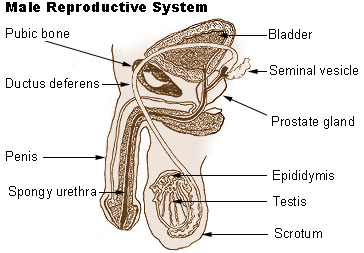
Here is what Year 7 biology looks like if you’re a boy:


Now, I have never been male, so I can’t speak with any authority on how a bisected man-willy might affect a 12-year-old boy. But, despite the adult(?) proportions and the weird squiggly bits drawn all over it, this appears to include a reasonable representation of what most males can personally find in their undies. And it has a biological action associated with it, an active purpose- again, not one that the vast majority of 12-year-olds can relate to, but one which most of them already know can be simulated in other ways.

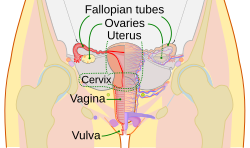
Now here’s what year seven biology tells girls is important:


It’s the uterus. What a great and noble piece of equipment that is, the very origin of the human race. And where is this great and noble piece of equipment? Oh, it’s inside of me, where I will never ever see it except in grainy ultrasound scans of my future baby (which I will have, to make this great and noble organ inside me worthwhile) or if I get in a really bad swordfight (which I won’t, because I’m a girl and swordfights aren’t girly). And what can I do with it? Well, based on what I learned in year 7 biology class, I can let a man put his penis in the bit at the bottom, then sometimes a baby will grow in it and come out of it.. Of course, there’s also whispered playground talk about these naughty things called dildos, but I put it to you that a 12-year-old girl with a dildo is a fair bit rarer than a 12-year-old boy with a pair of hands. There’s also a general sense that girls can also use their hands, but in my school that was pretty quickly appropriated by creepy-before-their-time boys who went around talking about “fingering”, probably a good decade before they actually got anywhere near a real vagina. But in general, the good things that are supposed to happen to this version of female anatomy happen to it, not with it.


Here, by the way, is what a medical picture of a vulva looks like. I saw one of these for the first time about eighteen months ago, when H. from the Staircase of Feminine Awesomeness inspired me to get a copy of “OurBodies Ourselves.” It’s not really relevant to this blog post but hey, I thought I’d share the vulva love.

You will probably be wondering at this point what on earth all of this has to do with Page 3 girls, who are not getting their uteri or their penes (hey, let’s not make assumptions!) out for Sun readers. It’s rather simple, really: from that moment in Year 7 when girls are told their sexuality rests in their uteruses and not their vulvas, women’s bodies become Someone Else’s. Sex, that most important function of the human animal, is for women about being evaluated as attractive enough that somebody will eventually put a baby in that womb. And, importantly, you cannot evaluate yourself. You can’t evaluate your own uterus, because it’s inside of you. You can’t evaluate your own vulva, because there is nothing to compare it to. And you can’t evaluate your own body, because that is the job of people who might put babies inside you. From there, it’s a depressingly easy step to the world we live in: where there exist, if not actual objective standards for female beauty, at least some very pervasive cultural myths about their existence and what they might be.

And that’s where Page 3, and all it represents, comes in. A topless woman can be in a newspaper because topless women can be objectively considered worthy of sexual evaluation, independent of anything else about them as a person. Cosmo’s men, on the other hand, appear in a magazine specifically for heterosexual women, are famous in their own right anyway, and are often presented with at least some sort of prop related to them as a person- usually to cover the crown jewels with. Across the world, pictures of anonymous pale women in various states of undress sell pretty much every consumer product imaginable, to both men and other women. It’s why this breast cancer campaign, aimed at both genders but primarily at women, can be called “Coppafeel”- because breasts are objectively sexy, so touching your own boob is just as sexy as somebody else touching it. Yes, groping one’s own boobs can be a very gratifying experience, but sorry, excited male readers, it’s not objectively sexy. And certainly not sexy enough for me to want to refer to it in dirty old man language. Oi, love, nice tits! Let’s cop a feel then, eh? No.

And as if the media weren’t bad enough, this all bleeds over, into the world where people are just being normal people and not trying to sell things using naked ladies. You see this so much in the Everyday Sexism page- the apparent progression, in some men’s minds, from “I am attracted to women” to “I have a right to evaluate women’s bodies” to “I have a duty to evaluate women’s bodies and tell them all about it”. It’s the place where wolf whistling comes from, and why some people still apparently can’t see it as anything other than a nice compliment- they just told you that you are worthy of being impregnated, what’s so wrong with that? Every day, everywhere, women are subjected to male commentary about how they look and how they make said men feel, as if it has any bearing whatsoever on our lives, and because of the way we have been brought up to evaluate ourselves, it does take on meaning. For most women**, attractiveness is about 1) evaluation by [male] strangers and 2) self-evaluation compared to objectively sexy women in pictures, from the perceived perspective of [male] strangers, rather than 3) having a good look at yourself in the mirror and going “Oh alright then”, or even 4) having somebody who is subjectively attracted to you as an actual human being go “you is well fit, let’s be individuals together”. Yes, women and men get around the constant awful messages every day in order to have non-awful relationships with each other, but it certainly doesn’t make it any easier! It is, as we feminists say, the Male Gaze, and it’s really not necessary or helpful to anybody’s life.

I want to finish up with the saddest comment I read on the Everyday Sexism Project, from somebody called Ruby:
“Told I look more feminine now I'm seriously ill and lost weight. 'Girls look better frail'. At least I'll die as a lady!”
The culture that Page 3 represents causes this, and it’s not right. If you love boobs, please also consider loving the people they are attached to. Go sign the damn petition.

--------------------------------------------------------------------------------------------------

*Although being a fan of pornography and being a fan of the pornography industry are very different things. I spend a lot of time on the parts of the internet that are full of young female nerds drawing pictures and writing smutty stories about fictional people shagging, and despite the fact the people are often not even human I think they’re probably more realistic than a lot of the “sex” that goes on over in Real Person Pornland.

** And I don’t doubt for many men as well, although culture doesn’t train us to see male worth or sexuality as intrinsically based on attractiveness in the same way.

Wednesday, 19 September 2012

Guns, germs, steel and really poor casting decisions

Last week was the start of a new term* for me, and with the start of a new term comes that most wonderful event, the first classes. An entire week of unusually high attendance, earnest professors, self-introductions and my personal favourite, the mystical marking schemes and course outlines that appear once embedded in a PowerPoint and then are never referred to again. The sense of ennui that this whole process inspires was exacerbated by the fact that most of the people in most of my classes are people whose self-introductions (and more…) I have been subjected to for over a year now, so whilst we all continue to find each other fascinating in oh so many ways, hearing for the eighteenth time where somebody was born or went to university is not one of them.

Fortunately, to counter this, many of my professors have apparently decided to be “hip” this term and punctuate their teaching with multimedia experiences! And so it was that at 4.00 on a Friday afternoon, after sitting through a couple of hours of questions about our lives and preferences which nobody should be asked an hour before the weekend, we all got to watch the first part of Jared Diamond’s “Guns,Germs and Steel”. The documentary is all online, so here's a link in case you have an hour to kill watching National Geographic adaptations of development classics.

This isn’t a development blog, so I won’t go into too much detail about Diamond’s theories**, but the basic premise is that all of human inequality can be explained by recourse to- yes, you guessed it- guns, germs and “steel”, i.e. technology. The part of it we were watching concerned the initial development of humankind, and how the development of wheat and barley farming and the domestication of goats in the Middle East, technologies which then spread across Eurasia, led to Europeans becoming colonising douchebags thousands of years later and screwing every other continent over despite only being superior by geographical accident. In other continents, where there weren’t good animals to domesticate or nutritionally balanced crops to exploit, communities didn’t have the people to spare to become technological specialists rather than food producers and technology therefore went nowhere.

It’s an interesting theory which makes good intuitive sense right up until one asks oneself why, if both Europe and Asia benefited from the same favourable conditions, it was specifically Europe who became the colonising douchebags and not East Asia. China was, after all, technologically superior for most of human history!*** I honestly don’t know if Diamond has an answer to this or not in the rest of the TV show or the book (although it’s a pretty glaring oversight if he’s not thought about it at all), but it does seem to me the book ought to be called “Guns, Germs, Steel and Poor Life Choices Made By Western Europe”, for accuracy’s sake. Although, to be fair, Jared Diamond is a published author and I am writing feminist tirades on Blogspot, so perhaps I should defer to him on the subject of book titles. He seems to know what he’s doing.

I’m getting severely sidetracked here. The point is, I watched the video with my classmates, and it was very interesting, even though it is narrated by an American and therefore very hard to take seriously. But it also made me extremely mad, in a way that has nothing to do with half-baked oversimplified approaches to history and development. In order to help us understand global inequalities, the movie regularly juxtaposed scenes from modern Papua New Guinea, where being asked a question about inequality by an angry man one day provided the inspiration for Diamond’s search for truth, and acted-out scenes from Back In The Day, when mankind was first learning to farm and building settlements in the Fertile Crescent. And yes, I used mankind deliberately just then, because the makers of this video (or, at least, their casting directors!) seemed pretty clear on the fact that it was mankind who made these great initial leaps in human history.

To make my point, I decided to take a foray into the world of screencaps. I learned two things from this little endeavour: the first is that taking screencaps is quite hard, and everything seems to be blurry; but unfortunately we’ll all just have to live with that. The second thing is that National Geographic needs to have a serious think about its casting directors, because these things do not line up.

So the video starts off with hunter-gatherers doing hunting and gathering, both in modern Papua New Guinea and in Cinematic Prehistory. These dudes are all men, which makes sense because I suspect it’s quite hard to be a hunter whilst pregnant (though having never tried either, I would welcome evidence to the contrary). Then we’re told that hunting doesn’t really provide enough food, so pre-agricultural communities also had to rely a lot on gathering! Here are the modern gatherers of Papua New Guinea, felling and processing a sago tree:

Women and axes!
Women carrying stuff!
Women and a stick!
            This all looks very difficult and time consuming, and we therefore get a shot of Diamond sitting in a swamp pontificating on the scarcity of these trees and their nutritional inadequacy. Whilst he is doing this, he is surrounded by hard-working New Guinean women, because as the voice over explicitly points out, it is women who do this work.

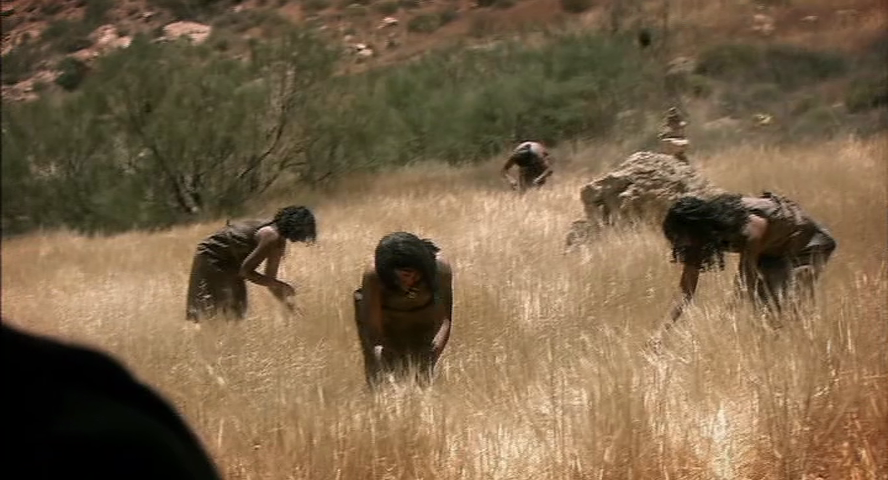
Meanwhile, in Cinematic Prehistory, the gatherers of the Fertile Crescent had easier and better things to gather, namely wheat and barley. Here are the people of Cinematic Prehistory gathering wheat and barley.

Hey guys, I lost my wedding ring!
Face shots are for posers.
Prehistoric silhouette dude
The video is more coy than I remember about actually showing these people clearly, but it's my contention that over 50% of the actors, and all of the prominently featured ones, are men. Which is interesting, because it was also the men of Cinematic Prehistory who were chasing that deer through the forest earlier. Our cinematic male antecedents must have been extraordinarily resourceful people if they were able to find more than twice the necessary calories for their individual survival, just so they could keep their women and children alive whilst said women sat around looking photogenic on a rock somewhere.

(I’m joking, of course, because standing around looking photogenic on a rock was a non gender-specific activity in Cinematic Prehistory.)


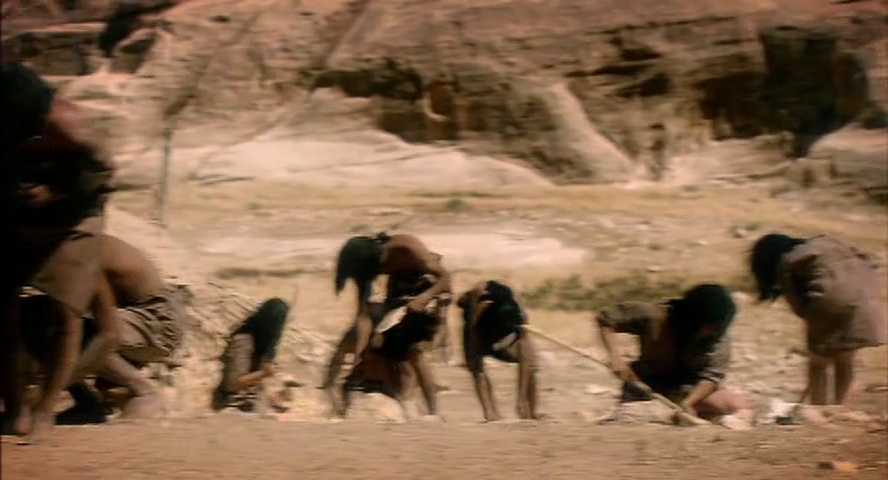
This difference continues into the discussion of agriculture. You see, the real reason that the people of Cinematic Prehistory were on that rock was to survey the terrible effects of Cinematic Prehistoric Climate Change. It turns out that existing so temporally close to an ice age really wreaks havoc on one’s Cinematic Prehistoric life plans! But we must remember that Cinematic Prehistory is very full of resourceful people men, and these men are about to do something amazing, i.e. farm those grasses from earlier! Here is Cinematic Prehistoric Man learning to farm.

Important men doing important manly activities. Like progress.
Manly man sowing. Not sewing, that's for girls.
... Women? Is that you?
Someday, son, you too will have an awesome Cinematic Prehistory beard.
SO HARDCORE.
Yes, I accept those people at the back of a couple of shots might be women, and that child with the goats may in fact be Arya Stark. I spent a long time looking at these scenes and I played a lot of “spot the female”, and I accept that they probably do exist in these shots. But they are not foreground in any of them. Sure, Prehistoric Cinematic Woman helped out a bit in the most revolutionary lifestyle change in human history, but there’s no way she was the main event!

For comparison, here’s modern Papua New Guineans farming.

Women! There you are!
A man is helping here. Good on you, man.
A man in a tree. Yep.
Pigs are not helpful livestock, alas.
            The roles are literally reversed. Apart from the man in the banana tree, who I will admit is pretty prominent, these are “spot the male” photos. Women are getting this stuff done in this society which is supposed to be parallel to Cinematic Prehistory in every way but the type of plants and animals being used.

            What does this say about how we think about human development? I’m sure that when National Geographic were thinking about how to present Cinematic Prehistory, they weren’t sitting in a board room going “well we all know women didn’t do anything, so we don’t need to show any of them prominently”. But, apparently, despite probably knowing how things were done in Papua New Guinea, it made perfect intuitive sense that the people to depict as innovators of the human race should all be male. Because Papua New Guinea is, the video takes pains to tell us, stagnant.  It produces no “cargo” (the New Guinean word for “cool stuff from abroad”, apparently). And maybe, on some level, it makes sense to us that this stagnant society is one that relies so heavily on womanpower, and that this aspect of its agriculture could not possibly be one of the hallmarks of a society that innovates. I mean, we live in a society where it is apparently not insane to believe that the entire of human civilisation was built by men so thatsexy women could sit around looking pretty and getting adored***! How could a society where women were playing these roles have the same level of progress?

            I sincerely hope that to most of my readers, the above looks like bullshit- if you’ll pardon my French. Certainly the little I know about prehistoric innovation (which basically comes from this one article that doesn’t cite its sources) suggests that this view of prehistoric human history is bullshit. But I also suspect that to a lot of people, this also looks like a total non-issue. Cinematic Prehistory is not real prehistory, after all, so does it really matter what gender the actors in it are?

            Perhaps not, as an individual case. But one of the strangest things about being A Feminist is how regularly things start to look this way- designed by people who almost certainly had the best intentions, but for some reason just couldn’t avoid unconsciously making these incredibly stupid decisions. Doctor Who is like that, these days, and for all it is still my favourite television show ever and I will love it, and Amy Pond, until the day I die, it still hurts that it’s apparently being helmed by people who just won’t think. My previously mentioned Favourite Writer Ever, Caitlin Moran, has a chapter in which she mentions how women have never ever done anything of artistic or technological worth, complete with a “feminists will try to tell you this isn’t true but think about it ladies, you know it is”, which just goes to show how I couldn’t even cover half the nonsense that got through the editing process in that book. We live in a world now where most of us know beyond a shadow of a doubt that women are supercool awesome powerful terrifying people capable of moving mountains (and, most importantly, for reasons other than babies), and yet when we retreat into culture, or start making culture of our own, we come up against all of these odd tropes and prejudices that too often have nothing to do with reality or how we experience it.

Like Diamond, I carry my own set of “statements made by [sometimes] angry men” which spur me on to figuring out what the truth about our human world and the people in it actually is. One of them is the assertion by a classmate, R., that he will never be a feminist because “feminism is a reaction, and women deserve better”. He is right on both counts, though obviously I don’t agree with his implied causality or his conclusion. I would love to live in a world where I can watch a stupid development video on Friday afternoon without going into a blinding feminist rage; my feminism will be pretty much useless when these unconsciously depressing gendered decisions stop being made. I very much look forward to that moment. Until then, annoying people like me are going to keep reacting to and pointing out these things, hoping that someday we might not have anything left to react to.

"History is a commentary on the various and continuing incapabilities of men. What is history? History is women following behind. With the bucket."

---------------------------------------------------------------------
*They’re technically “semesters” but as I am British (and so are the vast majority of my readership), I refuse to bastardise my language any more than is necessary in a world which mostly doesn’t know what a “chip” is. So let’s stick with “terms”.

**I also haven’t read the book or seen the rest of the TV show. So please direct all your sophisticated Jared Diamond-related questions elsewhere.

*** There are loads of fascinating theories about why this pre-modern superiority didn’t lead to an Asian industrial revolution which might have at least prevented China from its own nasty experiences with colonisation. Unfortunately they’re completely off-topic for this blog, so I’ll keep myself in check.